I sometimes wonder if too many people out there who call themselves Christians have become little more than bouncers for the Kingdom. By this I mean that they seek to spend all their time outside of the party trying to keep out the “rabble.”
In 1984, I attended InterVarsity’s Urbana conference. My goal was to get on with an evangelistic music group 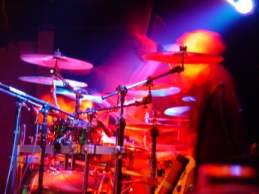 that would tour the communist satellite countries like Hungary and Czechoslovakia. What I did not expect was to run into problems with my choice of instrument.
Several music ministries had set up for the conference and I hit each one. On only my second interview with a group, I was asked what instrument I played by a very pleasant late thirty-ish woman with a mushroom cloud of hair that dwarfed her elfin face. I told her, “Drums.”
She swiftly drew back in her chair and put her hand to her mouth as if I had said I was a big fan of Baal. In her best Southern drawl she let me know my deception: “Well, young man, drums are the devil’s instrument—and we’ll have none of that.” She just shook her head full of Basic Youth Conflicts messages as if to say, “Such a nice young man and yet he’s one of the Enemy’s footsoldiers.”
Shock. Complete and total—that’s all I could say about how I felt. No one had ever said such a thing to me before despite my having played for more than a dozen years (at that time.) But then I started to consider the source and just walked away to the next booth.
I was greeted by skeletally thin man with an even thinner tie and the look of a lot of years of tobacco abuse before he saw the light. Told him what I was hoping to do and he, too, asked the vital question, “Waddya play?”
I told him.
This time there was less of a look of horror and more of a “Son, I was a prisoner of that hellish music, too, but now I’ve come clean.” He said, “We’ve got no place for that kind of instrument. We sing for the glory of God.”
So okay. Two out of three and already I’m starting to despair. How much had I paid to come here?
No one was at the next booth—it was singers only anyway.
At the end of the row was a lovely young woman about my age. Conservatively dressed, quite perky, with a fashionable hairstyle, she was the quintessential spokesperson for her traveling musical group. I looked over the material she had. Lots of good-looking young people and a full band—with one glaring exception.
“I see all sorts of instruments in your band, but I don’t see any drums.”
“Oh,” she said, taken aback, “drums are the devil’s instrument.”
I wanted to ask if she was somehow related to the Gothard with the bouffant, but what was the point? In a row of five musical evangelistic groups, three of them had basically told me I was going to hell because of my choice of instrument.
Eric Liddell, the great missionary of China (and martyred in an internment camp), said that the reason he loved to run was that when he ran, he felt God’s pleasure. I feel that same pleasure every time I pick up a pair of drumsticks.
I wonder if we truly know what it is to feel God’s pleasure. Many would contend, and rightly so, that much of Christianity has fallen under the spell of emotionalism. But we cannot merely chuck our emotions out of worship, nor can we assume that God’s pleasure cannot be experienced outside of a church building.
God’s pleasure is felt by the man putting the final touches on a piece of handmade furniture that will grace a home. God’s pleasure is revealed in the accountant who manages to save his company a small fortune by finding inefficiencies in the business process. God’s pleasure is alive in the mother who bakes her children cookies from scratch. God’s pleasure is in an elderly couple savoring the bottle of Cabernet Sauvignon they’ve been saving since their honeymoon in Paris fifty years ago.
Tim Challies has a well-reasoned look at worship that I think all of us should read. However, I think Tim’s reasoning has the tendency to turn worship into a “bloodless” experience. Not all of Christian worship can be reasoned, I think. When Isaiah fell on his face in his vision when King Uzziah died (Isaiah 6), I don’t believe he was filtering any of this through the “Regulatory principle of worship.” Not everything is so easily categorized. I don’t care if the Regulatory principle forbids dancing in worship, Psalm 150 says to go for it:
Praise him with tambourine and dance; praise him with strings and pipe!
—Psalms 150:4 ESV
Honestly, what are we afraid of? Do we fear that God enjoys listening to a full-bodied band of musicians playing for Him? Does the thought that dancing before the Lord might shake the dust off a few people frighten us? “Good grief, Martha, look at that woman over there raising up her hands during worship! Have you ever?”
God is worshiped when we experience His pleasure, when we open ourselves and lay bare our hearts in adoration of Him. When He is pleased, we are pleased. Even as I type, the Lord is preparing the greatest party that will ever be. Why are we so interested in being the bouncers?
So as I step back onto the role of drummer for the worship team at my new church, I just want to tell the boothminders at Urbana all those twenty-one years ago, “This pleases God more than you can know.”
Praise the LORD!
Praise God in his sanctuary; praise him in his mighty heavens!
Praise him for his mighty deeds; praise him according to his excellent greatness!
Praise him with trumpet sound; praise him with lute and harp!
Praise him with tambourine and dance; praise him with strings and pipe!
Praise him with sounding cymbals; praise him with loud clashing cymbals!
Let everything that has breath praise the LORD! Praise the LORD!
(Psalms 150:1-6 ESV)

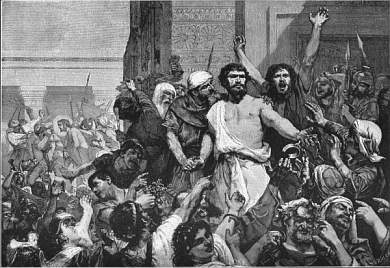 Those in the crowd knew the reputation of the man called Barabbas—as well as the reputation of the innocent man who stood in contrast to him on Pilate’s dais. They knew that Barabbas had victimized others through robbery, murder, and general thuggery. The other man, however, had taught them, healed them, given them hope, and relentlessly pointed them to God.