

The Chthonic Unmentionable

Standard

Demonic stareThe Evangelical branch of the Church today has one biblical issue it doesn’t want to discuss much anymore. Charismatics can’t seem to shut up about this for even one second, but Evangelicals—perhaps put-off by their charismatic brethren—can’t bring themselves to preach or teach about it at all. I know that in the last ten years this rarely mentioned topic has become to Evangelicals what the Ivory-billed Woodpecker is to the swamps of Arkansas: You knew it’s there, and while people want to see it, those who have seen it can’t reveal it lest some yahoo take a potshot at it.

I’m talking about demons.

I can’t remember the last time I sat in a non-charismatic church and heard someone speaking forthrightly about the demonic. I side with C.S. Lewis’s thinking that too much talk about them is not healthy, nor is too little. It’s that “too little” part in Evangelical churches that has me bothered.

Evangelicals simply do not take the issue of demons seriously enough. In a time that can be categorized by its unrelenting dereliction of truth, sources of deception and darkness must be exposed for what they are. Failure to shine the light on this infernal darkness means that it will necessarily increase in boldness.

Folks, I read the Book, too. I know how it all ends. But this doesn’t give us a pass on confronting evil. To ignore it imperils even those in the Church, because while Christians possessed of the Holy Spirit cannot be simultaneously possessed by unholy spirits, demons still oppose Christians. There are reasons why Paul wrote about the weapons available to Christians in our battle, just as there are reasons why our fight is not merely against flesh and blood.

The man I consider my spiritual mentor took me to a revival meeting out of town many years ago. During the speaker’s message, my mentor dropped a bomb on the young, impressionable Dan. “See that woman in the second row, the one in the red dress?” he said casually, his head nodding that direction. “She has a demon.” He turned back to his bulletin as if he’d said there was a great old Andy Griffith Show episode on the local UHF channel that evening, leaving me staring. He didn’t know her; we weren’t from around there. So how did he know? After a few minutes, I also sensed something in the room—and it came from that woman. For all appearances she remained calm and collected, but the second the speaker stopped speaking, she lunged for his throat. It took eight men to wrestle her to the ground. Trembling, I accompanied my mentor when he went up to pray over her. I heard her speaking in a disembodied man’s voice. I witnessed her fingers and limbs moving in directions even a first year med student could tell you were physically impossible. I felt the coldness in the air. And the sense that there was something horribly, awfully awry right in front of me was unshakable.

Through all that I learned something: They are out there and they have a signature stench that the Spirit readily reveals to those fully attuned to what He is saying.

We are doing a great injustice to folks in the Church when we shy away from talking about demons. Again, an unhealthy preoccupation is wrong, but so is leaving the chthonic unmentioned. We have too often treated the demonic like bogeymen, thinking that if we ignore them they’ll leave us alone. But rest assured of this one thing: they do not exist to leave us alone. And for this reason, we ignore them at our peril.

Since that day in that little rural church in Nowheresville, OH, I’ve had numerous run-ins with demonic powers. A friend and I praying in my car outside a psychic’s parlor experienced the chill of a demonic force that finally let loose with a moan when its power was broken. The psychic, who had been in that location for as long as I could remember, closed up shop less than a week later. Beyond personal accounts like that, I’ve heard several stories from friends who have served overseas as missionaries, telling of encounters that left former naysayers hospitalized when they casually took on what was ultimately a demonized individual.

As the time nears for their end, the demonic powers and principalities out there will grow increasingly desperate. We American Christians, who so easily live off our cultivated scientific rationalism, need to be diligent. Christians are coming under increasing attack and either don’t realize the true source for their problems or are lacking in the wisdom needed to confront real demonic oppression when it occurs.

If you never hear messages and teachings on how to deal with the demonic, ask your pastor why not. More to the point, ask him about his own personal encounters with the demonic. Truthfully, if he claims he’s never had any, then something’s wrong. Christians will be opposed. Demons hate it when we take back what they’ve stolen, expose their practices, or reveal their lurking about.

Along with the weapons of the Spirit in Ephesians 6:10-18, we also must know the saints of God

…have conquered [the accuser of the brethren] by the blood of the Lamb and by the word of their testimony, for they loved not their lives even unto death.
—Revelation 12:11 ESV

Adhering to the truth of the Gospel not only defensively prevents the Enemy from piercing the chinks in our spiritual armor, but it has offensive power as well. Therefore, we stray from the truth or use it carelessly to our own disadvantage. To our persecutors, the very human tools of the demonic, bearing that Gospel truth to our own deaths is their ultimate defeat.

Yet too many of us aren’t fighting the battle wisely or even at all. Nor do we cover each other’s backs as effectively as we could. Pray for the defeat of the demonic forces that may plague people in your church. Learn the signature of the demonic in people’s lives. Make certain the Lord’s revealed the chinks in your own armor and let Him patch them before you do serious battle against the demonic; they never abide by the rules and are far more vicious than we can understand this side of heaven.

As the world heats up, it will be demons stoking that fire. Our confidence despite that flame is that the Lord has already overcome them. Remember that, abide in Christ Jesus, and deal with the demonic soberly.

Wisdom vs. Optimism

Standard

For you say, I am rich, I have prospered, and I need nothing, not realizing that you are wretched, pitiable, poor, blind, and naked.
—Revelation 3:17 ESV

Jollyblogger is one of my favorite blogs, since David routinely writes on topics too often ignored in the Church. He’s recently read a book called Learned Optimism and discusses how faith and optimism go hand-in-hand.

Tragedy & ComedyWhile I appreciate David’s view, I believe that, in and of itself, optimism does not equal faith. Instead, optimism and it’s darker sibling, pessimism, are both essential to living a life of wisdom.
We Americans are the quintessential optimists. Our country is founded on ideals that say that every man has a chance to succeed and success is out there for anyone willing to work hard enough to achieve it. This idealism has permeated our church, too. We’ve hitched the wagon of our Christian beliefs to the draft horse of optimism and let it carry us wherever it will.

The rage over the television program American Idol is the essence of American optimism. Any poor waitress or cab driver could be the next pop star, singing before packed stadiums of people who have paid inflated amounts to hear the newly-crowned king or queen of the recording studio belt a few live tunes. And sometimes we even laud the runner-up, as Clay Aiken can attest.

But as much as we love the rags-to-riches story, we also have a revulsion for those who cannot see that their time has come and gone. There is no more American movie than Sunset Boulevard in which an aging silent film star is driven to madness by her optimism that her adoring public will clamor for her to make another blockbuster. Those who understand know that if Gloria Swanson’s faded star had been blessed with a little more pessimism to balance out her burden of optimistic glee, William Holden wouldn’t be floating face down in her pool.

American Idol also serves as a wake-up call when we get glimpses of the similarly deluded optimists who believe they are blessed with a set of pipes that would make Streisand or Pavarotti weep for joy. They “bless” us with their performance and we don’t know whether to laugh or cringe. Their optimism and faith has become a snare. These are the people who may never have a happy life simply for want of a little pessimism to balance out their optimistic dreams.

The Bible cautions us:

For by the grace given to me I say to everyone among you not to think of himself more highly than he ought to think, but to think with sober judgment, each according to the measure of faith that God has assigned.
—Romans 12:3 ESV

A few days ago, I wrote on the book of Ecclesiastes and its message to us (“On Becoming Ecclesiastical.”) For many Christians, if there is a book in the Bible that can be called “pessimistic” the “vanity, vanity, all is vanity” lament of Ecclesiastes makes a good case. I’ve heard well-meaning believers call the book “dour.” Yet, I would contend that this book isn’t pessimistic, but the accumulated faithful wisdom of a godly man who has seen

…that under the sun the race is not to the swift, nor the battle to the strong, nor bread to the wise, nor riches to the intelligent, nor favor to those with knowledge, but time and chance happen to them all.
—Ecclesiastes 9:11b ESV

Many true football afficianados will tell you that the greatest quarterback to ever play the game was Greg Cook. He had the size, the smarts, and a well-aimed howitzer for an arm. Cook was a first-round draft pick and the Hall of Fame was sure thing.

But time and chance happened to Greg Cook. Suffering a career-ending injury only a couple months into his pro career, he was the great one who never truly materialized. Just a month ago I heard a radio program talking about how phenomenal he was and how sad that he never got a chance to live up to his billing. Cook could’ve tried comeback after comeback, but he was no eternal optimist. Instead he dealt with the hand that was dealt him and went on to other things.

Optimism is what starts us on the journey. Pessimism is what informs us that perhaps a better way can be found along that journey. Optimism gets us started and keeps us going. Pessimism allows us to deal with the vagaries that life throws our way.

Anyone who reads enough of this blog knows that it exists to help the Church find its way back to the heart of the first century Church. And while American Christians want to be found faithful, too often we are merely found to be overly optimistic in a time that calls for more sober thinking. What else but misplaced optimism can account for our inability to interpret the times? We keep on going with bright, cheery faces, when we should be brought low by our refusal to repent of our optimism-inspired self-righteousness. Or as Ecclesiastes again says:

It is better to go to the house of mourning than to go to the house of feasting, for this is the end of all mankind, and the living will lay it to heart. Sorrow is better than laughter, for by sadness of face the heart is made glad. The heart of the wise is in the house of mourning, but the heart of fools is in the house of mirth. It is better for a man to hear the rebuke of the wise than to hear the song of fools.
—Ecclesiastes 7:2-5 ESV

We in the American Church of 2005 need to hear what the Lord says to the Church of Laodicea at the beginning of this post. Is the Lord being pessimistic here? Or is He calling for wisdom in the face of self-deceiving optimism? We ought not to think more highly of our position than we should. We should not call the days good when the Lord says they are evil.

Faith walks in wisdom and wisdom, like so many other components of Christian discipleship, is a narrow way that proceeds between two extremes. For us Christians, true faith is found in that narrow road that winds its way between optimism and pessimism, a hope in our perfect Savior and a knowledge of our own sinfulness. Only in this is true wisdom.

Let’s Play “Spot the Heretic!”

Standard

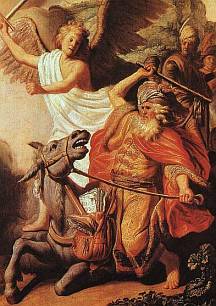
Balaam's Ass by RembrandtThis is the post wherein I make my secret confession before you all.

I've been a Christian for nearly thirty years. I've read a lot of books by a whole host of authors. And despite the fact that I'm fairly intelligent, graduated with high honors from probably the toughest Christian college in the country, and can use seven-syllable words with abandon, I don't read today's Christian writers much anymore.

Now I'm not speaking of Christian novels about young, chaste teachers coming of age on the Kansas prairie of 1880—aren't all Christian novels about that?—I'm talking about the non-fiction works of everyone from N.T. Wright to Brian McLaren.

If I were a proud man, I would attribute this to the lofty theological edifice I have constructed from bare rubble through my hard-won Christian discipleship. But I'm not a proud man; I'm simply a person like you who finds himself progressively confused by what passes for Biblical scholarship and discipleship lately.

Now with the Christian blogosphere filled from one end to the other with wild-eyed apologists, "remnant watchers," bell-ringers, deconstructionists, and self-christened "apostles for a time such as this," I've come to the conclusion that I simply can't parse it all. Yeah, this guy may be right and then he might not. She's got a good point, but arrived at it through a highly tortuous route that deviated through "Suspect City" to get there. And that guy in the corner always cries "Heretic!" over any idea that isn't his.

Sadly, there just isn't enough time in the day, so my only recourse is to ignore the vast majority of it. If it comes down to a case of discernment, perhaps the best discernment that a Christian in the 21st century can achieve is to always assume something's wrong unless it's been tested by time.

So that's my stance.

I used to help manage a Christian bookstore. I was the Bible and book buyer. Once you're in a position like that, you quickly attune your sense of smell to the stench of one lousy book after another grappling for bestseller status. I got adept at finding the stinkers before they found us. I attribute this to the Holy Spirit and to the spirit of our age.

The "spirit of our age" as I use it here is the quality of a book or set of thoughts that smacks of everything that is trending one way or another at this moment in time. Doesn't matter if it's right or wrong; in the end it simply won't last. Twenty years from now, no one will be referencing it for anything. It was dead on arrival, but the readers simply couldn't tell because the hype machine and word of mouth drowned out the naysayers.

Honestly, I think the Lord understands the dilemma of most earnest Christians today as they attempt to trudge through the mountains of half-baked theology and pseudo-spiritual tripe that get served to us on a sizzling hot platter—every single day. I believe that He knows it is far worse than in His own day when He battled the superstitions and mindless obeisance to the prevailing ethic of the land that relentlessly fought for the minds of His own disciples.

What is my out? Well, I'm hopelessly behind the times. I've said here before that most of the authors I read are dead. And that's my out. They're dead, no one is making big bucks off 'em, and yet their words last from one generation to the next. One set of Christians a hundred years ago read this stuff and found it spoke to the soul. And now another set today is reading it still because someone continues to be blessed. It won't crack the top ten on the bestseller list, or even the top ten thousand, but the words on those pages live. They give life and will do so until the day the Lord comes back—if, on that glorious and awful Day, He still manages to find enough people who take those old words to heart.

So I don't keep up with "New Think" for the most part. If I do mention a new book from time to time here, or mention a new blog that seems to have "it," then it's only because every reference in it goes back to someone from fifty years ago who could be trusted. I can tell you right now that Tozer, Ravenhill, Schaeffer, and a few like them can be trusted. Time's imprimatur has shown they can stand up and still speak the truth to a day and age where truth is so easily warped to be untruth that even the best of us can't always spot the mistakes.

I just can't filter it all; too much comes in. And while ninety-nine and forty-four one hundredths pure is good enough for soap, it's not good enough for the Gospel. As for me, I'm simply not smart enough or spiritually adept enough to mercilessly spot the 0.56% impurity that exists in today's writings.

Are you?

{Image: Detail of Rembrandt van Rijn's "Balaam's Ass" (1626)}