When the Pantheon of Christian Greats Blows It

Standard

C.S. Lewis, from another viewI mostly read dead authors, at least when I’m considering Christian theology. Call me crazy, but I find more truth in those writers than what I read in modern ones. My personal library reads like a big list of dead guys: Lloyd-Jones, Schaeffer, Tozer, Lewis, Bounds, Ravenhill, Edwards, Nee, Murray, Torrey, and Bonhoeffer.

We all have our pantheon of Christian greats, the people who inspire us and many times provide us our ideas as to what is true and right within the Christian life. I listed some of mine above. I’m sure you have your own.

But sometimes our Hall of Christian Fame gets us in trouble. From the reaction in some corners of the Godblogosphere, Tim Challies tossed a heap of burning coals on his own head last week when he quoted a list of great Christians who believed the Roman Catholic Church to be the antichrist.

No matter where you stand on that topic, the question lingers: Can great Christians be mistaken?

When I was at Wheaton College, I took a New Testament overview class from Dr. Robert Yarbrough, currently professor of New Testament at Covenant Theological Seminary. (I’ll say without flinching that Dr. Yarbrough may be the most intelligent Christian I’ve ever met, especially when it comes to the Bible. That class was my favorite at Wheaton.) When he discussed Revelation, he outlined at least a dozen end times scenarios, when they were popular, and most of all, some great Christians who supported those scenarios.

What struck me during that teaching was not the scenarios themselves, but the revelation (excuse the pun) that some exceedingly wise and far more biblically diligent folks than I arrived at the wrong eschatology. And for those who avoided predictions as to when the end would come, the law of non-contradiction alone will prove most of those theologians wrong when the End indeed arrives.

Given that all of us have fallen short of the glory of God and see through a glass darkly, ALL great Christians are wrong somewhere in either their faith or practice. I’m willing to say that the apostles were certainly as close as it gets to perfection, yet Peter’s brush with the Judaizers showed that even apostles could have feet of clay.

This is not a question of Biblical infallibility. I believe the Bible to be the perfect and infallible word of God.  But this IS about the foibles of human agents of God.

Pick a topic and you’ll find great Christians on opposing sides. At Monergism.com, witness the solid people at opposite poles on the credobaptist and paedobaptist position. Someone’s wrong, right? Who wins the tag team between John MacArthur and John Piper (credobaptists) and John Calvin and Martin Luther (paedobaptists)? If you want to go with the bulk of historicity here, then the latter win.

But what if the Reformers are wrong? And if they’re wrong on that one position, what other errors may lie in waiting for the undiscerning?

It bothers me sometimes that we treat great Christians as if they could never, ever, in a billion years have a mistaken position on an important piece of doctrine. The Godblogosphere is bristling with defenders of this great Christian or that, and God help anyone who questions that great Christian for even one second! People are so dogmatically in one corner massaging the shoulders of their Spurgeon, Tozer, Aquinas, or Merton and whispering into their man’s ear, “Throw the uppercut this round!” that they’re blind to their hero’s own glass jaw.

It’s not just dogma, either. It’s fairly common knowledge that some Christian greats who were married didn’t have rosy marriages by the standard we uphold today. No one liked Wesley’s wife, and evidently, neither did he. (Gives a whole new perspective to the amount of time John spent away from home.) Plenty of great Christians smoked and drank alcohol (which I think will get you pilloried in the SBC, if the latest conference is any indication), while other great Christians opposed such behavior. Who’s right? Who’s wrong?

The Bible says this about our hero fascination:

But I, brothers, could not address you as spiritual people, but as people of the flesh, as infants in Christ. I fed you with milk, not solid food, for you were not ready for it. And even now you are not yet ready, for you are still of the flesh. For while there is jealousy and strife among you, are you not of the flesh and behaving only in a human way? For when one says, “I follow Paul,” and another, “I follow Apollos,” are you not being merely human? What then is Apollos? What is Paul? Servants through whom you believed, as the Lord assigned to each. I planted, Apollos watered, but God gave the growth. So neither he who plants nor he who waters is anything, but only God who gives the growth. He who plants and he who waters are one, and each will receive his wages according to his labor. For we are God’s fellow workers. You are God’s field, God’s building. According to the grace of God given to me, like a skilled master builder I laid a foundation, and someone else is building upon it. Let each one take care how he builds upon it. For no one can lay a foundation other than that which is laid, which is Jesus Christ.
—1 Corinthians 3:1-11 ESV

Just a couple weeks ago, a commenter at another blog said she’d gotten a lot out of reading Watchman Nee. The very next comment was from someone warning her about Nee. I immediately responded that the Bible teaches us to be discerning about ALL things, not just what troubles us. Truthfully, the greatest errors arise when we cast our discernment aside because “Hey, I’m reading my favorite Christian great who I’ve enshrined on my altar of godliness.” What we build upon the foundation of Jesus Christ matters, and from time to time even the Augustines, Spurgeons, Tozers, Calvins, Luthers, Lewises, and Schaeffers of this world molded a few questionable bricks.

As the great theologian Sergeant Phil Esterhaus of Hill Street Blues fame proclaimed:

“Hey, let’s be careful out there.”

More Cowbell Award V

Standard

More Cowbell!I don’t normally begin a week with a More Cowbell Award, but I spent most of last week ruminating on the topic, then spoke to someone who totally agreed with the need to give out an award for this. So the award that no one wants to win returns to smiting duties.

For those following the scorecard, the More Cowbell Award is Cerulean Sanctum’s virtual stoning of stupid, vacuous, and over-the-top trends in modern American Christianity. Previous More Cowbell Awards have gone to the Church Growth Movement, children’s choirs in adult CCM, Christian conspiracy theorists, and Christian adware.

What makes this fifth edition of the More Cowbell Award so unusual is that I have nothing funny to say about the award recipients. Truth is, I’m continually appalled by them. Worse yet, I don’t read a lot of Godbloggers blogging about this issue. And unlike some other More Cowbell Awards, I have professional training and experience that may actually qualify me (GASP!) to speak on the subject.

And what would that subject be?

Well, this More Cowbell Award is given to that sound and fury that signifies nothing, yet is remarkably prevalent in our churches on Sunday, and well known throughout the summer. In other words, the fifth installment of the More Cowbell Award is presented to

Children’s Christian Education Programs
(including Sunday School, Vacation Bible School, and Summer Camp)

Surprised? You shouldn’t be. Let’s face it: most Christian education programs for kids are little more than babysitting functions wrapped in a Christianized veneer ultimately devoid of the Gospel message.

I don’t know the people designing the curricula used to teach kids about Christ, but all I can say is those folks are doing a horrendous disservice to the parents of those kids and the kids themselves. I used to design curricula for camps and was routinely horrified at the assumptions the curricula designers made about a child’s eternal state.

Somehow we’ve created this sheen about kids that says that all of them are flesh-and-blood Precious Moments figurines. That bedrock assumption fuels almost all learning materials aimed at little kids. But here’s the truth: All have sinned and fall short of the glory of God. Unless someone is born again, they have no relationship with God. Yet all of the Sunday School, Vacation Bible School, and Summer Camp curricula I’ve ever come across overlooked that truth and naturally assumed that somehow every kid got magically saved by little fairy evangelists that hovered around their pillows for ten years and whispered the Gospel in their ears.

Is there anything more tragic than a kid who’s heard every “Bible story” in the world, but never once got a real Gospel presentation aimed at their age group? By the time they’re teens, I suspect most kids can recite the stories of David & Goliath, Moses & The Burning Bush, Joseph & His Coat of Many Colors, and any other “X & Y” story we can give them each Sunday, but they don’t know the Lord and they have no idea how to be saved.

Some reading this will yell, “Well, where are the parents?” and that’s a great point. But on the other hand, the parents are assuming their child is getting a “Christian Education” from “Christian Educators,” only to find out too late that this education never went beyond the crayoned picture their child brought home captioned with the message, “God made a rainbow!” God made a hell, too, and we certainly don’t want anyone to end up there.

Too harsh? I think we parents need to get more harsh. Yes, a child may get the Gospel message at home, but until it sinks in and makes a difference in his or her life, I don’t think we should encourage Christian educators to waste time on “Jesus wants me to be good” stuff that has no effect on an unregenerate soul.

When I worked in Christian Camping I automatically tossed all the curricula the camp gave me and went back to a clear presentation of our sin nature, our separation from God, our eternal destiny, Christ’s atoning work, and our need to die at the cross in order to be born again. Anything else was gravy, but at least the kids got the basis of the Gospel.

While we’re at it, let’s also clarify that “Ashley, did you ask Jesus into your heart?” coupled with little Ashley’s head nod does not equate to knowing that Ashley is born again. In fact, what’s the deal in so many churches with cajoling kids into asking Jesus into their hearts? My Bible doesn’t list that as being the mechanism for salvation. We know what the Bible says about leading a little one astray, don’t we? Well, evidently not.

Is it any wonder that 85% of kids drift away from church between the ages of thirteen and sixteen? They’ve been David & Goliath’ed and Noah’s Ark’ed to death, but they never heard about their own need to die at the cross and be born again. Again, am I being too harsh? Well, I double-dog dare you to find any presentation of the Gospel in this popular VBS program. Evidently, asking teens how they feel about Ashton Kutcher is more important than being saved and growing in knowledge of Jesus Christ.

I’m disgusted by the throwaway junk I see kids coming home with from Sunday School. Makes me sick to see the content of the typical VBS program. And don’t get me going on the stuff they teach kids at camp.

Am I the only one that feels this way? I guess I am, because I see little uproar from parents over the vapid Christian education their kids are getting outside the home.

A Delightful Inheritance

Standard

In 1981, at the Baccalaureate presentation a few days before graduation, a packed house of about 2,000 filled my high school auditorium. Superlative students received scholarships and kudos, offered up prayers of thanks, gave speeches, and filled the evening with hope. Only one award remained—the one honoring the student most involved in school activities.

My folks and I sat together, and as the award recipient's list of clubs and groups grew, I sat on the edge of my seat.

"National Honor Society, Science Club, Math Club, Photography Club, Chess Club, French Club, French National Honor Society…"

I knew most of the folks in those groups and started narrowing down the list of contenders. More clubs and groups rattled by. I said to my mom, "The person getting this is never home." She nodded.

When the Student Body President started in on the astonishing number of band-related functions—Orchestra, Pep Band, Concert Band, Marching Band, Chorale, Stage Band, Theater Orchestra—I had to admit I had no idea who this nut could be who was so massively involved in the school.

Then she read my name.

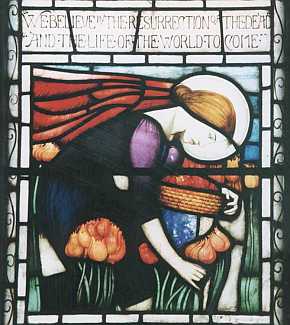
I fell out of my chair and somehow landed on my feet, rubbery legs guiding me from my spot way in the back of the auditorium to the stage. People were standing and cheering. Shock and disbelief on my part. Harrington Mann's "Angel Plucking Tulips"I'll probably never again get that feeling of being a celebrity.

And not once during the reciting of that list had I realized I was that highly involved person.

Last Monday, I attended the memorial service of a friend who spent the best years of his life giving his time and talents to others. When we pulled into the massive church, the parking lot bulged with cars. A human line streamed down the stairs into the church's auditorium. I suspect more than 1,300 people came to remember one man.

Upon witnessing the crowd, I failed to hold back the tears. Our friend was so well loved. During the service, a mic was handed around and people shared their stories of how our friend had touched others with his faith in Christ and his overt generosity, always giving away, always meeting a need. I think everyone there could have shared a special moment in which they'd been the recipient of this man's large heart. His past and present students spoke and when asked to rise, it seemed like the room was filled with people standing.

What a good, godly man. A man who never took the spotlight, but who gave and gave until it was time to go home. When a soloist sang Ray Boltz's classic "Thank You", there in that crowd I considered that never before had that song been so fitting a tribute.

One day, out on the boat from which he taught kids to water ski, he shared with me a Scripture he said was his life verse. A new believer at that time, his excitement at finding this verse was electric and his joy palpable: 

The boundary lines have fallen for me in pleasant places; surely I have a delightful inheritance.
—Psalms 16:6 NIV

When the discouragements of life press down on you, know this: you have a delightful inheritance. One day, you'll be standing among the saints in the presence of God and one of his angels will read through a list of godly acts rendered to others over the course of a full and blessed lifetime.

And then he'll call your name.

Was that you who helped the old lady get to her car without slipping on the ice? Or who taught the third grade Sunday School class? Did you sit and weep with a neighbor whose child died far too young? Did you prepare the communion elements alone in the church kitchen? Or pray through the church directory every day?

Thank you. Bless you for giving to the Lord. Surely you have a delightful inheritance.

And when you turn around to face that multitude in glory, we'll all be cheering.

{Image: Harrington Mann's Angel Plucking Tulips 1894}