

The Power of Story

Standard

Lost in a Good BookI thought I'd have my novel completed in January.

Sickness hit and January slid into February. February saw me finally completing the first draft. YEAH! It's been rough going ever since.

Even now, I'm ogling a foot-high-plus stack of drafts that I ran past my writers group, The Write Brothers. Smart them, they edited their own works as other Brothers commented. Me? I saved it all till I was ready to edit. Again, for a four-hundred-page novel, that becomes a stack of edits as tall as my size thirteen foot.

So I'm slowly making my way through it all. Emphasis on the slowly.

In the meantime, I'm reading Charlie and the Chocolate Factory with my son. We'll finish it today. If I could capture a third the magic that Roald Dahl imbues in his fiction, I'd be happy.

But to an aspiring novelist, the joy of great fiction is not in the publishing, but in the power of story and its ability to make us better people.

My son will be six in August, but even he can see the sins of the four brats who met ignoble ends in Mr. Wonka's mind-bending factory. Not more than a couple hours ago, we read the song the Oompa-Loompas sang over Mike Teavee, the boy addicted to television.  Through their song, Dahl spares no expense criticizing the brain-numbing aspect of TV and the counterpoint fascination of storytelling found in a good book.

When I write the words that comprise my novel, Fade into Blue, I pray that every word carries in it the strength of a redeemed imagination. There exists in a book a wonder that can be found nowhere else. Television supplies all the answers, but a book asks something from those who read it. As C.S. Lewis writes in his Experiment in Criticism:

What then is the good of … occupying our hearts with stories of what never happened and entering vicariously into feelings which we should try to avoid having in our own person? … The nearest I have yet got to an answer is that we seek an enlargement of our being. We want to be more than ourselves. We want to see with other eyes, to imagine with other imaginations, to feel with other hearts, as well as our own. … In reading great literature I become a thousand men and yet remain myself.

Many times in this blog, I've noted a failing of some believers to step out of themselves for even one second and be another person, to see with different eyes, to better understand through another person's perspective the failures, joys, sins, and redemption each of us experiences uniquely. The power of story, as Lewis notes, allows us to be a thousand men, a thousand women, and yet still be ourselves. I would contend that story allows God's grace to flow in a way we sometimes stymie when faced with reality. A gifted writer fashions characters who allow us to understand another in the pages of fiction that we might otherwise avoid entirely in everyday life.

If we are told a man is a thief, our judgments flow. But what if the grace of God can transform a robber into something more? We may not have any experience with thieves, but we may know of Jean Valjean from Victor Hugo's Les Miserables. Having just passed nineteen years in a French jail for stealing a loaf of bread, Valjean is released. Destitute, he is taken in by a kindly bishop and the man's sister. In return, Valjean steals the bishop's silverware and hightails it out of town. The story picks up below:

As the brother and sister were about to rise from the table, there came a knock at the door.

"Come in," said the Bishop.

The door opened. A singular and violent group made its appearance on the threshold. Three men were holding a fourth man by the collar. The three men were gendarmes; the other was Jean Valjean.

A brigadier of gendarmes, who seemed to be in command of the group, was standing near the door. He entered and advanced to the Bishop, making a military salute.

"Monseigneur—" said he.

At this word, Jean Valjean, who was dejected and seemed overwhelmed, raised his head with an air of stupefaction.

"Monseigneur!" he murmured. "So he is not the cure?"

"Silence!" said the gendarme. "He is Monseigneur the Bishop."

In the meantime, Monseigneur Bienvenu had advanced as quickly as his great age permitted.

"Ah! here you are!" he exclaimed, looking at Jean Valjean. "I am glad to see you. Well, but how is this? I gave you the candlesticks too, which are of silver like the rest, and for which you can certainly get two hundred francs. Why did you not carry them away with your forks and spoons?"

Jean Valjean opened his eyes wide, and stared at the venerable Bishop with an expression which no human tongue can render any account of.

"Monseigneur," said the brigadier of gendarmes, "so what this man said is true, then? We came across him. He was walking like a man who is running away. We stopped him to look into the matter. He had this silver—"

"And he told you," interposed the Bishop with a smile, "that it had been given to him by a kind old fellow of a priest with whom he had passed the night? I see how the matter stands. And you have brought him back here? It is a mistake."

"In that case," replied the brigadier, "we can let him go?"

"Certainly," replied the Bishop.

The gendarmes released Jean Valjean, who recoiled.

"Is it true that I am to be released?" he said, in an almost inarticulate voice, and as though he were talking in his sleep.

"Yes, thou art released; dost thou not understand?" said one of the gendarmes.

"My friend," resumed the Bishop, "before you go, here are your candlesticks. Take them."

He stepped to the chimney-piece, took the two silver candlesticks, and brought them to Jean Valjean. The two women looked on without uttering a word, without a gesture, without a look which could disconcert the Bishop.

Jean Valjean was trembling in every limb. He took the two candlesticks mechanically, and with a bewildered air.

"Now," said the Bishop, "go in peace. By the way, when you return, my friend, it is not necessary to pass through the garden. You can always enter and depart through the street door. It is never fastened with anything but a latch, either by day or by night."

Then, turning to the gendarmes:—

"You may retire, gentlemen."

The gendarmes retired.

Jean Valjean was like a man on the point of fainting.

The Bishop drew near to him, and said in a low voice:—

"Do not forget, never forget, that you have promised to use this money in becoming an honest man."

Jean Valjean, who had no recollection of ever having promised anything, remained speechless. The Bishop had emphasized the words when he uttered them. He resumed with solemnity:—

"Jean Valjean, my brother, you no longer belong to evil, but to good. It is your soul that I buy from you; I withdraw it from black thoughts and the spirit of perdition, and I give it to God."

Jean Valjean, broken by this act of gracious forgiveness, indeed becomes a changed man who goes on to right great wrongs in the world because of his encounter with a man of God who showed him grace. 

The power of story allows us the grace to be both the forgiving bishop and the forgiven thief. Their story enlarges us as people, distilling Gospel truth into the ordinariness of our own lives. Story grants us the chance to live what we have heard, to be changed by what we read.

Many Christian novelists have noted that there is only one archetypal story and all works that we write are mere copies of it. As a Christian novelist myself, I believe this to be true. And with that belief comes the one hero, the Lord Jesus, who embodies in Himself all heroes, He being the true image to which we all aspire.

In the end, the power of story is His story. 

If the power of story has enlarged you as a person, leave a comment and let us know which fictional works have touched your own life.
The Superspiritual

Standard

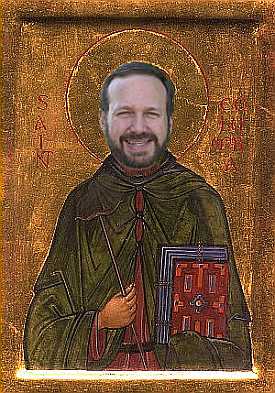
Saint Dan of PhotoshopolisA number of people I know have had recent encounters with strange persons who appear to be on the increase in the ranks of Christians in America. There’s no known genus and species name for these unusual creatures, so most people are forced to refer to them by their collective name, The Superspiritual.

I’m sure at least a few folks out there have crossed paths with this particular beast. For those unacquainted with The Superspiritual, a few of their traits stand out:

  1. They have a tendency to get up before the sun and have incredibly long quiet times that rival those of the great saints of old. In fact, the saints of old were pansies compared to these folks.
  2. They’ve memorized large swaths of the Bible—and in multiple translations. Ask them to quote a specific passage—they’re dying to share it with you.
  3. They have an answer to every possible theological question anyone might have. The best of them will offer multiple perspectives given by a chosen set of favorite authors. Always a very narrow selection of authors. Come to think of it, those authors always agree with each other on everything, so there isn’t much variation of perspective when you get right down to it.
  4. Their library of Christian books, if sold on eBay, could feed a hundred AIDS orphans in Africa for a decade, though it is doubtful they’d ever part with those books. Go ahead, try to snatch one out of their hands. (Fast reflexes, eh?)
  5. If they own a business, that business will be founded on, run by, and ever beholden to “Christian principles.” Those principles appear to include making as much money as possible by any means available.
  6. If you’re a heathen—meaning you’re not as spiritual as they are—you’re held at arm’s length until you ARE as spiritual as they are.  (Good luck! Typically it’s taken decades for them to reach their own peculiar nirvana.)
  7. “Christian practice” is defined as going to church on Sunday mornings, Sunday nights, Wednesdays nights, and at least a small group or two on a free night. Oh, and there’s a number of church boards to sit on, too. Christian practice is critical for enhancing one’s standing in order to maximize #5 above.
  8. They talk, talk, talk about family values, and you can’t help but think they’ve got the insular family thing down to a T, seeing that no one else associates with them. Just don’t bring up their middle child in conversation.
  9. They do an outstanding job of  telling you what the Bible says we should be against, but stumble a bit when pressed on what the Bible says we should be for.
  10. They have a way of making anyone who stands near them feel oddly guilty.

Sound familiar now? Certainly you’ve met one of these folks.

As to #2 above, their memorization skills are indeed impressive, but The Superspiritual seem to have mentally misplaced a few verses. Consider the following verses that routinely get overlooked:

And as you wish that others would do to you, do so to them.
—Luke 6:31 ESV

For judgment is without mercy to one who has shown no mercy. Mercy triumphs over judgment.
—James 2:13 ESV

And he said to him, “You shall love the Lord your God with all your heart and with all your soul and with all your mind. This is the great and first commandment. And a second is like it: You shall love your neighbor as yourself. On these two commandments depend all the Law and the Prophets.”
—Matthew 22:37-40 ESV

If anyone says, “I love God,” and hates his brother, he is a liar; for he who does not love his brother whom he has seen cannot love God whom he has not seen. And this commandment we have from him: whoever loves God must also love his brother.
—1 John 4:20-21 ESV

My brothers, show no partiality as you hold the faith in our Lord Jesus Christ, the Lord of glory. For if a man wearing a gold ring and fine clothing comes into your assembly, and a poor man in shabby clothing also comes in, and if you pay attention to the one who wears the fine clothing and say, “You sit here in a good place,” while you say to the poor man, “You stand over there,” or, “Sit down at my feet,” have you not then made distinctions among yourselves and become judges with evil thoughts?”
—James 2:1-4 ESV

What good is it, my brothers, if someone says he has faith but does not have works? Can that faith save him? If a brother or sister is poorly clothed and lacking in daily food, and one of you says to them, “Go in peace, be warmed and filled,” without giving them the things needed for the body, what good is that? So also faith by itself, if it does not have works, is dead. But someone will say, “You have faith and I have works.” Show me your faith apart from your works, and I will show you my faith by my works. You believe that God is one; you do well. Even the demons believe—and shudder!
—James 2:14-19 ESV

All joking aside, I’m growing tired of hearing stories about people afflicted with the disease of Superspirituality. And it  truly is a disease because it infects impressionable people who come under the tutelage of those already diseased.

  • What explains the Christian businessman who fires employees to cut costs rather than examine the careless way in which he doles out company money to ministries in order to get on their privileged donor list?
  • Or an upper-middle-class church that splits over outreach to a Hispanic neighborhood because the people they sought to evangelize in that neighborhood had the nerve to actually start showing up in the church on Sunday?
  • Or a radio ministry that promises a helpful book that can aid those who are struggling with long-term unemployment and its resulting financial ruin, but when calling in it’s a mandatory $30 “love gift” for the book—which Amazon sells for $8.99?
  • Or the Christian company that requests a prospective employee twice fly out for a job interview, only to later fail to reimburse the prospect for the plane flights or even bother to give her a follow-up phone call about the job?
  • Or the Christian organization that exists solely to help people with one specific kind of problem, but who gets a client in further trouble by failing to file critical paperwork because they were too busy preparing for a big evangelistic outreach they sponsor?

Don’t those just rip your heart out? What should be done with folks who have every appearance of being paragons of Christian virtue, yet they purposefully ignore the most basic aspects of the faith?

What would happen to us as a Church in this country if we spent the next year doing nothing that even vaguely resembled Superspirituality, instead simply doing unto others as we would have them do unto us? How hard is it to ask ourselves whether or not we like to be treated as badly by other Christians as we sometimes treat others?

I don’t think The Superspiritual ever ask themselves that kind of question.

A number of years ago, a friend, noting the sheer number of trivial things I know about highly useless topics, congratulated me on having filled my mind with so many facts. My response to him? I’d trade it all to be able to know the Bible inside and out.

Today, I realize that this response was Superspiritual. In reflecting about this issue of Superspirituality, it occurs to me that the less Superspiritual answer—and the one closer to the heart of Jesus—is this: that I be able to put into practice the amount of Bible I already know, rather than simply marinating my brain with it.

I mentioned this in a post last week, but what is the point in correctly learning and handling the Scriptures?

All Scripture is breathed out by God and profitable for teaching, for reproof, for correction, and for training in righteousness, that the man of God may be competent, equipped for every good work.
—2 Timothy 3:16-17 ESV

The end goal is good works. Good works are always others-centric. If we’re not putting into practice the things we already know, investing ourselves in the lives of our brothers and sisters in Christ, in the lives of the poor and needy, and in the lives of the lost, then all that Bible knowledge we’ve crammed into our craniums has no outlet. It puffs up our heads and leaves no room for our hearts.

The lost around us will argue our facts and figures, but they find it hard to argue when they’ve had a serious illness strike their household and we show up on their front porch with a homemade dinner. They used to refer to such selfless benevolence as “the milk of human kindness.” Trust me, folks; that’s “meat,” not “milk.”

James says this:

Religion that is pure and undefiled before God, the Father, is this: to visit orphans and widows in their affliction, and to keep oneself unstained from the world.
—James 1:27 ESV

And we already know that all the prophets were reiterating the same message of God: God desires that men love Him and love their neighbor as themselves.

Superspirituality is all too easy to catch, but there’s a way to avoid its disease. If we surrender ourselves lovingly to God and give of ourselves to our neighbors, there’s not a lot of us left over for that awful virus to infect.

Have a blessed week! And please show the love of Christ to someone this day who might not otherwise experience it.

{Image: Major apologies to the artist who crafted the icon of Saint Columba}

Sometimes Movies Get It Right

Standard

Mater & Lightning from Cars—by Disney & PixarMy family sees almost no movies in the theater. Truth is, we don't have time to watch movies, especially when so many today are vapid and vulgar.

Our gracious friend, Eric, invited us to go see Pixar's latest, Cars, on him. That's the kind of friends we have! Not being the kind to turn down a free movie that will probably be great, we saw the film Friday evening.

This isn't an in-depth review. A million reviews exist elsewhere. But I will say this: the themes covered in Cars are the exact same ones I discussed in "Unshackling the American Church ." The movie is about as "crunchy" as it gets. The value of small town life, valuing one's neighbors, understanding the sacramental, treasuring beauty, the need for local economies, learning to lean on others, even eating organic—the list goes on and on.

I think some people are getting it. I don't know if there are any Christians attached to the film, but I pray there are and that they have a positive impact in their churches.

A thumbs up from me.