Whoever believes in me, as the Scripture has said, 'Out of his heart will flow rivers of living water.'"
—John 7:38 ESV
It's funny how synchronicity strikes at the most opportune times. I'd planned on writing about rivers of living water today, but never had any indication I'd experience it so personally.
During my hiatus, I lined up about a half dozen good topics to discuss when I got back to blogging. The first was the post on labels, the second being about John 7:38.
My son and I read that passage together during our mutual quiet time. We've set apart a few minutes in the morning to read the Bible together and pray for the day. No one sweats great drops of blood or tears down demonic strongholds; it's just a dad and son spending time before God.
While reading through Chapter 7 of John, I read v38 to my son and God hit me between the eyes. I stopped at the end of the verse and let it sink in. I've heard the passage hundred of times in my life, but on reading it this time I started thinking. And I've not stopped.
Last night, my wife and I attended my 25th high school reunion. I'd originally not planned to go. My 10th had been a blast, I was out of town for the 15th, and was sick as a dog for my 20th (one I was dying to attend.) But for some reason I'd gotten in my head that the 20th had been a huge one and the 25th promised to be lightly attended. I'd not heard from any of the group I'd hung with concerning the reunion, so that only reinforced my assumption.
I'm one of those people who looks back on high school fondly. Though I was by no means a jock, I was popular, with high school being a sort of "glory days" time for me. My drumming opened up doors into sub-groups within the school, and I was fortunate in that I crossed into groups that ordinarily didn't converge. The jocks, band geeks, honor society, and stoner groups knew me and I knew them.
Some personal confession now: I've been down in recent months. A lot of dreams have died in the last year or so and uncertainty is our daily bread. Financial insecurity lurks in every electrical, water, and mortgage bill. (Just paying for the reunion and a babysitter gave me pause, one of the reasons I'd elected not to go to the reunion.) The sheer speed of life has left me drained, longing for some simpler time when I didn't stand in the middle of a room, thoughts surging, unable to figure out what I'm supposed to do next. The idea of attending my reunion discouraged me more.
At night, when the house is quiet and shadows fill the crevices of my office, I wonder how I got off track. That whip-smart young man of 1981 witnessed a lot of promise go out the window for no other reason than being in the wrong place at the wrong time doing the wrong thing. I'd sucked from the stream all through high school, but now those waters appeared dried up and so very long ago.
No one wants to be the "What ever happened to…" person people talk about at reunions. I didn't want to think that people would join me in wondering how I'd missed the obvious glory road ahead of me.
But the Best Man from our wedding colluded with the girl I'd dated my senior year, and together they got me to change my mind, so my wife and I went. The evening was great fun. I connected with a lot of old friends. Finding out that people were doing well raised my spirits.
Toward the end of the evening, a classmate who'd grown up in my subdivision walked over. I'd been having trouble recognizing a few people all evening, and I didn't immediately put her face with a name. 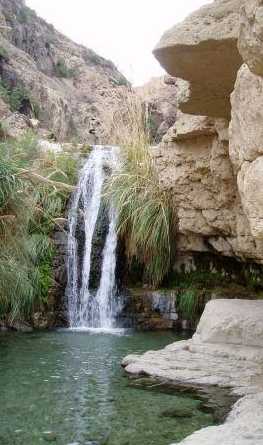 The second I saw her name tag, I did a mental brain slap (Duh! How did I not know right away?) and we started talking.
Donna told me right then that she'd been reading my bio in the reunion update. Her comment: "How wonderful your life has turned out for you, Dan. We always knew you would be someone important, a doctor, or someone who helps others. I'm so happy for you." Donna then pulled over another classmate, who agreed with what Donna had said.
I thought about my bio and wondered what Donna had read that I'd missed. I'd written the bio and it sure didn't sound as wonderful to me as it did Donna. But when she told me that she'd become a Christian since leaving high school and was now teaching Sunday School, it all made sense.
You see, out of Donna came rivers of living water. God put Donna there with a healing word at a healing time. She spoke into the desert, and from that stream came life.
There was nothing fake about what Donna shared. She spoke with the love of Christ and meant what she said. She can't possibly know what a blessing her words were. They may not sound like anything extraordinary, but I needed to hear them. Later that night, driving the babysitter to her place, I spent the return trip home in tears, thanking God for all He's given me.
Are we speaking words of blessing into other people's lives? Are rivers of living water perpetually flowing out from us into the lives of people who are thirsty?
How easy it should be for us to dispense grace! Yet for some of us, judgment and correctness fall off our lips faster than the Holy Spirit's life. How sad that we live in a culture longing for a drink of the Eternal, yet we turn on each other so quickly and without care for the death we inflict with our words and attitudes.
What does it mean for us who have the Wellspring of Life, the Zoe life of Jesus, living in us? How are our days different because we can offer drink to the thirsty that never fails to refresh?
Right now, people around us are dying for a drink of what we have welling up inside. In what ways would their lives be different if we broke down our internal dam that held back Living Water? What words of life can we speak into the dry desert that is a hurting person's daily existence? How can we be known as an oasis for the parched, whether they be lost or found?
I've met a few people in my life—only a few—who live each day as oases. That's the kind of person I long to be. Maybe if we did a better job allowing more of Christ's living water to stream out of us, we'd mutually help each other to become the oases that Christ longs for us to be.
Be blessed. And be a blessing to others.

 Psychologists of the 1950s had discussed the need for small encounter groups, but that idea didn’t express itself until the 1960s and the experimental groups of Big Sur. (The less said about them the better.)