
5 Reasons Christians Need to “Stifle It” (and #6 Will Change Your Life)

Standard

I’ve come to the point that I no longer care about what happens in cultural evangelicalism. I walked away from evangelicalism years ago, frustrated with the direction of the movement. I guess this is the natural end point of that walking away.

My leaving, however, is not even a blip on the radar. No one cares. And why should they?

Since I’m pushing rapidly toward geezerdom, I remember the ’70s-era TV show All in the Family. Opinionated loudmouth Archie Bunker would shoot down wife Edith’s insights by telling her to “stifle it.” And people would laugh.
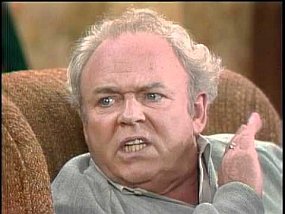
Archie BunkerBut as I look around the Internet, I see plenty of indicators that evangelicals need to take Archie’s advice and stifle it lest they become Archie Bunkers themselves. The Internet has become a gossip-fest, where too many Christians feel compelled to blather on about the latest scandal in the Christian community, whether it’s a real scandal or not. We must let others know just how a mature Christian views such goings on. We must.

I’ve been casually noticing the neo-Calvs cannibalize each other this past summer, culminating in one of their most famous members torn to pieces recently by former friends and supporters. The talk and speculation are crazed. It’s a nonstop train wreck, all of it, and we’re fooling ourselves if we think it makes us stronger.

We’ve become obsessed with celebrity Christians on the national stage, especially pastors, and their rightness or wrongness. We jump into cultural and racial conversations to inject supposedly Christian ideals, only they’re not all that Christian, and their lack of winsomeness makes us look horrible. We comment without facts. We talk without sense. We go on and on spouting myths. half-truths, and outright stupidity. We spew words about situations we know absolutely nothing about, and yet we think we’re worthy of enshrining on a panel for Meet the Press, Christian Edition, because we are so “wise.”

It’s foolishness writ large and in public. And nearly all of it does nothing but dishonor the Lord.

More than at any time in recent memory, I think we American Christians need a real self-check about how opinionated we’ve become. I know that’s an opinion in itself, but nonetheless, I think we would all be better off if we pulled out of all the online discourse and took a couple months off from making sure everyone knows what we think about _______.

One of the reasons that Cerulean Sanctum has been quiet goes beyond just my change in work. A good chunk of it is because I’m disgusted by online discourse. Everyone talks past everyone else, and there is little reasoned discussion. Worse, we seem to be investing huge amounts of emotional energy into conversations that have no Kingdom benefit—none. It’s just windbagdom, and it’s cruel, without love, and pompous to the nth degree.

Did you catch the title of this post? It’s SEO gold—at least the theory of it is. We’re sucked into this kind of thing on the Web, and it doesn’t help the situation. We feel we must comment. If a celebrity Christian’s name is attached, all the better.

Can we stifle it? Please? Does anyone else see how pathetic our discourse has become? Is my expressing my golden words the reason Jesus died? Is it critical to for everyone to know what you or I think about Pastor ________? Or about our government? Or about race relations in some town we’ve never visited? Or who is liberal and who is not? Or our thoughts on the sex lives of celebrities? Or why some actor killed himself? Or? Or? Or…?

Really?

Honestly, I’m at a point where I’ve stopped caring. We’re becoming blowhards talking our own smack. Time for all of us to wake up and get a life.

Fools

Standard

DuncecapThe fool says in his heart, “There is no God.” They are corrupt, they do abominable deeds, there is none who does good.

—Psalms 14:1 ESV

The English Standard Version translation shows 202 verses in the Bible that contain some variation of the root word fool. Reading those verses makes it evident that the world is filled with fools and folly.

Indeed, we are all fools in wisdom and knowledge when compared against God.

But some don’t get this. And they don’t comprehend it because they have no humility. If anything, they exult in their foolishness:

Whoever trusts in his own mind is a fool, but he who walks in wisdom will be delivered.
—Proverbs 28:26 ESV

Claiming to be wise, they became fools…
—Romans 1:22 ESV

I’m tired of foolish talk. Sadly, we live in an age when the people babbling on like fools are most likely viewed as wise by most of the world. I see a lot of scientists who get face time in the media prattling on with foolish and desperate theories about this and that, and it’s clear after a while that the one thing you can say most assuredly about their views is that they desperately want God to vanish. Fact is, God doesn’t care what they think because such people are fools, no matter how many letters and titles they stack before and after their names.

The really sad part about that is almost all of Western science is based on the ideas of scientists who were Christians, or at least who ascribed to a Christian worldview. In fact, because the Christian faith is one of the only ones that contends that God is both knowable and understandable and the creator of an ordered world that reflects His knowability and understandability, science is even made possible. What would be the point of examining a capricious world built on the whims of an unknowable God or on the ruthlessness of a random world? No, that science exists at all is because God Is, God Was, and God Will Ever Be.

But then, the fool can’t begin to comprehend that truth. Somehow, the fool thinks that faith and science can’t co-exist or that science alone can answer all the questions of life. Which forces us to ask, in the end, who then is the truly close-minded?

I listen to a lot of discussions between atheists and theists, and the one thing that never fails to strike me is that for all their learning, the atheists never seem to know all that much. Their arguments are remarkably simpleminded, and when people of faith bring up the slightest aspect of what it means to live by faith, the atheist seems baffled by such reasoning.

But then, atheists are just people who are unable to admit they are sinners and that their thoughts are futile and packed with one sinful idea after another, and isn’t it easier to justify all that mental futility and wickedness by erasing God? For intellectual cowards, yes, that may be true, but not for sober people who look at life with any seriousness.

I’m not surprised that people try to erase God as a means to justify their immoral lifestyles, though. A recent scientific study shows that many people are unable to morally reason from the perspective of someone whose beliefs differ from theirs. In most cases it is people who hold more “liberal” attitudes about life who cannot grasp the thinking of more conservative people, though the reverse is demonstrably not the case.  While this is not intended as a political statement, it nonetheless shows that an incapacity to grasp some moral truths does exist in people, especially those who proclaim their “enlightenment.” In that same way, the Bible says that issues of faith are foolishness to many. Things of the Spirit are incomprehensible to them:

Now we have received not the spirit of the world, but the Spirit who is from God, that we might understand the things freely given us by God. And we impart this in words not taught by human wisdom but taught by the Spirit, interpreting spiritual truths to those who are spiritual. The natural person does not accept the things of the Spirit of God, for they are folly to him, and he is not able to understand them because they are spiritually discerned.
—1 Corinthians 2:12-14 ESV

We live in an age when spiritual discernment is at an all-time low. Our leaders talk all sorts of lofty ideas, but they cannot bring themselves to talk about God or anything related to Him because they don’t know Him. In the end, their wisdom is actually foolishness, and that foolishness is blasted out for everyone to see and hear and receive as “wisdom” when it is anything but.

Sadly, some who self-identify as faithful are just as foolish. Many people who parade themselves as Christians are peddling fear instead of faith. That’s foolishness, too, and yet those hucksters are able to gather around them a sycophantic horde and sell millions of books that do nothing but stir the pot of fear.

In the midst of all these fools, what does God ask of us? It’s pretty simple actually:

He has told you, O man, what is good; and what does the LORD require of you but to do justice, and to love kindness, and to walk humbly with your God?
—Micah 6:8 ESV

Fools can do none of those things. Only the wise can acknowledge that, without Jesus Christ, we are all fools.

Waiting

Standard

Wait for the LORD; be strong, and let your heart take courage; wait for the LORD!
—Psalms 27:14 ESV

The LORD is good to those who wait for him, to the soul who seeks him. It is good that one should wait quietly for the salvation of the LORD.
—Lamentations 3:25-26 ESV

Then they believed his words; they sang his praise. But they soon forgot his works; they did not wait for his counsel.
—Psalms 106:12-13 ESV

WaitingI’d like to believe that the American Church is filled coast to coast with people who wait patiently on the Lord. I’d like to believe that.

I know better, though. The part of American Church that causes problems is the American part. In America, we don’t want to wait for anyone or anything. To wait is to waste time when something can be done. Doing is all that matters. Or as it is in many cases, talking about doing, even if the doing never happens.

Here’s a line you never hear from the pulpit in America: “We’re not moving ahead on this until God gives us the OK. Until then, we wait.

For the Christian, waiting doesn’t mean doing nothing. Prayer and faith together make a difference. In fact, prayer and faith might just be what God is waiting to experience from us before the awaited result comes. Two little practices, yet how we forget to do them.

Whatever it is that we’re forgetting, our porous memory hurts our waiting.

The Psalm 106 passage quoted above shows that forgetfulness and impatience go together. We know what the Bible says, and we sing about God’s care for us, but we forget what He has done nonetheless, and therefore we charge forward, as if THIS time is the time in which He will not come through in his perfect timing. So, we grease the rails and proceed full steam ahead anyway.

Regular readers will recognize this familiar lament: The good is the enemy of the best. In the American Church, that should be engraved on every church doorway lintel.

Impatience yields not only bad results but good. The problem is that we get satisfied with good results and never give God the opportunity to deliver mind-blowing results. All because we could not wait on Him. All because we had to make something happen.

None of that is of faith, though. And sometimes, the result is devastating.

I wonder how much we miss as a Church in the United States due to impatience. I wonder how many once-vibrant churches no longer meet because they didn’t wait on God.

Or perhaps they did and were so enamored of one type of answer that they missed God’s answer when it finally came. Either way, the best didn’t happen for them. So they grumble and blame God for not coming through on their timing. Except He did; they just weren’t attuned to Him.

Impatience and an inability to hear God when He does speak in His timing are epidemic in today’s noisy, “make something happen” churches. Will it take an ethereal hand writing on the wall to get us to pay attention and listen?

I’d say that’s something worth waiting for, except we all know how it turned out.