
Elijah didn’t die but ascended to God in a flaming chariot. Most of us know the story. Elijah was certainly a man of God.
Elijah was also something of a depressed prophet. He was always complaining about apparent circumstances, what he believed to be true about his situation. No matter the case, though, God never abandoned Elijah—far from it—and yet Elijah kept up the doom-saying.
One of Elijah’s “personal doom scripts” that kept running through his head was that the bad guys had killed all the other prophets and he alone was left. You read the life of Elijah in 1 Kings, and he repeated that script a lot.
God finally had enough of it:
[Elijah] said, “I have been very jealous for the LORD, the God of hosts. For the people of Israel have forsaken your covenant, thrown down your altars, and killed your prophets with the sword, and I, even I only, am left, and they seek my life, to take it away.” And the LORD said to him, “Go, return on your way to the wilderness of Damascus. And when you arrive, you shall anoint Hazael to be king over Syria. And Jehu the son of Nimshi you shall anoint to be king over Israel, and Elisha the son of Shaphat of Abel-meholah you shall anoint to be prophet in your place. And the one who escapes from the sword of Hazael shall Jehu put to death, and the one who escapes from the sword of Jehu shall Elisha put to death. Yet I will leave seven thousand in Israel, all the knees that have not bowed to Baal, and every mouth that has not kissed him.”
—1 Kings 19:14-18 ESV
And Elijah never again beefed about being the last one left.
God had His 7,000. God even had a successor to Elijah lined up. Despite Elijah’s office as prophet, he seemed blind to those possibilities. All he could focus on was the doom.
God has his 7,000 at all times. In your life and in mine, God has a form of that 7,000 on-hand and ready to supply.
Even if you don’t see it, that reserve exists. God had fed Elijah by ravens, but the prophet, so stuck in his doom, was unable to understand that provision or believe that God might have preserved other faithful followers to stand with him. All Elijah could see was his personal circumstance. God had to enlarge his vision.
Funny thing is, the prophet who followed in Elijah’s footsteps inherited nothing of his mentor’s doom and shortsightedness. A classic instance of how Elisha did better than his predecessor is found in 2 Kings 6. The king of Syria was frustrated because someone seemed to be telling all his plans to the king of Israel. Eventually, a servant told the Syrian king that Elisha was receiving this info supernaturally. The enraged king decided to put an end to that:
So he sent there horses and chariots and a great army, and they came by night and surrounded the city. When the servant of the man of God rose early in the morning and went out, behold, an army with horses and chariots was all around the city. And the servant said, “Alas, my master! What shall we do?” [Elisha] said, “Do not be afraid, for those who are with us are more than those who are with them.” Then Elisha prayed and said, “O LORD, please open his eyes that he may see.” So the LORD opened the eyes of the young man, and he saw, and behold, the mountain was full of horses and chariots of fire all around Elisha. And when the Syrians came down against him, Elisha prayed to the LORD and said, “Please strike this people with blindness.” So he struck them with blindness in accordance with the prayer of Elisha.
—2 Kings 6:14-18 ESV
Elisha understood that even in the midst of apparent doom, the apparency was an illusion. Something greater from God was present, and all it took was a greater vision of what God was doing. Elisha knew and could see what Elijah failed to: God frustrates doom.
Doom will never win because God is greater. Today, make that your personal script.
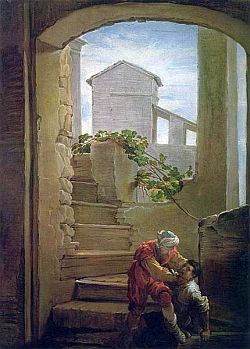 Then Peter came up and said to him, “Lord, how often will my brother sin against me, and I forgive him? As many as seven times?” Jesus said to him, “I do not say to you seven times, but seventy-seven times. “Therefore the kingdom of heaven may be compared to a king who wished to settle accounts with his servants. When he began to settle, one was brought to him who owed him ten thousand talents. And since he could not pay, his master ordered him to be sold, with his wife and children and all that he had, and payment to be made. So the servant fell on his knees, imploring him, ‘Have patience with me, and I will pay you everything.’ And out of pity for him, the master of that servant released him and forgave him the debt. But when that same servant went out, he found one of his fellow servants who owed him a hundred denarii, and seizing him, he began to choke him, saying, ‘Pay what you owe.’ So his fellow servant fell down and pleaded with him, ‘Have patience with me, and I will pay you.’ He refused and went and put him in prison until he should pay the debt. When his fellow servants saw what had taken place, they were greatly distressed, and they went and reported to their master all that had taken place. Then his master summoned him and said to him, ‘You wicked servant! I forgave you all that debt because you pleaded with me. And should not you have had mercy on your fellow servant, as I had mercy on you?’ And in anger his master delivered him to the jailers, until he should pay all his debt. So also my heavenly Father will do to every one of you, if you do not forgive your brother from your heart.”