
Media Clickbait and the Rise of the Hostile Pseudo-Christian

Standard

This past week, I read news stories that included the following:

  • Passengers applaud the removal of a sick Hispanic boy from a plane
  • Illinois debates a bill that forces women to legally name the father of their children, even in the case of rape

Enough to raise your hackles, right? What an uncaring mob on that plane! What an abrogation of good ol’ American right to privacy!

What in the hell is wrong with the world today?!

Well, maybe it has something to do with this acronym:

TL;DR

In case you haven’t read enough to encounter it before (oh, the wicked irony!), TL;DR stands for Too Long; Didn’t Read.

In what may be the most spotlight a semicolon ever received, this phrase expresses the go-go, harried nature of life today. A whole lot of data and words, and not enough time to properly ponder any of it. In fact, some news sources now include a TL;DR sidebar that summarizes the whole article. With Google claiming that 2,200 words is the SEO sweet spot for authoritative articles, it seems in an age of TL;DR, we now have even more content we’re reading even less.

And the less we’re reading is cheesing us off to no end.
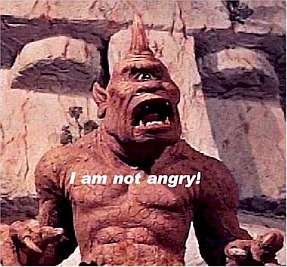
AngryReally, is it just me, or is everyone in a pissy mood?

Maybe this will make you more angry than you already are, but the headlines on those two articles up top are both lies. Sort of.

Clickbait is a term used to describe any headline or story phrased in such a way to suck people in. Given the overflow of info available, crafting a headline that grabs people is the difference between read-filed and dead-filed. No point in writing what people don’t read, no matter how stupendous the content might be. In an age of social media, some people read no further than that grabby headline.

The problem: Too many clickbaity headlines get written to purposefully rile. Write something that appeals to anger, and voila! Click, click, click.

About those two articles above…

Anyone who followed up on the awful, discriminatory, uncaring crowd aboard that plane later found that almost no one on the plane knew the boy was having a medical emergency. All they knew is that they were sitting on the tarmac for hours, missing connections and generally not getting where they needed to go. It wasn’t about the boy, his emergency, or his ethnicity at all. People didn’t applaud the boy’s exit; they applauded because an unknown delay finally got resolved and they could take off.

But a plane finally departing after a couple hours doesn’t make a story. Decrying fellow humans for prejudice and heartlessness–real or imagined–does.

Likewise, after castigating the bill proposer in the Illinois “name the father or else” story, a paragraph near the end states that the bill had been sponsored in an effort to help single mothers collect on deadbeat and absent fathers. It wasn’t a Nazi-like effort to embarass women but a means to help curtail the epidemic of fathers who inseminate, bolt, and let their partners and kids fend for themselves.

But that’s not at all what the headline implies.

What’s even more galling than these twisted headlines that hint at a different truth than the actuality just to entice people? That online news today enables instant editing and retraction. News organizations may alter headlines repeatedly to test which ones draw more people. Increasingly, articles also receive edits in real time, which means the story you read an hour ago may not have the same content an hour later.

The upshot: Media sources play emotional games with us, fostering anger where little or no anger should exist.

What does this mean for Christians?

Love, joy, peace, patience, kindness, goodness, faithfulness, gentleness, and self-control.

Those are the fruits of the Holy Spirit in the life of the believer in Jesus. The Lord Himself said that these traits distinguish someone who knows God from someone who does not. Their presence marks regenerated and saved believers, while their absence proves who is unregenerated and damned.

Right now in America, a lot of angry, hostile “Christians” are changing the future of this country for the worse. We see them online fighting, cursing, and calling others names. They throw support behind people who show no evidence of the fruit of the Spirit, and in their own dealings with others, they show evidence for all the traits opposite that fruit. They weep and gnash their teeth. Their general horribleness toward their fellow man makes the Baby Jesus cry.

And they may be you and me.

Media clickbait, purposefully twisted news headlines, and stories written to highlight the worst lies rather than the best truths are contributing to the social decrepitude of many. We’re all becoming worse people because we have a permanent chip on our shoulders and a stoked need to lash out at evil and enemies.

But are we adding to evil and becoming enemies of God as a result?

What does it mean when someone who claims to be Christian instead maintains an angry, hostile, permanently livid persona, especially online or in dealing with other people? Where are the fruits of the Spirit by which genuine believers must be known?

I can’t tell anyone how to live. Yet when I see what this suspect news fosters and note what it’s doing to people, I wonder if it’s best for Christians to start pulling back from media consumption.

Because what does it all profit us to engage information if we lose our souls in the process?

Why the Kitschy “God’s Not Done with Me Yet” Is the Most Profound Truth You’ll Encounter Today

Standard

It starts with a girl, because for many a guy, that’s where life lessons often begin.

I’d known her for years, but one day she took me into the off-limits basement of her home to show me a secret. There sat her dad, engineer’s hat in place, surrounded by his model train “kingdom.”

I say kingdom because the spread was impressive, perhaps 20 feet by 15, and from his perch, her dad controlled it all. Multiple trains, switches, throttles, and on and on. You could tell by the look on his face: He loved this hobby.

And nothing on those tracks escaped him. He knew the beginning, end, and everything in-between.

This imagery comes back to me because I continue to think we all need some perspective about perspective.

It bothers me greatly to see America descending into factions so imprisoning that no one seems capable of understanding anyone else. Soon, the verbal sparring turns into questions of an opponents’ intelligence, and all parties retreat to their corners still attempting murder with words.

We have become a people with no ability to step outside ourselves and to inhabit another person’s perspective. Worse, we question the other person’s motives, without any understanding of that person’s past, upbringing, hurts, joys, or hidden beliefs.

One of the sad realities I see played out online every day consists of the “enlightened” Christian believer tearing to shreds the novice. The sage must publicly destroy the naïf to show not only the sage’s wisdom but also to defend the honor of God against fools, regardless of how much punishment the supposed fool must endure and its personal cost.

And because pounding idiots into the dust is fun.

But it shouldn’t be.

You see, God is not done with any of us yet. Each of us is made in the image of God, yet we are all marred by sin. In our current form, we are flawed, but God can reshape us as He will. And He promises He will if we let Him.

When you and I encounter another human soul, we see a slice of a life, a moment in another’s journey. We do not see the departure from the gate, nor the arrival at the final destination.

But Father God watches over it all. Like my friend’s dad, He is the celestial engineer who knows the entirety of the track and all that is possible on the journey. He stands apart from time and sees the beginning, the end, and everything in-between. To Him, no surprises are possible, and the ultimate journey of each passenger He knows down to the second.

But only the Father knows.

The Bible says this:

For you have died, and your life is hidden with Christ in God. When Christ who is your life appears, then you also will appear with him in glory.
—Colossians 3:3-4 ESV

Not only can we not know another’s life, we cannot even know our own. We do not know the future. We incorrectly process the past. And we don’t see at all the workings of God in our inmost person. Our life truly is hidden in Him.

But He sees everything.

Which is why it’s such foolishness for any person to presume superiority over any other. We see a fleeting slice of another’s life, but if we try to draw suppositions from that slice, chances are we will miss the truth entirely. We critique another, and the criticism is based on vapor. If each of us cannot comprehend even our own thoughts and lives correctly, how can we be assured of anything about another’s life, especially as to where that person might be in the journey?

Each of us is a clay pot in God’s hands. The final form we take is not up to us but to God:

Shall the potter be regarded as the clay, that the thing made should say of its maker, “He did not make me”; or the thing formed say of him who formed it, “He has no understanding”?
—Isaiah 29:16b ESV

But now, O LORD, you are our Father; we are the clay, and you are our potter; we are all the work of your hand.
—Isaiah 64:8 ESV

The word that came to Jeremiah from the LORD: “Arise, and go down to the potter’s house, and there I will let you hear my words.” So I went down to the potter’s house, and there he was working at his wheel. And the vessel he was making of clay was spoiled in the potter’s hand, and he reworked it into another vessel, as it seemed good to the potter to do. Then the word of the LORD came to me: “O house of Israel, can I not do with you as this potter has done? declares the LORD. Behold, like the clay in the potter’s hand, so are you in my hand, O house of Israel….”
—Jeremiah 18:1-6 ESV

And I am sure of this, that he who began a good work in you will bring it to completion at the day of Jesus Christ.
—Philippians 1:6 ESV

Potter & clayUltimately, if we rashly condemn another believer in Jesus and deem him or her inadequate by our standard, we presume to judge God’s working in that person’s life. We stand in judgement over God Himself, questioning His sanctification, His timing, and His thoroughness.
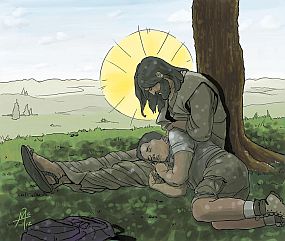
This does not mean that if we think that young woman over there is about to throw her life away or that elderly man is slandering someone without cause that we cannot make a judgment in that moment, one that might demand we intervene or correct.

But what we cannot do is write them off or think that they are outside of God’s redemption. If we do, then we presume to play engineer and to see all of the track, every train, switch, tree, hill, co-passenger, and all beginnings, middles, and endings. Or in the potter’s case, we question the artistry, the process, and the outcome. We commit the sin of the Garden. We attempt to strip God of His title and instead enthrone ourselves in His place as the engineer or potter.

Each one of us is in process. What you see in me now is neither who I was or who I will become. The same for you.

For the Christian, the journey is to make us more like Jesus. It’s an effort God undertakes but never completes this side of heaven. Much now is hidden. Only when the End comes, and Christ who is our life appears, will all be revealed.

Let’s not break the bruised reed or quench the smoldering wick. Instead, let us partner with God in the journey, whether it’s our journey or another’s. Let’s trust Him that He knows what He is doing in the lives of you, me, and everyone.

God’s not finished with any of us yet.

The Gospel’s Good News–And Why Even Some Christians Don’t Believe It

Standard

In trying to usurp the role of God, Man walked away from God and created a rift. To counter, God showed Man what it would take to cross that rift and return home to Him. That answer was called the Law. All Man needed to make the Law succeed was to do all of it perfectly.

Problem with the Law: No one got it right. Ever. In the end, what the Law accomplished more than anything else was to show the impossibility of doing it. The Law was a bridge too far, and no one could cross. God showed Man what was needed to make it across, but Man failed utterly.

Peace and rest in JesusExcept one man, Jesus. He kept all the Law perfectly. He achieved the holiness that comes from doing all the Law correctly. And when He had crossed that metaphorical bridge over the rift and reached the other side, Jesus announced, “It is finished.”

Except a lot of people don’t believe it is finished. Even Christians. Therein lies the problem.

Every Sunday in churches across the world, people sit in chairs, pews, and even on the bare ground and wonder what they need to do to cross the bridge. Because the rift is still there, and if they don’t cross the bridge, they remain separated from God. The rift they know. It’s that the bridge has been crossed for them that they fail to grok.

This sitting in church Sunday after Sunday and sometimes days in-between and wondering how one is going to cross that rift is one of the greatest plagues on the modern Church. It’s a sign that even though the Church has the Good News of Jesus, it’s not sinking into people.

The major difference between Christianity and nearly all other religions is that those other religions demand people cross the bridge using their own power, their own religiosity, their own supposed holiness. What methods people use varies from religion to religion, but one thing stays the same: people utterly fail to cross the bridge on their own.

In the Christian faith we have the Good News, or what we call the Gospel. That Good News first heard by the people of Palestine 2,000-plus years ago proclaims that Jesus has come on our behalf, and He will cross the bridge for us. He will keep perfectly all the Law, and not only this, but He will be the sacrifice of blood demanded as recompense for Man creating the rift in the first place.

Jesus came, lived, ministered, and accomplished.

Jesus did it all. It is finished. No more recompense necessary. No more need to cross the bridge on our own. Jesus did it all for us.

The question is of holiness, that which is required to approach a holy, perfect God who has set a bridge across the rift. The answer is in Jesus. His holiness in keeping all the Law and satisfying the debt becomes your holiness and mine. For those who come to Jesus as their hope for crossing, Jesus imputes His holiness. By being in Jesus, we have crossed the bridge and been counted holy and debt-free because God sees what Jesus did for us, not what we try to do for ourselves.

In the mockumentary This Is Spinal Tap, the stoner rock band releases its newest album the band members believe will be bigger than The Beatles’ White Album. Spinal Tap’s album is entirely black. No band name. No title. No cover information. Nothing but blackness. Trying to wrap their heads around the concept, they ask, “How much more black could this be?” To which comes the answer, “None. None more black.”

How much more holy can a believer in Jesus be? None. None more holy. Jesus did it all on His own for us. Nothing we can do on our own can make us more holy, more acceptable to God. It is finished. We can’t add to what Jesus did, either. Jesus took care of it all. Our ridiculous contributions add nothing. The Bible calls our feeble attempts “dirty rags.”

The fancy word for trying to cross the bridge on our own religious merits is Pelagianism. It should be better known as AbjectFailure-ism. Weirdly, while some people reject Pelagianism, they’re OK with a modified form of it. Saying that Jesus got us mostly there but adding our own merits boosts us all the way across is the mockery of Jesus’ “It is finished” known as Semi-Pelagianism.

Those who love what Martin Luther started in the Protestant Reformation get a hoot out of mocking–for good reason–the stupidity that is Pelagianism and Semi-Pelagianism.

Except…

You see, we have this problem of should-ing in the Protestant Church. Christians who say they believe Jesus when He says He finished it all don’t actually believe. Instead, Church leaders and other well-meaning busybodies tell us we should tithe, should volunteer, should read our Bible ___ number of times a day, and should pray ___ times a day too. We should have a monthly date night with our spouse, should avoid the wrong kinds of movies, should do this thing or that action. Should, should, should. The result? Too few Christians believe that Jesus said He finished the job and paid the price so that we can lay down all these shoulds and live truly free. Instead, we get a message that shoulds all over everyone.

That’s not Good News. It’s removing the chains of the Old Testament Law that Jesus said He fulfilled and freed us from and putting on chains we make out of a mistaken reading of the New Testament. We exchange one imprisonment for another. We’ve just added a coating of Jesus to the chains.

That’s the crazy thing about the Gospel. You and I don’t have more lawful requirements to fulfill. This is what makes the Good News a scandal. The idea that we can’t add anything to what Jesus finished galls people. It angers because we want to be proud of our own religiosity.

The group Jesus opposed more than any other were the Pharisees. They insisted they had crossed the bridge on their merit. When Jesus pointed out that they’d failed miserably, they sought to kill Him. That’s how much they worshiped their own religious pride.

Each of us has his or her own Pharisee inside that insists we can keep the Law and not fail. There’s an American version of that Pharisee too, one that tells us we have other laws to keep such as being beautiful, successful, empowered, in control, and masters of our own American Dream.

Whether an American Phariseeism or the old-fashioned original kind, that Pharisee in us is both deceived and a damned liar.

Jesus condemns this self-righteous, “don’t need your help Jesus because we’ve got this bridge crossing thing covered on our own” Phariseeism every time He can.

In Jesus’ parable of the prodigal son, the younger son tells his father that he wishes dear ol’ dad were dead and demands his inheritance, which he then blows on hookers, booze, and partying. Eventually reduced to coveting slop intended for pigs, he crawls back home demoralized.

At first sight of the prodigal, his father runs to him and tearfully welcomes him with open arms because he loves that messed up ingrate kid so much.

Meanwhile, the elder son stands by dad, pissed, because he never whored around, didn’t squander his inheritance, and was here at home all along, dutifully keeping his own nose clean.

Which of the two sons gets the stern lecture from the father? You’d think the younger, but you’d be very, very wrong.

Jesus also tells the story of a farmer who hires some men at the first of the day to come work in the field after those early risers agree to the wage. But the work is too big, so later in the day he hires more. Then even more. Near the close of the day, the farmer is still hiring.

Finally, the day ends. The farmer pays everyone he hired the same money, but the men who worked from the early morning, who agreed to work for that amount, are hacked off. They insist they acted like the best kind of workers and not like those who frittered away most of the day and only came out to work near sundown. How can the farmer give everyone, fritterers included, the same pay?

In both parables, Jesus points out self-righteousness: We’re scandalized by God’s ignoring of what humans do to try to cross the bridge, incredulous that He looks only at what Jesus has done.

Like the father of the prodigal, God stands at the end of the bridge over the rift with His arms open. In fact, when we hear the fancy spiritual word repentance, all it means is that God has His arms open and simply wants us to cross the bridge and come home to Him. And because the bridge was already crossed by Jesus and the bridge itself paid for, being in Jesus means we’re already considered to have crossed and paid. There’s nothing more to do but rest in the arms of Father God.

No more tragic figure exists than the person who believes Jesus is God but who spends all of life trying to be a “good Christian.” To him or her, I say this: Stop trying! It is finished. Jesus did it all. Rest in Jesus’ success. If you try to perform on His behalf, you’re usurping the role of God again, which was the very error that started this mess!

Some folks will object to this post on the grounds that we need to be slaving away to perfect ourselves to look more like Jesus. But the promise from God is that because of Jesus’ finished work, that’s not our job but God’s alone. He is both the author and finisher of our faith. It’s all on Him to make us look more like Jesus and none of it on us. Can the pot mold itself? No, only the Potter can mold it as He sees fit.

It is finished. All we have to do is acknowledge our failure to get across the bridge on our own and our desperate need for Jesus. Then we can head home and fall into the embrace of our Heavenly Father.

And that’s the Gospel’s Good News.