
5 Reasons Christians Need to “Stifle It” (and #6 Will Change Your Life)

Standard

I’ve come to the point that I no longer care about what happens in cultural evangelicalism. I walked away from evangelicalism years ago, frustrated with the direction of the movement. I guess this is the natural end point of that walking away.

My leaving, however, is not even a blip on the radar. No one cares. And why should they?

Since I’m pushing rapidly toward geezerdom, I remember the ’70s-era TV show All in the Family. Opinionated loudmouth Archie Bunker would shoot down wife Edith’s insights by telling her to “stifle it.” And people would laugh.
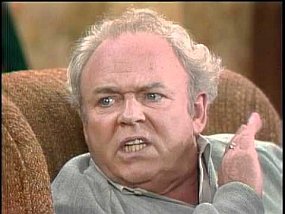
Archie BunkerBut as I look around the Internet, I see plenty of indicators that evangelicals need to take Archie’s advice and stifle it lest they become Archie Bunkers themselves. The Internet has become a gossip-fest, where too many Christians feel compelled to blather on about the latest scandal in the Christian community, whether it’s a real scandal or not. We must let others know just how a mature Christian views such goings on. We must.

I’ve been casually noticing the neo-Calvs cannibalize each other this past summer, culminating in one of their most famous members torn to pieces recently by former friends and supporters. The talk and speculation are crazed. It’s a nonstop train wreck, all of it, and we’re fooling ourselves if we think it makes us stronger.

We’ve become obsessed with celebrity Christians on the national stage, especially pastors, and their rightness or wrongness. We jump into cultural and racial conversations to inject supposedly Christian ideals, only they’re not all that Christian, and their lack of winsomeness makes us look horrible. We comment without facts. We talk without sense. We go on and on spouting myths. half-truths, and outright stupidity. We spew words about situations we know absolutely nothing about, and yet we think we’re worthy of enshrining on a panel for Meet the Press, Christian Edition, because we are so “wise.”

It’s foolishness writ large and in public. And nearly all of it does nothing but dishonor the Lord.

More than at any time in recent memory, I think we American Christians need a real self-check about how opinionated we’ve become. I know that’s an opinion in itself, but nonetheless, I think we would all be better off if we pulled out of all the online discourse and took a couple months off from making sure everyone knows what we think about _______.

One of the reasons that Cerulean Sanctum has been quiet goes beyond just my change in work. A good chunk of it is because I’m disgusted by online discourse. Everyone talks past everyone else, and there is little reasoned discussion. Worse, we seem to be investing huge amounts of emotional energy into conversations that have no Kingdom benefit—none. It’s just windbagdom, and it’s cruel, without love, and pompous to the nth degree.

Did you catch the title of this post? It’s SEO gold—at least the theory of it is. We’re sucked into this kind of thing on the Web, and it doesn’t help the situation. We feel we must comment. If a celebrity Christian’s name is attached, all the better.

Can we stifle it? Please? Does anyone else see how pathetic our discourse has become? Is my expressing my golden words the reason Jesus died? Is it critical to for everyone to know what you or I think about Pastor ________? Or about our government? Or about race relations in some town we’ve never visited? Or who is liberal and who is not? Or our thoughts on the sex lives of celebrities? Or why some actor killed himself? Or? Or? Or…?

Really?

Honestly, I’m at a point where I’ve stopped caring. We’re becoming blowhards talking our own smack. Time for all of us to wake up and get a life.

Three Faith Films–And What They Fail to Say about Faith

Standard

They’ve been calling 2014 the Year of the Faith Film. I know that in the evangelical community I tend to find myself thrust into, people were pumped about that. Perhaps Hollywood was waking up from its superhero love fest and rediscovering that the Good Book has its own caped crusaders (well, toga-ed, or whatever it is that they wore—you get the point) that can teach us about life.

So far, I’m not sure the Year of the Faith Film is delivering on its promise. And I wonder what that says about our understanding of what faith really is.

Three of those films have hit the cineplexes in recent weeks. I haven’t seen any of them. I’m not sure I would ever want to.

Noah has been called by its director “the least biblical biblical film ever made,” and at achieving this he seems to have succeeded, pulling from just about any ancient text outside the Bible that even hints at a flood narrative. He then offers us a man of “faith” whose righteousness appears to derive from despising anything that isn’t a fuzzy bunny, himself included. Rather than the LSD Methuselah slipped into Noah’s tea, Prozac may have been a better choice. Some have wondered if the director culled more from the works of J.R.R Tolkien and Timothy Leary than from the Jews.

God’s Not Dead is evangelicalism’s answer to Noah, pitting its faithful-to-a-fault, Christian-American, teen apologist against the evil college professor in a battle of hermeneutics, which everyone knows is the most gripping plotline any moviegoer could possibly hope for. And yes, there are other subplots, but they all add up to what amounts to an evangelical snuff film, where the most anyone can long for in life is to get one’s “fire insurance” and avoid hell. Should have titled this God’s Not Dead, But You Will Be.

Son of God purports to be about the life of Jesus. I heard a rumor that Justin Beiber plays Jesus. Or is it Zach Efron? Being a wizened curmudgeon, I get my teen heartthrobs mixed up. I also hear they cut out the devil because he looked too much like our current president. Also purportedly, the filmmakers saved time and cash by filming this movie alongside the making of their made-for-TV pseudo-epic The Bible. I think from what I’ve written, you get an idea of how unchallenging this film is. That I can’t recall anyone from my church claiming to have seen it may be the most damning statement I can make about it.

What these three films tells us about the state of faith in America 2014 is that no one, especially Hollywood, has one lick of an idea what it means to be faithful in the every day. God exists at the periphery of life, relegated to weirdos or to the moment of death or to some milquetoast interpretation of “faith” that has nothing to do with the guy who wakes up in the morning and hopes to connect to God amid the daily commute, a pile of unpaid bills, and the American Dream. Perhaps the superhero love fest does have more say to us (heck, even God Is Not Dead features the actors who played Hercules and Superman).

The reality of faith in God that the Bible holds out to each one of us is that it IS relevant to the mundane day-to-day. No sacred/secular divide exists, and Christianity is filled to the brim with truth that suffuses every part of life, which is what makes it worth living. God isn’t just there in the flood. He’s not just there when we die. He’s not a cleverly marketed and filmed made-for-TV-but-shown-in-the-theaters side project. God intends to be there in everything we do and to give those activities meaning.

Henry David Thoreau said that the mass of men lead lives of quiet desperation. If these three “faith” movies were the only gauge to what faith in God is all about, I can understand that desperation.

Perhaps it’s not possible to encompass the richness of a life found in Christ and jam it into a two hours of screen time. Filmmakers will keep trying, though. And I suspect they will keep failing.

Perhaps we don’t know what a genuinely Christian life looks like in America 2014. Certainly, a lack of models is one reason. We’ve made strange alliances with worldliness and can no longer extricate that worldliness from truth. Sometimes, we even call evil good and good evil.

The God of the Bible offers abundant life. His word speaks to all parts of human existence. He is our God both when we are kneeling in church and when we’re sitting on the john. All of life, especially the middle we can’t seem to ascribe to Him, is filled with His Life.

How we make that true and real to most of us has yet to be filmed. Or in America 2014, lived.

Attack of the Online “Prophets”

Standard

Ad hominem abusive.

If you don’t know what that means, here’s the ever-convenient Wikipedia with the answer:

An ad hominem (Latin for “to the man” or “to the person”), short for argumentum ad hominem, is a general category of fallacies in which a claim or argument is rejected on the basis of some irrelevant fact about the author of or the person presenting the claim or argument. Fallacious ad hominem reasoning is normally categorized as an informal fallacy, more precisely as a genetic fallacy,  a subcategory of fallacies of irrelevance. Ad hominem reasoning is not always fallacious, for example, when it relates to the credibility of statements of fact.
Wikipedia entry for ad hominem

I’ve been on the Internet from before it was the Internet. Back in my earlier days at Carnegie Mellon University, I would send emails to a friend at MIT using the old ARPANET defense network, which evolved into the modern Internet. How long ago was this? Well, the smiley emoticon was “invented” at CMU during my tenure as a student.

So, I’ve watched the Internet grow up.

Sad to say, but I think that as the Internet grew up, the people who used it didn’t. And this brings us back to that Latin phrase above and its definition.

I don’t know what has happened in recent years, but I’m seeing an increase in ad hominem attacks online. The worst part of this is the attacks often come from Christians.

A fictional, but true to form, example:

ScourgePerson A : “Yes, you need to love people in Jesus’ name, but you can’t excuse their sin. Love them, but call them to repentance too.”

Person B : “Clearly, you are a legalistic fool who doesn’t know the Lord. Jesus is love. Love is all that matters—and you would know that if you truly know Him. But you don’t. I bet a Pharisee like you has never loved anyone except yourself.”

That’s what passes for discourse and an engagement of ideas, and I’m seeing it more and more on Christian websites.

Beyond the fact of ad hominem‘s status as a logical fallacy unworthy of use in debates and discussions, it’s the faux prophetic attitude of people that bothers me greatly. Too many Christians are presuming to know the spiritual condition of another person with whom they converse online, but without having met that person or read anything else that person may have written. Instead, ad hominem attacks often come out at the first interaction.

At the risk of being accused of an ad hominem attack myself, I must say that this borders on divination. Really. Because the ad hominem user is not only NOT being loving toward a fellow believer, he or she is claiming to scry out the spiritual condition of the other person, as if doing a fortune teller’s “cold reading.”

Folks, we can’t do this. Ever.

Online discourse is in a race to the lowest common denominator. When people who claim to be Christians drop words like unbeliever or heretic almost as a reflex in reference to others online, they run a great risk of sin—and in a public space for lost people to note. We’re the light of the world. If our discourse is filled with negative “prophetic” statements about other people we engage in cyberspace, then that light becomes darkness. Then we scratch our heads when other people say, “No, I don’t want anything to do with your Jesus or your Christian religion.”

If we’re going to be online and discussing difficult topics, engage ideas. Challenge concepts. Dismantle erroneous thinking.

But don’t dismantle people. And for the sake of your own soul, don’t attempt to play diviner into someone else’s spiritual state, especially when that perceived foe states nothing online that would serve as fodder for such pronouncements.