
Reading Between the Lines of Paul’s Letters

Standard

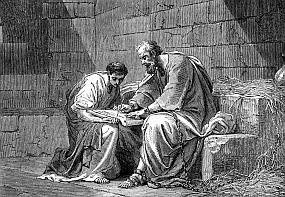
'Paul, The Apostle' by Gustave DoréMy son and I have been reading out loud through the New Testament this summer. We’ve tried to read as much as we can of one book in one sitting so that the harmony of the books is maintained. I’m convinced that we too often approach the Bible with a piecemeal mentality that ends up losing the bigger picture. This is especially true of the epistles, which should never be read any way other than in one piece. Reading them this way spotlights the confusion that our over-reliance on chapter and verse markings has created.

While I’ve read through the Bible many times in my life, I’ve never tried to read it both out loud and in the biggest chunks I can manage. That another person is listening as I read makes an additional subtle difference that forces me to be clear in how I pause and phrase the written word. Truly, it makes a difference. Try it.

This time through the New Testament, I’ve focused on most everything BUT the theology. Too often when we read the epistles, we tend to gloss over the credential establishments, the callouts to this person and that, and the real humanity depicted by the writers as they communicate to their readers.

For this post, I want to share a few thoughts from reading through Paul as if I were a long-ago church leader reading to an assembly of new believers who were going against the flow of the age.

A baker’s dozen thoughts on the Pauline epistles:

  1. We tend to see Paul as a dry, driven, exacting, Type A personality, but his emotional life is more rich on these pages than we give him credit for. This shows us that Christians need to be in touch with their emotional lives and bring emotion to our assemblies. Ours is not an arid, intellectual faith, though a quick perusal of Christian blogs and websites often communicates it as such. There is much to grieve—and also much to be joyful over. You can sense Paul’s melancholy and father-heart when he talks about his love for these young churches. His imprisonment weighs on him, and you can feel the sadness in the distance it creates. His writings show how important a solid network of Christian confidants and supporters is to our emotional well-being.
  2. Paul faced enormous opposition, often from people who seemed to be genuine Christians but were slightly off. (Sounds like today, right?) That so much of Paul’s writings consists of establishing his credentials is both illuminating and sad. This Christian life is more fragile than we imagine, and it is easy to go off the rails from simple carelessness regarding truth.
  3. To a modern age we think of as truly connected, Paul’s writings hammer the importance of Christian community, the need for loving, caring community that functions with peace, order, and utter dependence on God for direction. (Are our churches living that way?)
  4. Church hopping isn’t a 21st century phenomenon. Witness the number of companions to Paul who fade in and out of his life, many starting off well but finishing badly.
  5. As much as we look at Paul’s letters as theological treatises, the majority of their text, both opening and closing, is dedicated to connecting with specific people and establishing what Paul is all about.
  6. Personal holiness, perseverance, and a sober understanding of the age are themes in nearly every one of Paul’s books. So is the reality that Christianity is not another religion. The Christian faith cannot be equated with other streams of religious thought because it is not a dry—and ultimately empty—system like those others. Instead, Christianity is a dynamic relationship with Jesus Christ, based in complete reconciliation, and awash in grace for living each day.
  7. The Christian is to be the most average of people but one who lives an extraordinary, eternal life. Humility, gratefulness, and discipline are hallmarks of that life.
  8. Sins of a sexual nature and those that afflict male-female relationships are extraordinarily prevalent and a major stumbling block for many, but Christ can forgive, redeem, and restore.
  9. Paul’s letters repeatedly note that many people will wash out of the faith, and while we can have confidence in God’s preservation, the number of people who get sidetracked and seduced by the world’s offerings is larger and more common than we understand.
  10. The Christian life is NOT a set of rules and can never be. People who teach a set of rules are false teachers.
  11. Grace in our present age is largely misunderstand and rarely dispensed to the extent that Paul writes that it should be.
  12. Most of what Paul writes about isn’t rarefied, theological ponderings but practical Christian living. He points out how faith translates into real life and how practical our beliefs must be.
  13. A believer not living by the Holy Spirit is not living. The Christian life is less scripted than the religious life of the day, which is what makes it so exciting.

Those are a few thoughts on the writings of Paul from an overarching perspective. I hope they resonated with you. Have a blessed day and week.


Dad Gone

Standard

I read during lunch every day. This summer’s reading includes two very different books that, sadly, share one read-between-the-lines moral.

How Children Succeed: Grit, Curiosity, and the Hidden Power of Character by Paul Tough came to my attention from a Facebook friend posting that it was one of the books on Bill Gates’s reading list. As a father and as someone who majored in a field that deals with how people learn and succeed, I felt a duty to read this.

Lost Girls: An Unsolved American Mystery by Robert Kolker is not the sort of book I typically read, but it has garnered considerable attention. The book examines the Long Island serial killer murders of women who sold sex via Craigslist.

The Tough book is something of a chain yank, since it focuses almost exclusively on how children in poverty can succeed. Featuring mini-profiles of poor children and their efforts to rise above a multi-generational trap of failure, it postulates a set of a traits these kids can pursue to improve their chances in life.

Meanwhile, the Kolker book’s profiles of the victims shows one way for girls in poorer families NOT to succeed: by turning to self-managed prostitution. Almost without exception, the lives of the young women in this book mirrored those of the Tough book, save that the victims here are all white.

What neither book really wants to come out and say is what is most disturbing about their similarities. How Children Succeed dances around this reality like a soldier trapped in a minefield, and Lost Girls (so far) reports just the facts, also avoiding the issue.

In both these books what is most obvious is the lack of a concerned, involved, stable father at home.

Dad and kidsAn endless stream of ne’er-do-well men drift in and out of the lives of the kids in How Children Succeed and Lost Girls. It’s so glaring and so routine that the authors’ failure to elaborate on it speaks volumes, especially in the Tough book, which I found particularly gutless in its unwillingness to state the obvious: that children succeed when they have a stable mom and dad at home. And in the Kolker book, knowing that most of these women started life with an absent father makes their ultimate life choices and demise all the more heartrending.

But this blog is not about poor children and murdered prostitutes.

I’ve written previously on Cerulean Sanctum that men in the Church have a greater responsibility than they assume. At a time when so many children are being raised by a mother alone, Christian men cannot cocoon within their own nuclear families. Men of all ages in the Church must understand that their responsibility to the next generation does not end with their own children.

If we are to make a positive impact on that next generation, Christian men need to make a concerted effort to be involved in the lives of other people’s children, especially those children who lack a father at home.

No doubt, this is a heavy task. We Christian men are overburdened as it is.

Still, if these two books depict the canary in the coal mine of our society, it’s that America cannot be great if its families are not great. And despite what the Left in America thinks, great families start with a solid, caring mom and dad at home.

If that is not possible, though, someone needs to step up to make it better than it is.

Church leaders, you know the families in your church that have a dad who has gone missing. You need to be more intentional about calling the men in your church, as a group, to do something about that lack.

Kids of all ages need strong, positive male role models. Both How Children Succeed and Lost Girls make this obvious, even if they are unwilling to say so.

Down from the Ledge: Why the Church Needs to Drop the “Leap of Faith”

Standard

I miss reading Michael Spencer, the late, lamented Internet Monk. Since his passing, I don’t read his site as much, though Spencer’s successor, Chaplain Mike, does have a worthy post from time to time.

A post there that has drawn attention, Pastor Piper Scares the Kids, drew mine, and while many commenters have enjoyed ganging up on an ill-conceived children’s message from noted pastor John Piper, there’s another aspect to the Piper illustration I wish to address. So, go read that post, and I’ll wait for you.

{Thumb twiddling…}

Back? Good.

Now for my thoughts.

If there is a sin in the Piper illustration of the little boy jumping from a diving board to escape a vicious dog, it’s not really in the plethora of sub-images that riled the commenters at Internet Monk. For me, it’s the ubiquitous primary image of the “leap of faith” that Christians seem to always fall back upon when talking about how faith in God works.

This idea of a person confronted with a difficult decision hurling his person from a high place only to be caught by a faithful God could not be a more abyssmal illustration. Why the Church insists on using it is beyond me.

Here’s the major problem with the “leap of faith” analogy:

Then the devil took [Jesus] to the holy city and set him on the pinnacle of the temple and said to him, “If you are the Son of God, throw yourself down, for it is written, “‘He will command his angels concerning you,’ and “‘On their hands they will bear you up, lest you strike your foot against a stone.'” Jesus said to him, “Again it is written, ‘You shall not put the Lord your God to the test.'”
—Matthew 4:5-7 ESV

See the problem? The Enemy comes to tempt Jesus and asks Him to make a leap of faith. Jesus replies that He (and by extension, we) knows better than to test God that way.

Hmm.

Smart people would say that pretty much should end the whole idea of the leap of faith motif. Jesus says don’t test God like that.

How is it, then, that we’ve made the leap of faith the cornerstone of how we explain faith in God to others? And why is it we persist in doing something we should not do, testing God again and again? And how is it possible that we use this image as a way to encourage people facing difficult choices?

We need to stop using the leap of faith as an illustration of putting our faith in God. It simply is not biblical.

You’d think that would be the end of this post, but I have a bit more to add that I think is important.

Some of you remember the 1980s. (And some of you are trying to forget them, but bear with me…)

I spent most of the 1980s working both in summer and in year-round Christian camping ministry. At one camp, I was put in charge of the challenge course, a nicely designed set of outdoor tasks used in team-building exercises. Being the sole extrovert of the group that handled outdoor education at the camp, I was pretty much assured of the job by default.

I led church groups, youth groups, school groups, homeschool groups, and business teams through the course. We had a high wall the team had to get over under certain conditions, water crossings they had to make without getting wet, and so on. Trust fallThe course had about a dozen stations, the last of which was a trust fall.

Ah, the trust fall. The leap of faith made concrete.

The trust fall station was a platform about six feet off the ground. People would climb the platform, turn their back to the rest of the group, and fall horizontally into the outstretched arms of their waiting team below.

I monitored this process like I was in charge of handling 10 pounds of weapons-grade plutonium. I never participated with a group, but I ran them through the safety procedures like a drill sergeant. On my watch, no one was ever dropped or ever came close. Not even the 450-pound woman who made the platform groan, though I definitely inserted myself into the group catching her.

Can you predict what’s coming?

One day, a youth group I’d grown attached to over the week convinced me to take the fall and let them catch me. I’d done the fall with members of the camp staff before, so it wasn’t like I was new to the experience myself, so despite my Spidey sense a-tingling, I climbed the platform. I told myself there were half dozen adults with the group, so it’s wasn’t like I was entrusting myself to a bunch of 13-year-old kids solely.

I ran through the safety steps, did the countdown, and took that leap of faith into the certainly waiting arms of the group.

Now, I didn’t hear anyone yell, “Squirrel,” but somehow the group’s attention wandered elsewhere, and I hit the ground flat from six feet up, having felt a grand total of one arm brush past me on the way down.

Imagine being hit from behind with 10-dozen sledgehammers. The ground shook like it was the end of the world. So did I. Ouch.

It was a darned good thing I had hit perfectly flat, because if I had rotated just a bit too much and landed on my neck, I might be writing from a wheelchair today.

I’ll come back to that scene of near-personal-destruction in a moment.

We in the Church use the leap of faith to encourage fellow Christians to put their faith in God when faced with a difficult decision that indeed requires faith to address. But for those of us not making that leap, where are we in that decision-making process, its follow-through, and aftermath?

Here’s the thing: Some people who make such leaps end up dashed on the rocks below.

While it was not quite rocks for me in that trust fall moment, it was packed, hard ground. The aftermath of my collision with cold, hard reality included screaming girls, people running around, and adults yelling, “Omigod, omigid, omigod…” over and over and over. In short, pandemonium.

But how do we react in the Church when someone we encourage to jump and put their faith in God is NOT caught by the faithful God we insist will be there but instead meets the packed, hard ground?

My experience? Most of the time we go on as if nothing happened.

You would think that after encouraging the leap and witnessing the horror of a collision with the earth, pandemonium would break out and we would scream and start calling for help. That’s what the group did that dropped me. Once the initial panic subsided, everyone eventually settled into triage mode. If people had simply wandered off, whistling as they went, we would think something was seriously wrong in the moral lives of those people. It was bad enough that this big 6′ 4″, 200-pound man was dropped by 20 people, but for them to walk away as if nothing had happened would border on criminal.

And yet that happens to people in the Church who make a leap of faith and end up smashed to pieces. Many are simply left to tend to their own predicament alone, while the Church wanders off as if nothing happened, ready to tell the next leaper to jump.

We can’t do that. It’s morally reprehensible.

A few warnings about how we Christians approach dealing with people facing difficult choices that require faith:

1. If we are faced with others ready to take a leap of faith, we better darned well understand from how high they are jumping and just what awaits them below before we give them the thumbs up.

2. If we are not prepared to face that faithful decision as a co-“jumper” with the person faced with a leap, we should never tell another person to hurl himself or herself off the cliff. Ever.

3. If we are not prepared to deal with the aftermath of a leap, then we must stop advising others to jump.

Personally, I am dead sick tired of watching Christians plunge to their doom because of the leap of faith mentality we have in the Church. In real life, there’s something sick about the person who tries to convince the person on the ledge of a high building to jump off. I don’t think that Christianizing a figurative jump is any better. And I think that casually walking away from the aftermath of a fall that didn’t end with the jumper nestled sweetly in the arms of God is the sickest response of all.

Can we grow up a little and start being a collective body of believers? Can we start doing a better job of dealing with fellow Christians who go out in faith and come back in little shards? Because it happens. If it didn’t happen, there would be no faith element to it. There would be no risk.

How we deal with the aftermath of people who do come back in pieces says everything about what we really believe. And what I’m seeing isn’t pretty.

But for all I just wrote, there’s that truth from Jesus again: Don’t test God by jumping from high places.

I wish we could just drop the leap of faith mentality. If Jesus said not to test God that way, then we shouldn’t. Period.

Time to come up with a more mature attitude toward faith and the aftermath of decisions made in faith.