
When Christian Celebrities Crash and Burn

Standard

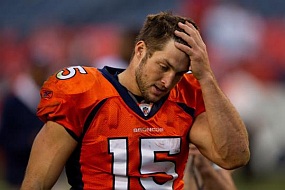
Tim TebowWith a recent long losing streak and a new coaching philosophy in New York, Linsanity is dead.

As of yesterday, Tim Tebow is riding the bench again and likely will be traded.

Two evangelical sports stars are now no longer lighting up the heavens. And that’s OK.

Well, it’s OK with me. Some other people may be taking Tebow’s and Lin’s descents hard. Seems we have a way of doing that when it comes to Christian celebrities. Christian sports stars are particularly ripe sources of adoration, but as the old axiom goes, the bigger they are, the harder they fall.

There is something desperate in evangelical Christian circles to be both taken seriously and liked enormously. Whenever a Christian “comes out” in Hollywood, it gets trumpeted in every Christian media outlet that follows popular culture. Somehow, it becomes news by the sheer force of will of people who are struggling to hold onto the idea that Christians are just as cool as everyone else—and possibly cooler. Like moths to a flame, Christian media outlets stampede to dub some Christian sports, music, political, or film sensation the next Great Christian Hope and the model for us all to emulate. That many of these celebs have a Q Score in single digits and often show up in a higher number of direct-to-DVD film productions seems not to trouble the true believers.

And then there are the celebrity pastors/preachers and their all-too-visible ministries.

Aside from the B-list nature of most Christian celebrities in the entertainment industry, once in a while we get some notable Christians in sports, with Jeremy Lin of the NBA Knicks and Tim Tebow of the NFL Broncos being the latest headline grabbers. Tebow has endured a level of scrutiny I wouldn’t wish on a presidential candidate, while Lin suddenly had all of Asian sports hopes dropped on his Ivy League shoulders. We Christians only made the hype worse, finding ourselves compelled to comment and to wish the very best for these golden representatives of Our Side®.

Then comes the inevitable fall. In the case of Christian celebs, that fall comes in the form of either some sin that becomes public or a rapid descent into averageness or irrelevancy.

This troubles the true believers to their cores because, honestly, their true believerdom is much shallower than they care to admit. It is as if the success of a Christian celebrity somehow is essential to proving true our Christian beliefs. Sadly, the triumph of a Christian in the public eye is too often seen as validation not only of the existence of God, but also that He favors us Christians above all other people.

I’ve been around a while, and I can say with all assurance that more often than not, our dependence on Christian celebrities to confirm our beliefs fails. And often fails spectacularly. We may no longer trust in chariots (Psalm 20:7), but we still trust in humans to meet our need for validation. Yet there is no more fragile receptacle for faith than fame. That it gets in the way of the Gospel far more often than it boosts it should be obvious to most Christians. Yet when the latest celeb comes around, we’re hopping on the bandwagon in droves. If experience should have taught us anything, it is that such bandwagons have an affinity for cliffs.

We won’t know who the real superstars in the Faith are until we get to other other side. Curiously, the overwhelming majority will be folks we never heard of. I suspect that’s the way the Kingdom works best. God doesn’t need celebs to advance the Gospel. He needs dedicated, mostly average, anonymous people who aren’t impressed by worldly accolades. In America 2012, those folks are rare indeed.

So please, can we stop with the hero worship? Clay feet are part and parcel of this world, and too many of the modern Christian heroes of our own creation come equipped with deluxe models. No one should be surprised, yet we always are, which only makes us look silly when a Christian celebrity we hyped to the max crashes and burns.

We don’t need celebrities to prove our beliefs true. Jesus more than validated Himself. Of course, God added the “This is my beloved Son, with whom I am well pleased. Listen to Him!” If we can’t trust God, then what’s the point?

Jesus had no need for a Q Score, and neither should we.

Steve Jobs, Jesus Christ, and the Bland Conformity of Western Christianity

Standard

Here’s to the crazy ones. The misfits. The rebels. The troublemakers. The round pegs in the square holes. The ones who see things differently. They’re not fond of rules, and they have no respect for the status quo.
—Apple Inc., “Think Different” ad, 1997

And as they were speaking to the people, the priests and the captain of the temple and the Sadducees came upon them, greatly annoyed because they were teaching the people and proclaiming in Jesus the resurrection from the dead. And they arrested them and put them in custody until the next day, for it was already evening. But many of those who had heard the word believed, and the number of the men came to about five thousand. On the next day their rulers and elders and scribes gathered together in Jerusalem, with Annas the high priest and Caiaphas and John and Alexander, and all who were of the high-priestly family. And when they had set them in the midst, they inquired, “By what power or by what name did you do this?” Then Peter, filled with the Holy Spirit, said to them, “Rulers of the people and elders, if we are being examined today concerning a good deed done to a crippled man, by what means this man has been healed, let it be known to all of you and to all the people of Israel that by the name of Jesus Christ of Nazareth, whom you crucified, whom God raised from the dead–by him this man is standing before you well. This Jesus is the stone that was rejected by you, the builders, which has become the cornerstone. And there is salvation in no one else, for there is no other name under heaven given among men by which we must be saved.” Now when they saw the boldness of Peter and John, and perceived that they were uneducated, common men, they were astonished. And they recognized that they had been with Jesus. But seeing the man who was healed standing beside them, they had nothing to say in opposition. But when they had commanded them to leave the council, they conferred with one another, saying, “What shall we do with these men? For that a notable sign has been performed through them is evident to all the inhabitants of Jerusalem, and we cannot deny it. But in order that it may spread no further among the people, let us warn them to speak no more to anyone in this name.” So they called them and charged them not to speak or teach at all in the name of Jesus. But Peter and John answered them, “Whether it is right in the sight of God to listen to you rather than to God, you must judge, for we cannot but speak of what we have seen and heard.” And when they had further threatened them, they let them go, finding no way to punish them, because of the people, for all were praising God for what had happened.
—Acts 4:1-21

In the wake of the death of Steve Jobs, people all over the world have lamented the passing of Apple’s charismatic leader. Gene Veith, provost and professor of Patrick Henry College and a member of the Alliance of Confessing Evangelicals, attempted to understand this outpouring in his article “The Apotheosis of Steve Jobs.” In it, he writes:

I would say that it isn’t just that Jobs has been turned into a saint.  In our newly-minted paganism, he and other celebrities have undergone apotheosis.  That is, they have been turned into gods.  The parallel is what would happen in the Roman Empire.   An accomplished emperor dies.  So the Senate votes to proclaim him a god.  Whereupon he enters the pantheon and citizens are enjoined to perform sacrifices to him.

Hardly.

Unfortunately, Veith is blind to the real feelings of people who seem unusually grief-stricken by the death of a business leader they didn’t know. He represents the typical Evanglical Christian position that interprets the world through personal perspective only, not from any view larger than the individual. “Personal Jesus” indeed.

Everything we need to know about the lament over Jobs and what it means for Western Christianity can be found in two Apple commercials, “1984” (hailed by advertising experts as the greatest commercial of all time) and “Think Different,” which followed 13 years later with the identical message:

The average American slogs through the wreckage of the industrial revolution, commuting through endless traffic to a job he tolerates simply for the (diminishing) money, rushing through some “quality time” with the fam, and then collapsing into bed—only to start the relentless process anew the next day. His life consists of buying things he doesn’t need so that people will think better of him. He buries himself in his work, his family, and his home, walled off from the greater world—and from any hope of transcendence. He consumes for 70 years, retires, takes a job as a greeter at Walmart to make his insufficient pension last, and then he dies, having made no mark on the planet at all save for a pile of garbage.

The epidemic of prescription psychoactive drug use, the Occupy movement, the Tea Party, the overwhelming worry and angst people everywhere are feeling—much of it is due to the collapse of ideologies we once held dear. Industrialism made us little more than cogs in a broken machine, and the American Dream imploded.

What Steve Jobs and Apple sold better than any individual or company in the last 100 years is a break from that oppressive conformity. The kingdom Jobs promoted told people crushed by it all that their thoughts can make a difference. That they could be more than just a cog in an impersonal machine. They could think different. They could toss the hammer into the face of the oppressor. Each of us was creative and could make a difference, a better world for ourselves, our families, and the rest of the world.

Now whether Jobs was a true visionary or just a marketing genius is debatable. So is his kingdom’s ability to pull off what it sold.

But the only thing that mattered in Jobs’ message was that other people bought it. They hated being crushed down by the world and they thought Apple products might be able to unleash their inner world-changer.

The outpouring of grief over the death of Jobs reflects two similar trains of thought.

Those who had a teacher or coach who stood by them when no one else did, who challenged them to reach further, who believed in their potential when others scoffed, understand the loss of that mentor.

Those who look around the world today and believe even more strongly that we must break out of conformity and conventional thinking to solve the problems of the world feel the loss of someone who urged them to do just that.

This explains the continuing lament over the loss of Steve Jobs.

It also starkly frames what is wrong with the Church in the Western World.

Jesus Christ came to establish a Kingdom that turned every status quo belief and practice on its head. Everything we thought was right about God and what He desires of us was out of kilter with reality. The Kingdom of Heaven comes and upsets the conventional, bland, and mundane.

Read the Book of Acts and tell me if today’s Western Church resembles that dynamic, supernatural, communal, loving entity that was the Early Church.

How is it that we Western Christians have become so bland? Why are our services so dead? Our people so disempowered? Why do we settle for living like dogs who eat crumbs from the Master’s table when we are supposed to be seated beside the Master Himself?

Steve Jobs was a man. He’s dead and gone. Jesus Christ was not only a man, but He was God Himself too. He lives and reigns forever. His Kingdom is infinitely better than anything Steve Jobs could whip up, and it’s not based on clever marketing or tapping into some cultural angst, but on everlasting truth.

The reason for the almost religious fervor over Apple products and over Steve Jobs’ death comes because people today are starved for transcendence. They need not only to know that there is more to this life, but they want to feel empowered to reach out and make a difference. They want to live and think differently from the status quo. They want to be extraordinary.

We Christians can pooh-pooh that desire, but the fact is that God lit that flame in us. He made Adam to be remarkable, creative, strong, and intrepid. Those qualities reflect the fulfilled man of God.

So how is it that the Church has driven out the creative class? Why do we love conformity and the status quo? Why do we endorse the conventional rather than the unconventional? How is it that we are so reactionary rather than revolutionary?

We are the square pegs in the round holes, the fools for Christ. We have a better Kingdom! How then can we let our churches continue to be so conventional and bland?

Steve Jobs tapped into mankind’s discontent with bland conformity. How the Church continues to ignore that discontent and go on doing the same old same old is one of the tragedies of our times.

Does Anyone Still Care About the Great Commission?

Standard

Over my break, I heard a young, Christian man tell an assembled crowd how he was forsaking his house, his job, and his former life to give everything for the cause that has captured his heart.

Usually, the passion of men and women on fire for a righteous cause enflames my own heart, but honestly, I was bored to tears and wanted to get up and leave.

It’s not because the cause wasn’t just and right and noble and oh so needed, but because I can no longer get fired up for any old cause within the Body of Christ—save one.

The amount of spam in my Cerulean Sanctum mailbox from Christian organizations lamenting the state/condition of this institution or that now overwhelms the legitimate email. I look at my inbox and see it as the perfect microcosm of where the Church in America is today. We’re like Don Quixote, and the  world is a vast plain strewn with windmills.

Tilt. Tilt. Tilt.

Funny thing about that young, Christian man I heard speak. At his age, I was zealous for the same cause he was. That’s not the case now. Old age is teaching me something.

Over my break, I watched a few episodes of Mythbusters. Being a science-y sort of guy, I find the show interesting and informative.

One of the phrases they used a lot in the episodes I saw was physics thought experiment, meaning that physicists had created an illustration based on scientific principles to explain a foundational concept in simple terms.

I want to attempt the same thing.

From what I can tell, there are 300,000 churches in the United States. Our population is close to 300 million. Roughly 40 percent of our population claims to attend church services on any given weekend. That’s about 120 million people who could be said to be Christians of some type. Doing the math yields an average local church size of about 400 people. That sounds like a reasonable number.

With a church of 400 people living out genuine Christian discipleship according to the Bible, how impossible would it be to think that those 400 would be used of God in a given year to lead 20 unbelievers to Christ? We’re talking a 5 percent conversion factor.

Now how is it, in reality, that in the average church of 400 people such a thing is unheard of?

Some will object and point to our children coming to Christ. Heaven help us, I hope that would be so—a given even—but I’m less concerned about the basics of a Christian husband and wife replacing themselves in the church pews via their two children (on average),  and more concerned with reaching people who would never otherwise darken the doorway of a church.

Fundamentally, I want to know why, of the myriad Christian causes of worth, the Great Commission—the one Jesus charged us with before He left this earth—has become the most neglected.

How is it that we can get whipped into a frenzy about aiding the poor, stopping same sex marriage, putting more conservatives into the halls of American power, and a million other causes, but the simple act of helping lead a lost soul to Christ is something we have neither time nor energy for?

Let’s be honest here. The Great Commission no longer compels us. The proof is right before our eyes, but we don’t want to see it.

I read ads for churches that proclaim that theirs is Spirit-filled. I hear Christians talking about charismatic gifts and soaking in the Spirit. Everyone seems to be about ushering in the Spirit during worship. We talk and talk and talk about the Spirit and being filled by Him.

But no surer sign exists for being Spirit-filled than having a burning desire to see the lost come to Christ. Being Spirit-filled awakens the Christian heart to the brutal emptiness of what it means to lack Christ. The stark division between having Christ and not having Him ends up driving the believer to share Christ with anyone who will listen.

That reality used to compel the saints of old. Christians would die to ensure that one more soul came to knowledge of Jesus. Believers gave everything they had, even their own lives, to ensure that no one would go into a Christless eternity.

Yet today, the Great Commission hardly charts on the primary cause list for most Christians.

A few years ago, I did another thought experiment in a post, wherein I computed that 4,212 people go into a Christless eternity every hour of every day. I’m sure that number is higher today.

I’m at a point in my life where I’m convinced that no cause we Christians can join trumps depopulating hell.

How is it, then, that this most important cause gets short shrift?

I see scores of people ready to radically change their lives to ensure more Republicans get into the Senate, but where are the people who forsake all so that one more person can come to know Jesus Christ?

What amazes me most of all is that many of the causes we give everything for would fix themselves if we just led more people to Jesus and trained them up to maturity.

So why don’t we do this?

My first post back from my break was going to be about freedom in Christ, and I’ll get to that soon enough. But at the very heart of freedom in Christ is dying to self. And being dead to self means no longer caring what others think of us. It’s no longer valuing what the rest of the world values. It’s realizing that eternal life is knowing Jesus, and only that matters.

That’s where we stumble in the Great Commission.

We haven’t made the choice to die to self.

We haven’t set aside the things of the world that distract us from the real work.

We don’t really know Jesus.

Don’t really know Jesus? Dan, how can you say that?

I say it because I’m increasingly aware it’s true. Most Americans Christians can’t share Jesus with another person because they don’t truly know Him. They know a few facts about Him, but that’s it. And when it comes to facts, I think average Christians would be much more likely to share their knowledge of their favorite hobby or sport than to share what little they know of Jesus.

So rather than appear to be ignorant before others of the very truth they supposedly wrap their lives around, most Christians say nothing.

I just can’t get away from that. Nothing else explains the utter lack of evangelistic fervor going on in “Christian America” 2011.

I’ve always felt my own calling was to discipling Christians to maturity, which is part of the Great Commission. But my lacks in evangelism are ever before me. I’m praying that 2011 will be the year that changes.

And that means dedicating this year to knowing Christ and making Him known.

Folks, no other cause trumps that. All others are pretenders to the throne.

God help us if we continue to fail to grasp this!

Note: I planned to include an image in this post, but every image of evangelism I could find online was clearly of evangelism occurring someplace other than in America. If that doesn’t make the point, I don’t know what can.