

Why I’m Not in Church on Sunday Mornings Anymore

Standard

Leaving, walking out of churchurchWhen my 15-year-old son graduated out of Sunday School, he missed the dialog he got in class. We sat passively in church on Sunday mornings, and I could tell he was disconnecting. I’ve never been a twice-on-Sunday person, so I thought that perhaps we instead could go on Sunday nights, where the youth group was a little more like the Sunday School he had been attending. Similar worship, but with a little more back-and-forth, and a more intimate crowd.

Still, something is not the same. It’s not just the transition from Sunday morning to Sunday evenings, but something in me. And it’s because I’ve changed at the same time the Church in America has.

We’re at a crossroads, folks. I’ve written about it for years, but I think I need to talk more about it.

This transition has got me pondering where we as Christians got off base and the general status of the Christian Church in America. I want to share my experience.

I want to reiterate that it’s my experience. I’m drawing on it. It may be different for you. It probably is.

First, I don’t have any allegiances to any one flavor of Christianity. Each has some validity, and each has its blind spots, and even its wastelands. In fact, the valid and invalid differences are largely what define each church or denomination.

I’m going to cheese off a lot of people by saying this, but if you’ve been in the same denomination from the day you were born, it’s like living on a farm in Montana in the middle of nowhere. Nothing wrong with your place, but East Etherville, Montana, is not New York City, and it sure as heck is not Beijing, China. Don’t kid yourself into thinking you know what the Christian faith is like, because your flavor of it ain’t even close to being the full expression. Really. You don’t know. And as much as I’ve been around the block in a bunch of American denominations of radically different expressions, I’ve never sat in a Catholic cathedral in Argentina, a house church in peril in Iraq, or a decaying Greek Orthodox Church in Athens. I can imagine what those would be like, but I would be wrong. You and your favored flavor are wrong, too, about some aspect of the Christian Church universal. Just accept your limited view and subsequent wrongness. You’ll be a better and more humble servant of Christ if you do.

So again, what I share here is my experience. It’s wrong from the start from someone’s perspective, and I understand that. You don’t have it all down either. Thank you.

I grew up in the Lutheran Church, and as much as the Lutherans had it going on with understanding grace and the centrality of Jesus, there wasn’t a lot of concern for the lost or for being the priesthood of all believers empowered by the Holy Spirit. Sure, the priesthood of all believers is a bedrock Lutheran understanding, except like an excerpt from Animal Farm, some creatures were more equal than others—and those had ordination papers and a seminary degree.

Ironically, it was a Spirit-filled Lutheran who taught me about the charismata, but then there wasn’t much room for that wonderful man in Lutheranism either, so…

I saw a lost-concerned, Spirit-filled way to live when I started attending an Assemblies of God church. While the leaders at that church were solid, the denomination had trouble with some of its other leaders and big names, and it all tainted the rest of it. Human frailty—and for a young, naive man, it was hard to make sense of. Now, I know better.

The Church of Christ Restorationist asked many good questions about some aspects of the Faith I had always taken for granted, but they had the opposite problem with wayward leaders, and I never understood how one could restore the Christian Church by blackballing people.

The Presbyterians held Scripture and study in high regard, but sometimes money was held up equally high, and people who didn’t have any money not so much.

Evangelical Free excelled at being all evangelically. Good sermons, though.

Methodists somehow hold together their big tent of diverse factions, and we can all learn from them, but they also have a hard time telling anyone, “Yeah, that ain’t right, and you need to stop doing that.”

The Vineyard rocked both the Kingdom of God Now and the Kingdom Not Yet, and it also got the gifts, creativity, and worship right. In fact, the Vineyard folks had the best balance—at least until John Wimber died. And that whole Kansas City Prophets fiasco.

American Baptists—well, they have John Piper and a few other solid pastors who are trying.

Pentecostals have a great sense of duty to God and country and to ol’ time religion. Coming full circle, I just wish there were more focus on Jesus (rather than whatever it is I’m doing) and grace.

Here’s the thing. All those churches and denominations have their goods and bads. But somehow, someone, somewhere, some church, has got to put all those goods in one place. And start dumping the bads at the same time.

Does any church pray anymore as a corporate body on Sundays? And not here and there, three minutes and a cloud of dust, but on-your-knees, specific, intense, non-canned prayers, both with church leaders leading and the people in the seats praying for the immediate needs of the folks sitting next to them. I mean, how hard is that? Really, if the Church as a whole isn’t devoted to prayer, we might as well pack up and end the charade. We’ll spend a half-hour singing witless, CCLI-approved chart-toppers, but praying for more than five minutes taxes everyone’s ability to focus. C’mon, Church!

I used to adore worship times. I would genuinely lose myself in the hymns of my old Lutheran church and during the peak era of the Vineyard with its huge P&W influence. Great, great music sung with passion to our great God.

Today, I grit my teeth in worship time because the songs we sing are so bizarre, unfocused, irrythmic, vague, and constructed for marketing purposes. Who is this sung to? For? And why is there a new song or two every week? Why does the entire verse consist of the same note or two, and yet it’s so hard to sing? Heck, I used to play drums on a church worship team, and I’m not even sure how to make all the syllables fit in that line. And why does nothing rhyme so I might recall the rhyme and remember how the song goes? Maybe it’s me. I dunno. I think the last contemporary worship song that helped me connect to God was “Revelation Song,” and that came out like a decade ago, right?

I don’t want to sit in a pitch-black theater anymore, where I can’t see people around me (you know, the Body of Christ), and where I can’t look at anyone on stage because I have a strobe light flashing in my eyes, all 50,000 watts of it. I don’t want to go to church and worry that I may have an epileptic seizure from the light show.

Jesus, Light of the World. Remember when churches were lit by natural light? Often with some stained glass windows, which were enough light show for most of us? I get enough darkness during the week. Can I come to church and see the faces of fellow believers lit both by natural light and also the Light of the Holy Spirit? Please?

And speaking of Jesus, can I hear the Word of God read out loud? A big chunk of it? In context, please, and not a set of cherry-picked verses used to make a point. And can the sermon be about Jesus and not about how I can try harder to be a good Christian? I don’t need five points and an application or three. I need Jesus. I need to hear about Him because it’s unlikely I’ll hear about Him from the world, except as a curse word or two, and the world is where I dwell for most of the week anyway. Maybe if I heard more about Jesus, some of those places where I’m screwed up as a husband, parent, employee, or whatever would get better because I had more of Jesus—rather than having more Christian principles I can’t possibly keep because I’m a broken person who is terrible at using checklists to make myself better.

Maybe I could go to church and use the gifts God gave me to help other people. If I had a chance. I pray well, I think, and I do hear from the Lord for other people. Words of knowledge. Words of wisdom. I care about other people, but sometimes my life is harder than I wish it was, so I don’t get the chance to do as much personal ministry outside of this blog and those opportunities I might have for a couple hours a week in the assembly of the believers.

Sometimes, I wonder if any church thinks I have value within the Body of Christ. I think I’m not alone in wondering that.

Maybe I’m too self-centered by asking these things and wondering what the solutions might be.

I hope to see a church that lifts up Jesus and never stops doing so, where the whole Bible is read actively and with joy, and prayers are the language of love that each of us bestow on each other (and not just hidden in our prayer closets).

I want to sing to the Lord and not worry that I’m off beat or that I’ll screw up the words, and that those words have real meaning about Jesus, and not some capitalized Someone, or some River, or Rain, or whatever the market-driven metaphor of the week is. I want to connect with God in worship and not hope to and instead leave disappointed that somehow I knew how to worship just fine once, but I’m not doing it right anymore.

I keep hoping for more spiritual Light and not more artificial lights. There’s enough gloom in the world; I don’t want to marinate in it on Sunday, punctuated only by lasers and disco balls.

I really don’t want to hear about me anymore or what I should be doing. I’m painfully aware of what I can and can’t do, and the can’ts outnumber the cans. I want to hear about Jesus, because He can do everything, and without Him, none of us can do anything.

I want to hear about and experience the Kingdom of God Now. Because none of us is marking time until Heaven. It doesn’t work that way and never has. Most of us are aware of the Kingdom of God that is Not Yet. Most of the Church in America has shifted everything to the Not Yet and acts like the other half doesn’t exist. I want to see—and be a part of—the other Kingdom half too.

I long to be the beneficiary of the assembled Body of Christ’s collective charismatic giftings and to use my gifts to help too. Because that’s the entire point of being the Body of Christ, each person unique and necessary to the health of the whole. Along the way, maybe we will hear prophetic revelation that will be discussed and discerned as true by mature leaders, so the church can anticipate needs and not always just react, both with too little and too late. You know, the way Paul said the Church should be, not this deaf and dumb thing we substitute because we’ve disempowered everyone out of ungodly fear.

More than anything, despite all the cranks, killjoys, fearmongers, and naysayers, I pray for a Church that is everything we see in the Book of Acts and more. Because THAT Church has never stopped existing—except in the hearts and minds of shriveled people. And I’m not one of them. God help you if you are.

We keep asking what is wrong with the Church in America. We’re wringing our hands over what has gone awry, and why attendance is down, and why, why, why…

I’m no genius, but it seems to me that we have simply forgotten what is main, plain, and important. We have no patience for God, no love for anything authentic, and we want to be entertained for an hour.

But that’s not everyone.

I really don’t want what most people seem to treasure in a church nowadays. A show doesn’t cut it for me. Neither will business principles and celebrities save a church, nor hip leaders, marketing trend analysis, or flash.

The Holy Spirit showing up in power WILL draw people, though. Churches toss in everything else when there is no presence of God. Sooner or later, people get wise to the lack. They’re getting wiser every day.

Some people want the presence of God. Heaven knows I do.

Maybe I’m self-centered in my wants, but I want real Church done the old-fashioned way. More than that, I desperately need it. Maybe you do too.
Men, Go Deep

Standard

Few plays in sports capture more excitement than a QB rearing back on his heels to launch a long bomb to a receiver deep downfield. The football hangs in the air, taunting fans, and raising adrenaline levels all over the stadium. Everything depends on what happens next.

Many of us men will recall days of backyard football, where we barked out plays in small huddles. Some of those plays were complex and needed a Ph.D. in neighborhood sports to decipher. Inevitably, though, one of those plays consisted of telling the fastest guy, “You go deep.”

We need deep. We need someone who is out there in case all else fails. When no other options exist, you can count on that one guy in the next Zip code, the one you sent deep, to save the day.

“Men, go deep.”

If I have a word for this year, it’s that.

What I say here isn’t specifically in the Bible, so you can take it for what it’s worth, but I think God made men to be deep. Deeper than women.

God gave women the gift of breadth. They have a social gifting that pulls in people from all realms and crosses social boundaries more easily. They are the roots of the tree that spread out to the dripline to capture the rain and find nourishment.

But God gives men the gift of depth, of being the taproot of the tree, the anchor, the leading edge, the part that goes where other parts don’t, that explores the boundaries yet holds it all fast. Being deep means you dwell in many places alone and unaccompanied. God alone can see you. God alone knows and understands your function.

I believe with all my heart that the combined social and theological crisis of our generation is a lack of men who are deep. Deeply rooted in God. Deeply committed to truth. Deeply in love with their Savior and not with anything or anyone else. Men who are deep because of their devotion to the only One who matters.

Men, go deep.

I say all this because it is my experience in this life. While I have met a few deep women, they are of a different quality than the deep men I have known. And those deep men are an increasing rarity.

Feminism hurt men more than we know. Whatever women gained by the feminist movement, men lost in kind. It was not a win-win. And when men don’t win, women don’t either. I think many feminists of those early days of the movement would look around today and wonder what happened to men.

Men don’t have any heroes anymore beyond fictional ones. Why are comic book superheroes our transcendent role models today? Because real men aren’t.

One could argue that younger men today manage successfully to dwell in the shadow of the full bloom of feminism’s flower, yet one could argue equally that young men today have responded by retreating into infantalism, stuck in the mode of Peter Pan, dealing with our cultural and societal experiment by forever staying 12 years old. Forever shying away from digging down.

But men go deep.

I don’t think there has ever been a time in human history when the clarion call for men has been more clear and loud. God calls for men to go deep in Him.

The challenge for men who heed that call is that no aspect of our culture or society supports depth. All of it, every shred, caters to shallowness. All of it is arrayed against God. Every little bit.

Men who go deep will have no support. Not from other men. Not from their wives. Not from their children. No one will understand the man who goes deep–except God.

If we want to point a finger at our churches and ask why there is no power, no revelation, no vision, no transcendence, no fire at all, it’s because of a dearth of deep men. Period. You can stop right there, because that’s the answer for almost everything that ails us.

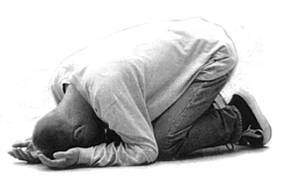
Prostrate before GodYou can’t fake deep. You can’t look in the eyes of a shallow man and find wisdom, only in the eyes of the deep. And there are fewer men with that piercing, penetrating depth today, so good luck finding them.

Instead, you be that man. Go deep.

God holds out His hands to any man who will pull himself away from myriad distractions that hinder to instead find respite in the Him and go deep. You can’t buy depth. It comes only from intimate time spent with God away from the rest of the world. It means turning back to God every moment of every day. Again and again. It means having zero confidence in oneself, none, but taking it all back to God and operating out of His Spirit’s empowering alone. No substitute exists.

Men today want to be inoffensive, liked, entertained, in control, and successful by the world’s standards. Theirs is a wide, well-trod path.

The man who goes deep into God will be misunderstood, chastised, and even hated. Often by people who should instead be supporting his desire for God and the deep places God alone can take him. We used to have men like that. Used to.

Such men are our only hope.

Because the clock has wound down. It’s fourth and 25. Without a man open way downfield, there will be little chance for victory.

“Men, go deep.”

3 Major Ways a Church Misses the Mark with Insufficient Theology

Standard

The Bible, old school style...Cerulean Sanctum deals largely with how the American Church lives out what it believes. Where I only occasionally stray is into the theology that undergirds that belief.

In crisscrossing the Christian blogosphere, visiting local churches, and viewing Christians posting in social media, I’ve witnessed repeated thought patterns based on “insufficient” theology. Too many statements made by supposed believers lack something essential to well-rounded Christian belief.

While the whole of Christian theology and apologetics encompasses a staggering breadth of topics and issues, I want to stick to three areas of deficiency that continually cripple solid understanding of what it means to be a Christian in the 21st century.

That said, an obvious one must be discussed, too, as well as one that is a “major minor.” But I’ll get to those two later.

First, a declaration. To do this subject justice requires a ton of footnotes and a plethora of Bible quoting. If I put all that in this post, it would end up in the TL;DR pile. So, we’re all adults here: I will leave the study to you. Please do look up these issues in your Bible and confirm them for yourself. I will be writing from the 30,000-foot view. I want to put these ideas out there. You can follow up as you see fit.

The Obvious

The Trinity.

Now you know why I’m keeping this high level. A study of The Trinity could fill 20 posts and still not touch on everything.

By Trinity, I mean God the Father, God the Son (Jesus), and God the Holy Spirit. Three unique, co-existing persons enveloped in one Godhood.

I say with no hesitation that if a church gets The Trinity wrong, everything else is wrong. Stop right there. Do not pass GO. Do not collect $200.

While the word cult raises hackles in a politically correct age, you can separate a genuine, orthodox Christian church from a pseudo-Christian cult 99.999% of the time by how it portrays the unity of the Father, Son, and Holy Spirit. That criterium alone. Seriously.

What does your church believe about The Trinity? How does that square with small-“o” orthodox Christian belief? Find out. Really.

The Three Majors

How a church thinks and how that thinking informs its practice is not something most people ponder. They show up on Sunday, sing a few hymns, listen to someone talk about God, share an awkward handshake or two with some folks they don’t know as well as they should, and they go home.

You don’t want to be that person. You want something more.

I think that more you want hinges on how your church deals with the following three issues:

  1. Sin
  2. The Journey of Christ
  3. The Kingdom of God

These three rise to the top because most people, even Christian leaders, don’t think much about them once they’ve convinced themselves of the basics, especially how teaching and understanding them manifests itself in practice.

Sin

We need to look at sin as two component parts:

  1. Estrangement from God
  2. Bad behaviors we do (because of estrangement from God)

Many Christians spend their entire lives managing bad behavior because that’s what their churches teach. The Christian life becomes an endless wrestling against those couple rotten behaviors we can’t seem to overcome.

That’s picking nits, though, and it’s doomed to failure. Constantly monitoring oneself for sin slipping in here or there leads only to despair. And that’s where many Christians are regarding their sin.

In reality, the core problem isn’t sinful behaviors but estrangement from God. The first thing God said to Adam and Eve after the Fall was not “What have you done?” but “Where are you?”

Whenever we talk about sin, the word repentance follows close behind.

Want an interesting exercise? If you have a King James Bible, do a word search in the Old Testament for the word repent.

Not many uses, are there? And usually only related to God changing His mind about something.

Yet the history of God and His People in the Old Testament was a history of God doing what? Asking those people to repent. But if God didn’t use that word, how did He ask? By holding open His arms and longing for His beloved people to walk away from their idols and return to Him. To come Home.

What does biblical repentance that ends estrangement from God look like? Read Jesus’ parable of the Prodigal Son (see Luke 15).

God wants a relationship with us. He wants us to turn from whatever it is that distracts us and come back home to Him. At its core, that’s what repentance truly is.

A funny side effect occurs when that happens. You find it in this classic hymn:

Turn your eyes upon Jesus,
Look full in His wonderful face,
And the things of earth will grow strangely dim,
In the light of His glory and grace.

When it comes to the second half of that sin theology, first dealing with our estrangement from God tends also to diminish greatly our sinful behaviors. The closer we draw to Him after we’ve come home, the less those sins bedevil us. Drawing close to God matters most.

The Bible says this:

And this is eternal life, that they know you the only true God, and Jesus Christ whom you have sent.
—John 17:3 ESV

The problem many churches have with their theology of sin is a focus on managing sinful behaviors rather than a focus on coming home to God and deepening intimacy with Him. Knowing God deep in our very core makes all the difference. THAT is eternal life. If a church does not spend the majority of its time helping us deepen our intimacy with God, then we may forever struggle to manage sinful behaviors.

The Journey of Christ

Ministry –> The Cross –> The Resurrection –> The Ascension/Pentecost

Please note the four component parts of The Journey of Christ. Now realize it is highly likely that a church will not fully teach and minister from an understanding and practice of all four parts equally.

That’s a huge theological deficiency.

The worst part: Most churches and denominations insist they teach and practice it all equally. They don’t, though. Most cherry-pick a place or two in that journey and throw those select few all their time and effort. This diminishes how they frame the Christian life, teach it to others, and practice it.

For instance, it’s easy to see many charismatic churches skip right to the end and spend most of their time living their faith out of The Ascension/Pentecost. Sure, there’s a little talk of the other three parts, but they remain forever secondary. That diminishment skews the way charismatics look at everything. A lack of teaching on The Cross as a means to end the willfulness of the Christian almost never gets discussed. It’s one reason why so little humility exists in some sectors of the charismatic movement.

Many mainline churches jump right to The Resurrection. They talk a lot about new life and clearly perk up around Easter time, but they don’t do as well dealing with the old life and its troubles or with the charismata. The Cross and The Ascension/Pentecost get short shrift.

Likewise, stopping at The Cross with one foot into The Resurrection explains why some of the loudest Reformed voices on the Web get hung-up on sin, talk less about what a new life looks like in full, and rarely venture into The Ascension/Pentecost and what that means for the Church. As a result, you hear a whole lot of sinner and not much saint. Oddly, as much as Reformed and Holiness churches clash in the rest of their theology, they both share this affinity.

It is highly probable that your church and mine do not deal equally with the four parts of The Journey of Christ. Again, leaders will protest this like crazy, but it’s true. Something in that journey is being overemphasized and something under-. It’s a very human failing.

To be a balanced Christian in our theology, we must identify the dearth in our church in regard to The Journey of Christ and supplement from other sources that highlight the underserved part(s) of the path. Those sources will likely fall outside the ghetto of our church or denomination. Because, hey, blinders. Don’t be afraid to step outside your familiar church neighborhood. You will be a more well-rounded Christian if you do.

The Kingdom of God

The Kingdom of God consists of both The Kingdom Now and The Kingdom Not Yet. Jesus brought The Kingdom of God with Him in His incarnation and it persists in the Church (Now) until He comes again and restores everything (Not Yet). Almost every church will insist it believes The Kingdom of God is both Now and Not Yet, but too many of them don’t act as if they do. The Church in America struggles with its teaching and practice of The Kingdom more than almost any issue.

When a church is heavy in Kingdom Now, we see a strong emphasis on ministry to others and on the power to do so. Nothing wrong with believing that The Kingdom manifests in power through the living, dynamic Church. Charismatic churches tend to dwell in Kingdom Now theology.

However, that’s not all The Kingdom is. And this explains why so many charismatics become disillusioned when they assume Kingdom Now, but God is directing them toward Not Yet. We simply will not see every tear dried until Christ returns. We have the Lord’s Supper now, but the Marriage Supper of the Lamb will far, far outstrip it in glory. Kingdom Now folks need to bear this in mind and recall that our ultimate destination is not here and now.

When a church is heavy in Kingdom Not Yet, everything feels delayed until we die and go to heaven. This thinking reminds us of the temporality of this life and the eternity of the life to come, where we will see the fulfillment of everything we hoped for here and now. That’s a good thing.

However, too much Kingdom Not Yet can ignore the present. The Cult of Suffering I see in some Reformed and mainline churches today is a result of thinking only Kingdom Not Yet. That leads to a church that is powerless in the face of current problems, always preaching muddling through rather than any kind of triumph over the vicissitudes of life. Everything positive feels delayed until we see the Pearly Gates. Obviously, that’s a deficient way of looking at The Kingdom and what Christ empowered the Church to be and do this side of heaven.

The Kingdom is both Now and Not Yet. We must live and believe both parts fully to have a fully realized faith.

The Major Minor

How Christians view The Atonement of Christ, while a major aspect of our theology, runs under our radar and is therefore often assumed rather than understood. Pastors know which type of atonement theory they teach and preach, but most people in the seats can’t distinguish Penal Substitution from Christ Victor, much less define them.

By The Atonement, we mean what Jesus accomplished for us by His death on the cross. Many theories exist for what happened in Christ’s sacrificial act. Theologians will defend their particular favorite theory almost to the death and to the point of calling anyone who doesn’t share their singular belief a heretic.

I find that ludicrous. I look at the many Atonement theories and each has something interesting to say about the breadth of Christ’s finished work that I can see the Bible validating. Excluding all other theories to the acceptance of one alone is unwise, in my opinion. While YMMV, I believe we should familiarize ourselves with the many theories and use them as a means to widen our understanding of the enormity of Christ’s Atonement. This can only lead to a greater appreciation for all Jesus did for us.

Like the three Majors listed above, what we think about The Atonement will flavor what we believe about the Christian faith and how we manifest it…

…BUT…

…so will many other aspects of Christian theology. Our eschatology, how we view the End, factors into how we live now. As does our soteriology, what we believe about how Jesus saves. And many other -ologies within our theology. All have importance. All will lead us to the expression of the Faith we believe and show to the world.

Still, each of us must ask how our churches and denominations bend our beliefs and practices in one direction or another. Because the direction we do not go is likely valid, too, and when we skip it, we may just find ourselves believing and living a less-than-optimal Christian life.