
View from a Glass House

Standard

So, how about that recent celebrity performance in the news?

Or that latest ghastly thing our government leaders did/said?

Or that unbelievable event that caused that stir among Christians that we’re all up in arms about?

Or that thing that happened there?

You know, that thing.

Notice how generic those questions are? They’re that way because not a day goes by when there isn’t some uproar from Christians about something that happened that made the news and is causing us to shake our heads and lament the age we live in.

While I may lack the ability to breathe the rarefied air at the altitude occupied by pundit Victor Davis Hanson, he nails the intellectual response to that recent celebrity performance in the news in his “An American Satyricon” post at the National Review. As always, please read the whole thing (though I offer no additional commentary on it).

I have only one general statement:

But evil people and impostors will flourish. They will deceive others and will themselves be deceived.
—2 Timothy 3:13 NLT

In other words, no matter what the latest buzz is, ho hum. Just another day in Babylon.

To all the Christians riled by the latest completely expected behavior from lost people, I ask this:

What are you doing concerning your own glass house?

If I have a beef with the contemporary Christian Church in America, it’s that we seem to be startlingly reflective about what other people are doing but almost never so about our own behavior. Broken glass cuts everyoneWe can wonder what kind of lousy father or mother some debauched former teen superstar might have had that led that fading star to commit whatever sins he/she committed, but then we scream at our kids on the way home from church and generally let ourselves off the hook for our own miserable taint.

I wish there were some way to get Christians in America and their self-appointed spiritual leaders to start looking in the mirror and asking what can be done about the person staring back. You know, that person who never goofs, never blows an interpretation of world events, never makes a hypocritical comment, and never does anything that requires amending, fixing, or apologies.

With an indignation right of hell, we do a smash-up job of judging the other guy, and I wish we would stop.

Lost people act like lost people. We should not be surprised.

When we SHOULD be surprised is when saved people act like lost people. And even then, the surprise shouldn’t be that great. All have sinned and fall short of the glory of God.

Our biggest problem is that we don’t respond appropriately to what causes our indignation.

Rather than join the masses by spouting off, do something almost no one ever does: pray instead. Rather than posting on Facebook about what some celebrity, government leader, or 15-minutes-of-fame-grabber did, pray. Pray for that person and for the situation. Pray that the holy and perfect light of Christ would dawn in that broken life and dismal circumstance. Do this every time instead of adding to the shrill discourse. Just pray and move on.

And after we’ve prayed, let us consider our own state as a creature of dust that is here one day and blown away by the breeze the next.

There’s a reason the eldest in the crowd dropped their stones and walked away first when confronted with words from Jesus regarding a terrified, guilty-as-sin adulterer. And yet that reason doesn’t seem to grab us anymore. We all think too highly of ourselves and our accumulated “wisdom.”

I wish there were more personal reflection in the American Church today. I wish we all could acknowledge our own glass house. I wish we all spent more time dealing with our own failings rather than concerning ourselves with another’s. I wish we would stop thinking that people who don’t know Jesus should act as if they do, especially when those who do know Him act as if they don’t.

But then, perhaps I should stop wishing and start praying.
Reading Between the Lines of Paul’s Letters

Standard

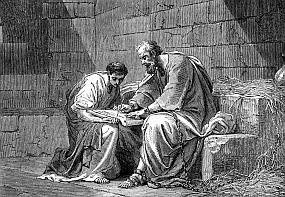
'Paul, The Apostle' by Gustave DoréMy son and I have been reading out loud through the New Testament this summer. We’ve tried to read as much as we can of one book in one sitting so that the harmony of the books is maintained. I’m convinced that we too often approach the Bible with a piecemeal mentality that ends up losing the bigger picture. This is especially true of the epistles, which should never be read any way other than in one piece. Reading them this way spotlights the confusion that our over-reliance on chapter and verse markings has created.

While I’ve read through the Bible many times in my life, I’ve never tried to read it both out loud and in the biggest chunks I can manage. That another person is listening as I read makes an additional subtle difference that forces me to be clear in how I pause and phrase the written word. Truly, it makes a difference. Try it.

This time through the New Testament, I’ve focused on most everything BUT the theology. Too often when we read the epistles, we tend to gloss over the credential establishments, the callouts to this person and that, and the real humanity depicted by the writers as they communicate to their readers.

For this post, I want to share a few thoughts from reading through Paul as if I were a long-ago church leader reading to an assembly of new believers who were going against the flow of the age.

A baker’s dozen thoughts on the Pauline epistles:

  1. We tend to see Paul as a dry, driven, exacting, Type A personality, but his emotional life is more rich on these pages than we give him credit for. This shows us that Christians need to be in touch with their emotional lives and bring emotion to our assemblies. Ours is not an arid, intellectual faith, though a quick perusal of Christian blogs and websites often communicates it as such. There is much to grieve—and also much to be joyful over. You can sense Paul’s melancholy and father-heart when he talks about his love for these young churches. His imprisonment weighs on him, and you can feel the sadness in the distance it creates. His writings show how important a solid network of Christian confidants and supporters is to our emotional well-being.
  2. Paul faced enormous opposition, often from people who seemed to be genuine Christians but were slightly off. (Sounds like today, right?) That so much of Paul’s writings consists of establishing his credentials is both illuminating and sad. This Christian life is more fragile than we imagine, and it is easy to go off the rails from simple carelessness regarding truth.
  3. To a modern age we think of as truly connected, Paul’s writings hammer the importance of Christian community, the need for loving, caring community that functions with peace, order, and utter dependence on God for direction. (Are our churches living that way?)
  4. Church hopping isn’t a 21st century phenomenon. Witness the number of companions to Paul who fade in and out of his life, many starting off well but finishing badly.
  5. As much as we look at Paul’s letters as theological treatises, the majority of their text, both opening and closing, is dedicated to connecting with specific people and establishing what Paul is all about.
  6. Personal holiness, perseverance, and a sober understanding of the age are themes in nearly every one of Paul’s books. So is the reality that Christianity is not another religion. The Christian faith cannot be equated with other streams of religious thought because it is not a dry—and ultimately empty—system like those others. Instead, Christianity is a dynamic relationship with Jesus Christ, based in complete reconciliation, and awash in grace for living each day.
  7. The Christian is to be the most average of people but one who lives an extraordinary, eternal life. Humility, gratefulness, and discipline are hallmarks of that life.
  8. Sins of a sexual nature and those that afflict male-female relationships are extraordinarily prevalent and a major stumbling block for many, but Christ can forgive, redeem, and restore.
  9. Paul’s letters repeatedly note that many people will wash out of the faith, and while we can have confidence in God’s preservation, the number of people who get sidetracked and seduced by the world’s offerings is larger and more common than we understand.
  10. The Christian life is NOT a set of rules and can never be. People who teach a set of rules are false teachers.
  11. Grace in our present age is largely misunderstand and rarely dispensed to the extent that Paul writes that it should be.
  12. Most of what Paul writes about isn’t rarefied, theological ponderings but practical Christian living. He points out how faith translates into real life and how practical our beliefs must be.
  13. A believer not living by the Holy Spirit is not living. The Christian life is less scripted than the religious life of the day, which is what makes it so exciting.

Those are a few thoughts on the writings of Paul from an overarching perspective. I hope they resonated with you. Have a blessed day and week.

The Cardiovocal Atheist

Standard

Vocal atheist returns less than 11,000 results, says Google, but I ran across it at least three times in items I read last week. In contrast, vocal Christian returns 127,000 Google results.

Funny thing is, atheism doesn’t start with what is voiced with the mouth. I guess Google, fount of all theological wisdom it might be, got this right.

Psalm 14:1 begins like a punch to the solar plexus:

The fool says in his heart, There is no God.

I did a bad thing there in that quote. I left out the ESV’s quotation marks around what the fool said. Instead, I went more for the formatting style of an internal thought. You see inner monologue formatted that way in novels. Sometimes, it’s even written like this:

The fool says in his heart, There is no God.

That second style seems even more ominous than the first. Almost like a shout. Or the whispered thoughts of the heroine in the horror flick who is walking the “empty” house, and we hear her inner trepidations–and all the while we know the deranged killer is right behind her.Inner wasteland

Regardless, what is said in Psalm 14:1 is internal only. It reverberates inside the heart. Call it cardiovocal. A resonate dissonance that ends up shattering the whole man, like some cheap crystal facing Ella Fitzgerald on Memorex.

One gets the sense that it’s a ruminated internal saying, too, a cardiovocalization people repeat over and over as if looped, a repeating sample people dance to.

I think if you could hear the cardiovocalizations of the average person, you would hear There is no God loud and clear. A person doesn’t have to say it with his or her lips because it never stops echoing in the chambers of the heart.

Which is why I think that Alister McGrath, the noted theologian, is wrong in his The Twilight of Atheism. There is no God is the mantra of atheism, and it is being cardiovocalized by millions, if not billions. It is not a saying fading into twilight but a reality expressed nonstop in the world today. Even if we do not hear people saying it with their lips, we see it practiced ad nauseam. People living as if there were no God. Some mantra must be driving that reality.

While the silent cardiovocalizations of some people do come out in practice or in veiled writings, the nature of such inner monologue is to be hidden. You won’t get a judge who claims to be a moral person yet who makes immoral judgments admit that There is no God drives his decisions. Or the pastor who can’t stop checking out the ladies. Or the soccer mom who lives solely to buy more stuff.

Funny, though I’ve learned a lot in 50 years, one of the most important lessons goes back to my childhood and a children’s story. In that story, it says, What is essential is invisible to the eye.

Might I substitute ear for eye, in this case? Because that interior cry of atheism is rampant. It is essential to understand its prevalence, what it means, and what its ramifications are.

Christians are not immune to cardiovocalized atheism, which should sober us. Every day, I read material written by supposedly devout Christians who deny the gifts of the Spirit, mock the supernatural, make peace with the things Christ gave His very life to destroy, and craft endless mitigations of truth, which masquerade as “enlightened” spiritual treatises and “doctrinally pure” systematic theologies. In short, there is no difference between such people and atheists. The cardiovocalizations are the same. There is no God is at the core.

Sounds like a conflict, right? How can believers in Jesus have a heart that says There is no God?

Simple. They decide that they don’t like what the real God is saying and substitute a god of their own creation. If that’s not a denial of God, then what is? There might be a god, but there is no God.

No person is immune. What is your heart silently saying?

If Christians don’t understand this broken message of the heart, then we will not understand why people appear OK on the outside, yet the world keeps moving forward in the wrong direction. We will not understand motivations that seem to clash with spoken intentions. We will assume everything is fine with the people we encounter, yet inside they are screaming something that should appall us.