
Christianity, Evil, Control, and the End of Storytelling

Standard

I’ve become a fan of The Phil Vischer Podcast/Videocast. The show talks popular culture and Christianity, and it’s almost always thoughtful, despite verging into moments of silliness. (This is the guy who started VeggieTales, remember.)

The following episode has so many interesting talking points on Evangelicalism, evil, tolerance, witchcraft, control, the world becoming post-Christian, and the end of storytelling, I didn’t even know where to start to unpack it. Once you get past the Pope sneaking out of the Vatican to give alms to the poor (ends around 7:17), the conversation shifts to the depiction of supernaturalism in films and what constitutes good and evil in a post-Christian world.

At around 22:38, Phil, Drew Dyke, and Skye Jethani begin discussing what happens when diversity attacks shared values and how this destroys the ability to tell a story. Phil quotes screenwriting guru Robert McKee noting that when a society has no shared common values you can’t tell a story because no one will agree with the framing mechanisms of rightness and wrongness needed to make a statement about a value depicted through story. Earlier, the trio decided that this has left us with only one agreed-upon value: Don’t oppress (or be mean to) other people. And in the end, this is all that is left of evil.

It’s a powerful discussion with startling ramifications for Christianity, both as Christians seek to share The Story of All Stories and as we confront genuine Evil as the Bible defines it.

The discussion then verges into talking about external evil and how stories are loath to discuss a greater evil that cannot be explained as just bad thoughts we might have for people who are different from us. We also see into how this comes down to control and why religious ideas with controlling godlike powers or controlling God Himself are anathema to the Christian worldview. And then Jethani mentions how some Christians are essentially practicing witchcraft.

If you want something to ponder this weekend, this provides a monster-sized load of fodder. Consider how certain groups in the U.S. are marginalizing Christian voices using revised storytelling. Ask how it is that Evangelicals try to control God. How are systems evil, including those systems we cherish as Americans first and Christians a distant second? And isn’t Atheism nothing more than a grab at control?

A lot of issues we American Christians don’t want to touch get talked about on this podcast/videocast, and not just this episode. Check it out.

(And for the Cincinnatians in the reading audience, yes, that’s a Skyline Chili mug in front of Skye Jethani, who is a graduate of Miami University in Oxford. The videocast is shot in the Wheaton, Illinois, area, home to my alma mater.)

Church of the Missing Words

Standard

One of the truths that has struck me in recent years, and one not every Christian is willing to consider, is that nearly every tribe, tongue, and nation has some concept of sin. Those tribes, tongues, and nations may view sin in a way that does not conform to orthodox Christian theology, but the acknowledgment that you/me/us has somehow done something wrong to anger “the gods” remains.

Where the divide comes is how you/me/us deals with that sin, and this makes for the most obvious differences between Christians and everyone else. In nearly all religions, some element of works righteousness exists, and while none should in Christianity, I’d say the majority of the world’s Christians are still trying to earn their way out of their sin or the consequences of it.

But that huge topic is another post.

This morning, I read the Outreach Magazine newsletter and an article in it, “5 Things Jesus Says to the Gay Community.” I’d like to say that I resisted considering what that article would NOT say, but I am weak and came to it expecting not to see a few Things Jesus Says even if He did, in reality, say them.

I wish I could say the article surprised me. I wish I could say that.

If anyone questions our status in the Last Days before the return of Christ, it is enough to know that while ancient pagans who participated in all manner of perverse activity still maintained some concept of personal sin, we don’t seem to have any concept of this today. Sin seems to be relegated to the other guy OR to political parties OR to groups with bad public relations departments OR to jerks who can’t manage their carbon offsets properly.

Reading “5 Things Jesus Says to the Gay Community,” one does not get the sense that at any time Jesus wants to say “stop sinning” or “repent, or you will all likewise perish.” Those statements of His are in the Bible, though. While it’s true they are not aimed at any one sin, the fact is that they are aimed at everyone and they cover every sin is what should make them an obvious addition to anything Jesus says.

Gagged and silencedThe problem for the Church today is that some elements within it seek to silence those words that accompany those concepts that make people uncomfortable. Or those same folks dance around truth like it’s a primed hand grenade, hoping that some other poor schmuck will take the risk to stick the pin back in. This is happening because we have become purposefully dishonest about Mankind’s status before God. We find it impossible to say without caveats, “Actually, I am a bad human being,” and have that badness mirror what God says is bad rather than what Man says is bad (“You wore white after Labor Day? For shame!”) Even the ancients knew that something was grossly wrong within them, yet in declaring ourselves immune to such gross wrongness today, we see the language associated with that wrong decay and go missing. In the end, we find we can’t express truth in any way that makes life uncomfortable for anyone, and every Gospel appeal sounds like little else than salve for bruised egos.

When the Church can’t bring itself to state the obvious, then it has lost whatever force God has endowed it with. And Jesus had something to say about that:

“You are the salt of the earth, but if salt has lost its taste, how shall its saltiness be restored? It is no longer good for anything except to be thrown out and trampled under people’s feet.”
—Matthew 5:13 ESV

Telling the Time

Standard

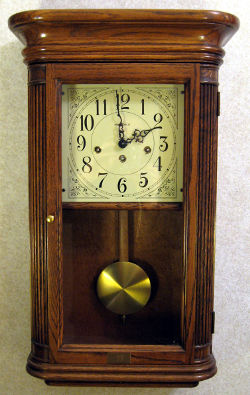
Grandmother clockWhen I came downstairs to eat breakfast before going to church, I saw that the wall clock had stopped.

It’s a “grandmother” clock my father received as a gift for 20 years of service with the company he worked for. He wouldn’t make it to 30. That company downsized him nine months before he was to receive his full retirement package. Nine months.

Still, it’s a nice clock, and it was given under a different company ownership, when people still cared, before the relentless string of mergers and ownership swaps.

Because it’s a grandmother clock, it chimes every 15 minutes. And because it chimes every 15 minutes, it has three keyholes where you stick in a key and wind it. I wind it pretty religiously, but life is filled with distractions, especially this time of year, and I forgot that regular task.

The hands read 1:59. Sometime in the a.m., it had stopped right before it was due to chime.

Having had the clock all these years, I take the chiming for granted. I think any owner of such a clock does. After a while, you don’t notice the chiming as much. When it fails to chime, you don’t realize it. You have to note the lack of pendulum movement, and then you know.

Something about a stopped clock makes me a little sad. That clock is wondrously alive so long as all its springs remain tightly wound, and the slow tick-tock fills the foyer. It’s a comforting sound, one that recalls a different, slower time. A time of artisans working deftly on such things as grandmother clocks, of great-grandfathers smoking a pipe while reading the newspaper, of sepia-toned memories and a sense that what is to come is a marvelous thing where people are somehow better than they are now.

I wonder what Christian people in the age of grandmother—and grandfather—clocks thought the present age might be like. What can a clock tell us?

My clock stopped a minute before it was due to chime twice. Slack springs couldn’t do the job of alerting us to the hour. People in the household forgot their duty, so the clock tick-tocked until it ran out of stored energy. It had been running on its last winding for too long and had no power left. Without that power, no alert sounded. It took a long time for anyone to notice the clock had stopped.

The silence of a stopped clock doesn’t register immediately. One must know to listen for it. If no one listens, and no one considers what was once present is no longer, the clock persists in its mute deadness.

A stopped clock is still right twice a day—so goes the old joke. Still, a stopped clock is far more wrong than right. It becomes less than helpful, because if you don’t see or hear it actively working, it gives mistaken information that can lead astray. What was once critical to one’s proper functioning is now detrimental. A stopped clock becomes an excuse for lateness and for failing to attend to important matters.

A long time ago, a stopped clock was a major problem. How can it be reset unless another, working timepiece is present in the household? If the stopped clock was the sole teller of time locally, one had to go elsewhere to discover the correct time. In some communities, the church belltower might have a clock. Or the village square. Today, centralized timepieces are mostly lost to the past. Oddly, time signals fly continuously through the air now—but beyond perception without special gadgets to snag them. The proper time is always with us, but we can’t sense it without help. Those special clocks that intercept hidden signals require something more than just the simple human intervention of a winding. The average person might understand how a wound clock works, but the new kind are inscrutable to all but the most technically adept.

Some would argue that the new technology behind clocks renders the old act of winding a clock moot. Everything has a clock in it nowadays. Funny, though, that so few can truly tell us the time.