
How Christians Can Demolish Atheism with a Word

Standard

I’ve been listening to Unbelievable, a British podcast that pits Christians and atheists against each other on popular topics. Often, the battle is purely head-to-head, with no other topic than why atheism or why Christianity is true or not.

Here in the States, we had a slow news cycle leading up to the Olympics, so the Ken Ham and Bill Nye debate took on a life of its own, with even the secular press touting the “event.”

Urg.

I say this because all this logic and carefully worded argumentation misses the point. While I can see atheists not understanding how the point is lost, that Christians can’t see beyond is most troubling and says much about the state of the Church in the West.

What Christians forget is what places the Christian Church above all other religious groups and systems, including atheism. Christians believe God put His Spirit into each believer, which both empowers and grants the ability to experience true relationship with God through Jesus.

No Spirit, no Church. End of story.

And yet Christians almost never go to the Spirit when confronting atheism.
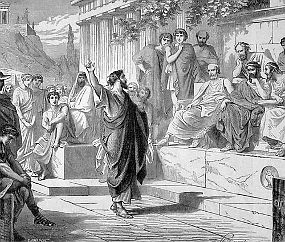
Paul preaching at the Areopagus (Mars Hill)All the reasoned logic in the world is unlikely to sway modern skeptics. We can appeal to Paul’s example at the Areopagus, but what was new to the ears of the Stoics and Epicureans in Paul’s day has had nearly 2,000 years to accumulate rebuttals. Reason alone cannot be our primary weapon.

While the Bible is God’s special revelation to mankind and contains what we need to know to have faith and to live the Christian life, many do not acknowledge it as such. To any who saw the Ham and Nye debate, Ham’s repeated returns to Scripture fell on Nye’s deaf ears. This is NOT to say the Bible as God’s Word is inadequate in some way, only that many have inoculated themselves against it when it is used alone.

But there is a word that can stop an atheist argument in its tracks. Why Christians today don’t use it is one of the great losses of our generation.

That word? The word of knowledge.

Yes, the charismatic gift.

A Christian and an atheist arguing presuppositions about the origin of matter can dispense with all the bilateral systematic dismantling if the Christian would simply say, “Your mother told you when you were 13 that she wished she had never conceived you , and you struggle daily to recover from rejection, don’t you?” Or how about “God revealed to me that you’ve been cheating on your spouse for the last two years”?

Any Christian out there wonder if that would change the direction of the debate?

If we’re talking whether God exists or not, connecting with the supernatural is the natural course of argument. A spoken word of knowledge immediately dismantles all opposition. Immediately. People who claim God does not exist must now explain that word of knowledge. Let them try. They won’t succeed. NOW who is on the defensive?

See, God intended us to be more than a Word Church. He intended us to be a Word + Power Church.

In the sidebar of this blog is an ad for Gospel for Asia. When you read the testimonies of the missionaries involved in that organization, nearly all came from non-Christian homes, and nearly all had some power encounter because of a missionary coming into their homes and bringing a miracle of some kind. Supernatural healing, deliverance, words of knowledge, words of wisdom, whatever—the Word was accompanied by a Spirit-filled believer operating in supernatural Power. The result was faith.

You see, the arguments against the Lord went dead in the face of God working through His people in power.

Is it any wonder why atheism has revived in the age of a Western Church that more likely than not DENIES the operation of the charismata? And is it any wonder that the Church is moving forward in leaps and bounds in those places where Christians place no such restrictions on the Spirit moving through charismatic gifts?

American Church, are you listening?

Get the gifts moving again and see the arguments against God crumble. Because they will.

And one more thing…

We always like to say that Christianity is not a religion but a relationship. Why then do we Christians never press the relationship reality when we debate atheists? Why is it always a battle of logic? If knowing Christ is eternal life and relationship with Him is the cornerstone of our Faith, why do Christians never bring up this living relationship with Christ when talking with atheists? Ravi Zacharias is about the only apologist I ever hear who gets to the heart of relationship with Christ when discussing the uniqueness of Christianity and its superiority. More of us need to talk about our vital relationship with Christ with our atheist friends.

For too long the discussion has been from our heads. It’s time to take it back to relationship with Christ and to Word + Power. Because that’s what makes Christianity the only true answer.

The End of the Cult of Suffering?

Standard

One of the strangest phenomena I’ve witnessed in contemporary Christianity has been the rise of what I call the Cult of Suffering. Young Christians (under 40), usually with allegiances to the Young, Restless, and Reformed movement, glamorize suffering without relief as some sort of spiritual badge of honor, something they want to hold in high regard as a means to be more godly.

I first noticed this “cult” more than a decade years ago. What struck me as most bizarre is that most self-proclaimed members had never truly suffered even once in their lives, yet they wrote online missives proclaiming the joys of suffering.

Here’s the thing: Suffering isn’t wonderful. In fact, suffering because of the human condition sucks. The depths to which such suffering can go are nearly limitless in some cases. No one should wish that on themselves.

Fast forward a few years. Now many of those most entrenched in the Cult of Suffering are experiencing something new.

What? Genuine suffering. Some from becoming pastors and getting involved in the messier side of ministry. Some from having true suffering finally hit closer to home.

There’s something about getting older that changes the tint of rose-colored glasses. Those pro-suffering folks have now added a few years. They’ve buried parents who died after excruciating battles with cancer or some other pain-filled, debilitating disease. They’ve seen young children cut down. They’ve had to counsel people with serious mental illness. They’ve had to plunge into the septic tank of life. Suffering no longer affects someone else. It has come home to roost.

The result? Many of those in the Cult of Suffering have backed off their previous adoration of human suffering.

I think part of the problem is that too many of those folks conflated suffering for Christ with general human suffering due to sin.

I don’t see those sufferings as the same.

Jesus routinely praised people who came to Him because they were not content to suffer. Jesus regularly called those people faithful because they sought Him out as a way out of their suffering.

The hemorrhaging women who spent 12 years looking for a cure.

Bind Bartimaeus, who would not stop shouting for Jesus to heal him even when others told him to shut up.

The Samaritan woman with the possessed daughter who would not take Jesus’ rebuff for an answer.

And on and on.

FAITHFUL because they were NOT content to suffer or see those they loved suffer.

The Bible says this about Jesus:

That evening they brought to him many who were oppressed by demons, and he cast out the spirits with a word and healed all who were sick. This was to fulfill what was spoken by the prophet Isaiah: “He took our illnesses and bore our diseases.”
—Matthew 8:16-17 ESV

What did Jesus say about His reason for coming?

And the scroll of the prophet Isaiah was given to him. He unrolled the scroll and found the place where it was written, “The Spirit of the Lord is upon me, because he has anointed me to proclaim good news to the poor. He has sent me to proclaim liberty to the captives and recovering of sight to the blind, to set at liberty those who are oppressed, to proclaim the year of the Lord’s favor.” And he rolled up the scroll and gave it back to the attendant and sat down. And the eyes of all in the synagogue were fixed on him. And he began to say to them, “Today this Scripture has been fulfilled in your hearing.”
—Luke 4:17-21 ESV

And John writes this about Jesus’ purpose:

The reason the Son of God appeared was to destroy the works of the devil.
—1 John 3:8b ESV

The Kingdom of God does not have a place for such suffering. Jesus came to deal with it.

So why does Jesus say his followers will suffer? Because they seek to be like Him.

Indeed, all who desire to live a godly life in Christ Jesus will be persecuted…
—2 Timothy 3:12 ESV

“Blessed are those who are persecuted for righteousness’ sake, for theirs is the kingdom of heaven. “Blessed are you when others revile you and persecute you and utter all kinds of evil against you falsely on my account. Rejoice and be glad, for your reward is great in heaven, for so they persecuted the prophets who were before you.
—Matthew 5:10-12 ESV

There’s the difference between types of suffering.

Jesus wasn’t of two minds on this issue because He understood the distinction between leprosy, barrenness, and demon possession and being persecuted for faith in Him.

The Cult of Suffering never made that distinction. Now they have come face to face with disease, misery, and death, and it doesn’t seem so wonderful. Sadly, some are even questioning their faith or the goodness of God because of their mistaken notions about suffering. I know, because I keep stumbling across their recent confessions online.

It didn’t have to come to that.

Suffering because of the human condition outright sucks. Jesus came to address it.

Never make peace with the kind of suffering the Enemy brings. Never. The Bible tells us how we should respond:

And he told them a parable to the effect that they ought always to pray and not lose heart. He said, “In a certain city there was a judge who neither feared God nor respected man. And there was a widow in that city who kept coming to him and saying, ‘Give me justice against my adversary.’ For a while he refused, but afterward he said to himself, ‘Though I neither fear God nor respect man, yet because this widow keeps bothering me, I will give her justice, so that she will not beat me down by her continual coming.'” And the Lord said, “Hear what the unrighteous judge says. And will not God give justice to his elect, who cry to him day and night? Will he delay long over them? I tell you, he will give justice to them speedily. Nevertheless, when the Son of Man comes, will he find faith on earth?”
—Luke 18:1-8 ESV

“Give me justice against my adversary” indeed.

I find it interesting that Jesus concludes that story by asking if He will find faith when He returns. What kind of faith is He referring to? The kind that never gives up and is never content to suffer from the human condition. The kind of faith displayed by the hemorrhaging woman who would not be content with sickness, even after 12 years with no relief. The kind of faith displayed by a Samaritan woman who would not take no for an answer, even when it was from the lips of her Maker. And the kind of faith displayed by a man who did not want to continue to suffer from blindness, so he would not let anyone quiet him when he saw his opportunity to be free from suffering. The kind that relentlessly demands vindication against an enemy who sows suffering—the Enemy.

THAT kind of faithful.

“But Dan, what about Paul’s thorn in the flesh?”

This is the the typical response from people who simply don’t want to deal with a Biblical response to suffering, who somehow want to make peace with misery.

Never give upIf God comes to you and explicitly says that your suffering has a purpose to keep your pride from possibly disqualifying you from His glory, then yes, be content. Otherwise, don’t be. And I can tell you right now that God is not using suffering in most people to keep them from being disqualified from His glory, or else He would have said the same thing to that hemorrhaging woman, that blind man, and that Samaritan woman, and all those other great men and women of the faith who were called faithful because they weren’t content to suffer.

In other words, never stop seeking God for relief from suffering unless you get a clear revelation from Him that explicitly states otherwise.

Never give up seeking God for relief from suffering. Never!

And to those former members of the Cult of Suffering who are questioning everything now that genuine suffering is theirs, I say the same.

God’s Forever Family: The Jesus People Movement in America

Standard

God's Forever Family @ Amazon.comI came of age in the late 1970s. Amy Grant’s song “1974” was for me closer to January 1977, but the sentiment was the same. My spiritual life up to that point reflected the influence of the Jesus People Movement (JPM) that began in the late 1960s and eventually faded away by 1979. The Lutheran Church I was raised in channeled some of the movement and had even begun to change its musical styles for youth before the JPM hit, incorporating folk-styled worship songs that emerged from Roman Catholic youth revivals that erupted post-Vatican II.

So when Christianity Today magazine named God’s Forever Family: The Jesus People Movement in America by Larry Eskridge its book of the year, I snapped it up and immediately started reading. A historical overview of the  Jesus People Movement, the book traces the movement’s rise among Haight-Ashbury hippies in San Francisco circa 1968, covers the establishment of countercultural Christianity across the country, looks at Christian communes, notes predatory pseudo-Christian cults that arose alongside the movement, discusses the genesis of Contemporary Christian Music, and concludes with how the JPM changed the American Church.

For Christians who came of age in the late 1960s and 1970s, I’d call it a must read. You might even see people you know discussed in the book. (I know I was surprised to see a pastor of a church I formerly attended named in the acknowledgments as a contributor of material and background info.) The story Eskridge lays out for readers has a bittersweet taste for those of us who recall those innocent days and wish the best parts of that JPM mentality had not gone missing from the modern American Church.

For those too young to remember the 1970s, God’s Forever Family serves as a history to explain why the Church today looks and acts like it does, for good and for ill. I even learned a few things.  I did not know the Full Gospel Business Men’s Fellowship graciously bankrolled many of the most influential JPM ministries, or that Pat Robertson had a hand in establishing and legitimizing Christian rock music. The history depicted in God’s Forever Family will help make sense of contemporary evangelicalism and may de-vilify Christian leaders and their ministries that started with good intentions but somehow went off course or moved the entire Church in a direction that has not best served the Lord. In the pages of this book, we see how good intentions sometimes lead to less than ideal outcomes.

I won’t offer a review of the book other than to say I wish author Eskridge had delved deeper into more of the issues closest to my heart. But as an overview, it’s essential reading, covering a tumultuous era, the movement it spawned, and the impact it still has today. The JPM has been forgotten in recent years, so a contemporary revisit is most welcome.

The best Christian book published in 2013? Whether it is or not, you would do well to read it.