
Strange Fire in Florida?

Standard

And Nadab and Abihu, the sons of Aaron, took either of them his censer, and put fire therein, and put incense thereon, and offered strange fire before the LORD, which he commanded them not. And there went out fire from the LORD, and devoured them, and they died before the LORD. Then Moses said unto Aaron, This is it that the LORD spoke, saying, “I will be sanctified in them that come nigh me, and before all the people I will be glorified.” And Aaron held his peace.
—Leviticus 10:1-3 KJV
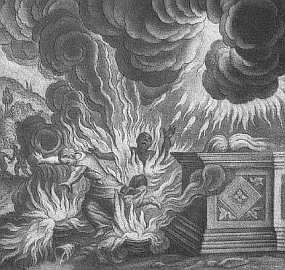
The sons of Aaron pay for their errorA couple weeks ago in church, I was talking with some small group friends when a woman approached us and regaled us with stories of a massive revival going on down in Florida. She said it was all over the TV (*cough*, TBN, *cough*). Said hundreds were getting healed. (Okay, good.) Said the gifts were operating powerfully. (Also good.) Said people were coming from all over the world to attend. (Not sure what to think about that, since fads can pull in people, too, but okay.) Said God was giving people gold teeth. (Yikes!)

A few bloggers/writers are discussing this “revival” (here, here, here, and here) and all the typically charismatic hoopla that attends it. The descriptions seem all too familiar.

Me? My hackles are up. I’ve been around enough real manifestations of the Holy Spirit to know that something is odd about this “revival.” I was never a big fan of the so-called Toronto Blessing, had a boatload of reservations about the Brownsville Revival, and now this.

Here’s my take on the revival in Lakeland:

1. All true revival is marked by one overarching, indisputable reality: People are driven to repentance. And not “Me too, me too!” repentance, but the kind that soaks the carpeting in tears of holy remorse for sin. Any revival that is not first and foremost preceded by and given over to repentance is not a Holy Spirit-ordained revival. The number one fruit coming out of any revival will always be fruits of repentance. And those fruits remain. They don’t vanish six months after roadies pack up the revival tent; they last a lifetime. Want to gauge who’s behind this revival? Watch for fruits of repentance. If everything but repentance is visible front and center stage, then it’s not a revival from God.

2. There’s no fool like a charismatic fool. And I say that as a charismatic. Too many charismatics drink from poisoned wells only to clutch their guts in pain later, asking what went wrong. What went wrong is that no one was bold enough to test the spirits to see if they were from God. Want a wise foundation for that kind of discernment? Start right here.

3. Whenever the emphasis gets off Jesus, a revival’s focus is off target. The Holy Spirit always pulls people to Jesus. He doesn’t pull them toward angels, canny preachers, or displays of spiritual gifts. He doesn’t need gold teeth, gold dust, and angel feathers to point people to Jesus. (Those are illusionist and occultist tricks.) He just needs himself because He is sufficient to do the pointing. Real revival isn’t about what you or I want, but what Jesus Christ wants.

4. When the sons of Aaron offered “strange fire” before the Lord, their offering was probably close to what it should have been. After all, they knew the formalities. The problem was that close doesn’t count except in horseshoes and hand grenades. God doesn’t put up with close. His worshipers worship Him in Spirit and in truth. And there’s no “almost” in truth. You want “almost” when it comes to truth? Consider Satan; he’s a master of the almost truth. If we’ve got experienced charismatics at a revival with folded arms and scrunched brows saying, “Well, you know…,” then it’s strange fire.

5. Real revival doesn’t just draw one kind of Christian. It draws everyone. It draws Episcopalians, Lutherans, Reformed, Presbyterian, Nazarene, Brethren, Mennonite, Methodist, Baptist—everyone. And not just Christians, either. Real revival pulls in hundreds of the unsaved and the cultists. Real revival spills out of the cup that first held it. It rains down on whomever is near because God doesn’t discriminate. He’s an equal opportunity anointer of those who wholeheartedly seek Him.

That’s what I have to say about this “revival” in Florida. You can take my comments for what they’re worth.
More on Charismatic Gifts

Standard

Several people have asked questions about my post on praying in tongues from earlier this week, so I thought I’d post a few more thoughts.

My reference texts:

Now there are varieties of gifts, but the same Spirit; and there are varieties of service, but the same Lord; and there are varieties of activities, but it is the same God who empowers them all in everyone. To each is given the manifestation of the Spirit for the common good. For to one is given through the Spirit the utterance of wisdom, and to another the utterance of knowledge according to the same Spirit, to another faith by the same Spirit, to another gifts of healing by the one Spirit, to another the working of miracles, to another prophecy, to another the ability to distinguish between spirits, to another various kinds of tongues, to another the interpretation of tongues. All these are empowered by one and the same Spirit, who apportions to each one individually as he wills.
—1 Corinthians 12:4-11

And God has appointed in the church first apostles, second prophets, third teachers, then miracles, then gifts of healing, helping, administrating, and various kinds of tongues. Are all apostles? Are all prophets? Are all teachers? Do all work miracles? Do all possess gifts of healing? Do all speak with tongues? Do all interpret? But earnestly desire the higher gifts. And I will show you a still more excellent way.
—1 Corinthians 12:28-31

In a nutshell, here’s what I believe about the charismatic gifts:

  • The gifts are still for today.
  • Some of the gifts are more rare than what we see expressed.
  • Not all people will have all gifts.
  • A person who lacks a particular gift is not a lesser Christian for that lack because he or she may possess other “compensatory” God-given talents and anointings.
  • We should always ask God for empowering through the gifts yet be satisfied should He elect not give us a particular gift on our timetable.
  • Sometimes there is a long delay between asking for and receiving a gift.
  • As the Lord sees fit, some gifts may only be given for a time or season.
  • Because the Lord gives to us according to our measure of faith, He will not give charismatic gifts to people who don’t believe that they are still in operation.
  • While a person may appear to have a gift, it may indeed be nothing more than a well-developed talent and lack the full nature of a genuine charismatic gift.
  • As with all spiritual abilities, as we grow in the Lord we better understand how to use the charismatic gifts He has given us.
  • The Lord may remove gifts from people who fail to properly use them.
  • Yes, sadly, some people fake gifts.
  • People who fake gifts should be exposed immediately and not tolerated.
  • Yes, the Enemy does mimic some gifts and empower deceived people with ungodly versions.
  • All gifts must be tested.
  • Churches that support the gifts must do a better job policing those who use them in public.
  • Church leaders are responsible for encouraging and discouraging the use of the gifts by their congregants.
  • We are a poorer Church if we fail to use the gifts.

A convenient way to break down the gifts is into three categories of three gifts each:

Gifts of Discernment:

Word of knowledge

Word of wisdom

Discerning of spirits

Gifts of Power:

Faith

Miracles

Healing

Gifts of Proclamation:

Prophecy

Tongues

Interpreting tongues

Like tongues of fire...I feel strongly that one of our greatest failings in our churches is that our spiritual leaders are not calling out the gifts in people. By that I mean that too many churches rely on people self-identifying their own spiritual gifts rather than the leadership of the church doing it. Of course, this necessitates that the leaders of a church actually KNOW their people well and spend time helping each individual cultivate the gifts (and talents) God has given them. (Kind of precludes being an anonymous face in a megachurch, doesn’t it?)

Instead, too many churches have let their leadership off the hook by resorting to congregant self-identification of gifts, often through spiritual gift inventories—a recipe for disaster, if you ask me. Gift inventory checklists are responsible for myriad people being placed in the wrong positions within a church or trying to use gifts they don’t truly have, thus leading themselves and others astray. My experience has been that too many people identify wants rather than gifts through this inventory methodology. If I want to be a prophet and fancy myself one, how will I fill out my gift inventory? Sort of self-fulfilling, isn’t it? And that makes for enormous problems.

Now, what is your take on the charismata?

Banking on God: The Tithe, Part 2

Standard

See Acts 4:34-35Today’s post is a tough word that may anger a few people. Asking people to give is always a tricky proposition. In the Church, it’s an even more sensitive issue because we have tied giving with our spirituality. Plenty of churches still exist where one’s piety is measured by how readily one ponies up the moolah.

And that brings us to the tithe.

My belief on giving money within the church is what I call “The Quick, Dead Priest” model. And nope, you won’t be hearing anyone else labeling what follows by that name. I believe, though, that this model best represents the true New Testament model of giving.

The first truth: Christians have been crucified with Christ and are now dead to the world.

The Bible is full of legal truths, the kind lawyers love. And one universal legal truth is that a dead man can’t own anything. Whatever once belonged to the deceased must be passed on to heirs. You can’t take it with you. End of story.

For you have died, and your life is hidden with Christ in God.
—Colossians 3:3

As Christians, we have been united to Christ in His death. The stamp of the death certificate on your life and mine is the cross. Being in Christ means being in no one or no thing else. You, therefore, are not your own. You have been bought with the price of Christ’s death.

Outcome? You own nothing, not even yourself.

Therefore, all this talk of “what is mine” is just that, talk. Christians have no legal precedent to claim they own anything. God may indeed bless you with property and possession, but under the legal system of the Kingdom of God, you are merely stewarding what belongs to someone else. And that someone is God.

The second truth: The death and resurrection of Jesus permanently ended the temple system instituted in the Old Covenant.

This understanding is critical. We no longer perform sacrifices because Christ, the perfect sacrifice, died, satisfying the demand of blood as a covering for sin. Because Christ satisfied all conditions of the Law in Himself, if we are in Him, then we no longer must strive to fulfill the Law. (Don’t believe me? Sit down and read the entire book of Galatians in one sitting. Then read it again for good measure! Follow that up with the entirety of Hebrews.)

One of the hallmarks of the old temple system was the Aaronic priesthood. The giving of tithes in the Old Testament went to support the work of the Aaronic priesthood. The temple economy, based on the tithe of one-tenth, existed to keep the temple system running, to care for the priests (who were allowed no other forms of income under the Law), and to ensure the purity of the people before God through the sacrifices.

But Christ eliminated the old temple system. The sacrifices are gone. The flawed Aaronic priesthood and all that pertained to it, including the mandatory one-tenth tithe used to support it, was put aside, surpassed by the perfect priesthood of Christ. To prove the case even more thoroughly, the Sovereign God oversaw the destruction of the temple itself in 70 AD.

The old has passed away. The new has come.

Under that new priesthood of Christ, you and I are the priests. For all you Protestants out there, the Reformation was built, in part, on the idea of the priesthood of all believers:

But you are a chosen race, a royal priesthood, a holy nation, a people for his own possession, that you may proclaim the excellencies of him who called you out of darkness into his marvelous light.
—1 Peter 2:9

But our priesthood is radically different. It’s a priesthood of equals. It’s a priesthood of community. It’s a priesthood that has God living inside each priest, not in a temple built by human hands. And that truth radically transforms how we must view giving.

The third truth: Each priest in the Kingdom of God in Christ is quickened by the Holy Spirit and that quickening informs giving.

The priests of the Old Covenant did not have the Holy Spirit’s indwelling, hence the need for a man-made temple. The priests of the New Covenant, however, do have God living inside them. We see how that plays out immediately after Pentecost:

And all who believed were together and had all things in common. And they were selling their possessions and belongings and distributing the proceeds to all, as any had need.
—Acts 2:44-45

That concept is expanded two chapters later:

Now the full number of those who believed were of one heart and soul, and no one said that any of the things that belonged to him was his own, but they had everything in common…. There was not a needy person among them, for as many as were owners of lands or houses sold them and brought the proceeds of what was sold and laid it at the apostles’ feet, and it was distributed to each as any had need.
—Acts 4:32, 34-35

Upon being filled with the promised Holy Spirit, the first thing the new priests of Christ did was to ensure that no one among them lacked for anything. They sold houses, properties, whatever, to ensure that the new priests were provided for. The difference in this priesthood, though, was that everyone was a priest, so all were entitled to the largess of the community, not just a certain tribe or class. All. And the payment? Everything, to the point that no one claimed personal entitlement.

Another truth emerges. The new priesthood did not build on the ashes of the old. It was and is a new thing that God has done. It relies not on Law, but on the indwelling Holy Spirit.

God created a new economy and with that economy comes a radically transformed idea of giving:

The one-tenth tithe has been abolished. Totally. It does not persist in any way in the new Kingdom economy.

As the Bible says:

In speaking of a new covenant, he makes the first one obsolete. And what is becoming obsolete and growing old is ready to vanish away.
—Hebrews 8:13

The new standard of giving has replaced the old. The old was for men and women who did not have God dwelling inside them. The old was for men and women who had not been crucified with Christ and therefore dead to the world. The new asks everything of us. It asks for our houses, our possessions, our jobs,our kids, our spouses…even our very lives. It’s all on the table and can be used for the purposes of the Lord any way He chooses, even if that means that we must be martyred so as to accomplish His goals for the Kingdom.

How will you know how much to bring and whether His call on you is to simply give $20 or go so far as to sacrifice your life?

The Bible tells us:

“When the Spirit of truth comes, he will guide you into all the truth….”
—John 16:13a

And

For all who are led by the Spirit of God are sons of God.
—Romans 8:14

The mark of our acceptance into the new economy of God, into His new Kingdom, is that we are led by the Spirit of God. The truth revealed by the Spirit will show us exactly what we should be doing with the money He’s given us to steward.

So how is it that far too many of us cling to patterns of given obsoleted by God’s new economy? Why do so many continue to endorse a ten percent tithe?

Because it’s easy.

It’s easy because it requires so little of us.

It’s easy because it asks nothing of going before God to inquire of Him by the Spirit to know what we should be giving in any and all situations

It’s easy because it doesn’t require us to live by “Give us this day our daily bread.”

It’s easy because it doesn’t ask us to give until it hurts, to take up our cross daily and follow Christ.

And that’s the problem in a nutshell. The old economy asked very little. The new economy in which dead men and women made alive in Christ are priests in a new Kingdom…that economy looks messy, fuzzy, and difficult compared with the old economy. However, the new is one thing the old is not: perfect.

If we want to see the Church be what She is intended to be by Her Bridegroom, then we MUST start living under the new economy of His Kingdom. Not the old economy, but the new.

Now if only more of our churches in America understood this.

***

Banking On God: Series Compendium