
Make Miracles Happen in 2014

Standard

While the liberal drift over at Red Letter Christians turned me off long ago, someone pointed me back there today, noting 14 New Year’s hopes for 2014 as posted by Shane Claiborne. The concluding hope garnered a huge head nod from me:

14)   BELIEVE IN MIRACLES… and live in a way that might necessitate one.  Oldie but a goodie –  friends living in pretty extreme poverty have taught me that part of the reason that those of us in industrialized countries don’t see many miracles is that we don’t “need” them.  When we get sick we go to the doctor, when we get hungry we go to the store… but when we live like the lilies and the sparrows in utter dependence on God we see God provide in miraculous ways. I want more of that… not more poverty, but more of that kind of faith.

I believe one of the great troubles with modern Christianity is that it lives in most people’s heads alone. Our discourse has been driven by thinky Christians rather than the kind that occasionally throws thinky to the wind. Sometimes, that toss is what we have to do with thinkiness.
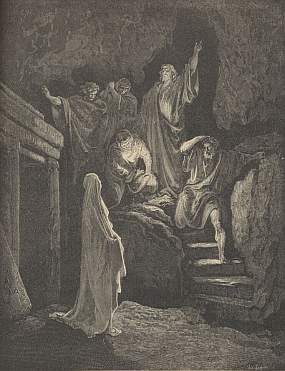
'Resurrection of Lazarus' by Gustave DoréWhy are Western Christians so fascinated by the miraculous? Because the Bible is filled to the brim with miracles and yet we experience so few genuine ones today in the West. I keep seeing that the most neglected aspect of our church life is the freedom to stand up before the congregation on Sunday and say, “This is how God made a miracle happen in answer to my prayers and yours.” (And conversely, “This is how I asked for a miracle and have not yet seen it come to pass,” a bold confession that scares the living daylights out of a lot of Christians—oddly enough, mostly church leaders—who find a lack of miracles disturbing to their faith.)

But really, God help us if living in hope for the miraculous is not a daily part of our faith walk! Claiborne is right here: We don’t live in expectation of miracles. Worse, we don’t subsequently have faith for the miraculous because we don’t live with an expectation for it.

All the apologists are talked out, when you get right down to it. Today, bold atheism seems to scare Christians. But you know what scares the hell out of atheists? Miracles. Because miracles are hard to explain away, and when someone tries to explain them away, that person just seems sad and pathetic. And let’s be honest here: Atheism IS sad and pathetic

So in 2014, say yes to believing for—and living for—more miracles. God wants you to.
TBN Founder Paul Crouch Dies

Standard

Over the weekend, the Christian broadcasting world lost one of its most powerful leaders when Paul Crouch of TBN died Nov. 30 at 79.

Anyone who has read Cerulean Sanctum knows I am not a fan of TBN, largely because it was indiscriminate in who it gave airtime to. For every Jack Hayford or Kirk Cameron featured on its programming, there was Benny Hinn or T.D. Jakes.

And then there was all the garish opulence and money, much of which was spent in ways I’m pretty sure Jesus would not have condoned.

From a TV broadcasting standpoint, though, few can argue with the success of what Paul Crouch built almost singlehandedly. Some might contend that one did not need to be a broadcasting genius to blow through millions of dollars generated through prosperity gospel teachings, but still. In it’s prime, TBN was a force to be reckoned with, and despite some fall-off from its glory days, it remains the largest religious TV network of any kind. At one point, I used to watch TBN because it was the only place one could see Christian music videos. As a popularizer of the Christian subculture through media, Crouch and TBN were both shrewd and peerless.

What will be the legacy of TBN and Paul Crouch? I find it hard to say. Certainly, TBN put Word of Faith and its teachers in a bigger spotlight. Even if Oral Roberts had been the real forerunner in that regard, Crouch perfected it. Those unfamiliar with Pentecostalism got an eyeful and earful of it through TBN, and I’m certain that some of TBN’s broadcasting had an influence on African nations and the religious trends toward Pentecostal Protestantism both there and in South America.

For me, Paul Crouch is a conflicting character, and I don’t know what else to say about him and the television ministry he built. There really is no real contender for that Christian broadcasting throne, and with Pat Robertson hitting 83,  the last formidable challenger for Crouch and TBN may also be exiting center stage shortly.

Charismatics, Cessationists, Strange Fire, Logic, and Bible Truth

Standard

Now there are varieties of gifts, but the same Spirit; and there are varieties of service, but the same Lord; and there are varieties of activities, but it is the same God who empowers them all in everyone. To each is given the manifestation of the Spirit for the common good. For to one is given through the Spirit the utterance of wisdom, and to another the utterance of knowledge according to the same Spirit, to another faith by the same Spirit, to another gifts of healing by the one Spirit, to another the working of miracles, to another prophecy, to another the ability to distinguish between spirits, to another various kinds of tongues, to another the interpretation of tongues. All these are empowered by one and the same Spirit, who apportions to each one individually as he wills.
—1 Corinthians 12:4-11 ESV

Last week was something of a new low in the “conversation” between those who believe the gifts of the Spirit (charismata) continue today (charismatics or continualists) and those who claim those gifts ceased as of the closing of the apostolic age (cessationists). It’s almost a fact that charismatics don’t start battles with cessationists. If only the opposite were true, especially on the Internet.

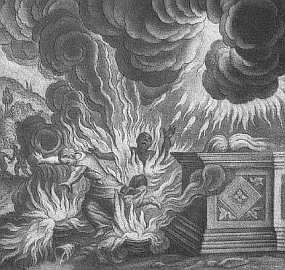
Nadab and Abihu offered "strange fire" to God and were slainThe supposed reason for the Strange Fire Conference of last week was to address and correct “charismania”—out-of-control or flat-out bogus gifts and the people who express them. The authority question arises when the correctors included no charismatics. So much for cleaning one’s own house first or sticking to the log in one’s own eye before finding the speck in your brother’s.

There is no doubt that the charismatic movement is a mess. Most charismatics with orthodox theology will acknowledge this—and there are MANY of us. I know I’m not happy with charismania and have written EXTENSIVELY on it and its practitioners, decrying the nuttiness and flat-out heresy. And MANY of us have loudly proclaimed this.

Which is why it’s frustrating that some folks who reject the charismata waltz into the charismatic house and tangentially proclaim by live streamed conferences that every charismatic is borderline, and if we’re actual born-again Christians, we’re so in spite of our charismatic beliefs. Like I said, a new low. No end exists for the ways in which such reasoning can be reversed and delivered back upon the correctors. But then, most charismatics don’t want this fight and never asked for it.

I was working through a response to a teaching at the Strange Fire conference that was liveblogged by Tim Challies and given by Tim Pennington, “Strange Fire Conference: A Case for Cessationism.” Frankly, I was appalled at the teaching, not only for descending into the very argument types that the group giving the conference would ordinarily savage if they came from others, but also for the teaching’s extensive logical fallacies. In short, the entire teaching has so many obvious problems, it besmirches legitimate Christian scholarship. And I say that with great reluctance and sadness.

I was prepared to blog a response in light of Scripture, history, and logic, but someone else wrote an almost identical rebuttal. I’d say it’s amazing how similar my response would have been, but then that’s how the Holy Spirit works in like-minded charismatics.  😉

Anyway, please do read Andrew Wilson’s “Cessationism and Strange Fire,” as it mirrors my thoughts.