
Terri Schiavo, the brain-damaged woman in Florida that many thousands of words have been written about in the last two months, has died. She was starved and dehydrated under the watchful eye of the State and her husband.
There is much I can say about this, but I offer an unusual take. This is the second time in a week that I have taken a look back to dusty bones, but the April 2005 edition of National Geographic has a look at the recent find of tiny human-like bones in a cave in Indonesia that speaks volumes about how shrunken our souls have become.
I’ll let the images and copy from the article “Family Ties” say it all:
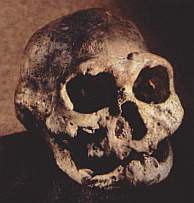
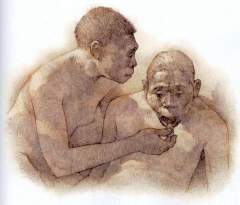
A toothless Homo erectus skull (left) discovered in Dmanisi poses an intriguing question: How did he survive without chewing? Maybe he found soft foods, or perhaps another hominin helped him (right)—which, if true, would be the first sign of human caring. {Caption and images from National Geographic, April 2005, pp. 18 & 19}
Now I am not an apologist for Darwinism (quite the opposite, in fact), nor do I necessarily support the contentions of National Geographic here. But whatever your take on “proto-humans” may be, the issue stands. If it is true that Homo erectus—with a brain nowhere near the size of ours—cared for the toothless old individual in their midst that may not have been able to care for himself, how is it that Homo sapiens in 2005 can willfully starve one of our own to death?
Have we become less moral than animals?