
Stuff I Don’t Get: Is Left Right?

Standard

We all know this passage from the OT:

It is the LORD who goes before you. He will be with you; he will not leave you or forsake you. Do not fear or be dismayed.
—Deuteronomy 31:8

The NT frames it this way:

And behold, I am with you always, to the end of the age.
—Matthew 28:20b

But not as many people know this passage, one that makes for a series of puzzling questions:

And Hezekiah himself stopped the upper water courses of Gihon, and brought it straight down to the west side of the city of David. And Hezekiah was blessed in all his works. But, in regard to the ambassadors of the rulers of Babylon who sent to him to ask about the wonder that was done in the land, God left him in order to try him, to know all that was in his heart. And the rest of the acts of Hezekiah, and his goodness, behold, they are written in the vision of Isaiah the prophet, the son of Amoz, and in the Book of the Kings of Judah and Israel.
—2 Chronicles 32:30-32

So, when this righteous king, one of the few bright lights to sit upon the throne, Hezekiah and the Babylonian Envoysneeded God’s wisdom to know how to deal with Babylonian envoys, God leaves Hezekiah in order to test him?
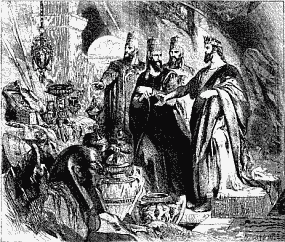
The Hebrew word for left is pretty strong: ‘ âzab. One of its connotations is to forsake.

Hezekiah was a pillar of virtue. Sin was not the reason God left him at that point.

The passage said that God did this to see what was in Hezekiah’s heart. Didn’t He already know?

If Hezekiah had responded in some odd way, would this have surprised God?

Why test a king who had consistently proven himself good?

This is Babylon Hezekiah’s dealing with, not some podunk nation. Wouldn’t God’s presence and help be essential?

If nothing good can come out of a man apart from God, what’s going on here?

And sure, the Holy Spirit always indwells believers, but did God do this personal test with one of His own just this one time in 2 Chronicles? Or does He do something akin to this “leave in order to test” with believers today?

Nearly all the commentaries I have note that 2 Kings 20:13-21 expands what happens, as Hezekiah shows the envoys everything in his kingdom. Some commentators say that this proves that Hezekiah loved earthly riches and did not value God as much as he should. Or that he did not point the envoys to God by explaining the miraculous retrogression of the sun (Isaiah 38:4-8) or his own deathbed recovery (earlier in Isaiah 38). Yet this is what the Bible says elsewhere about Hezekiah:

In the third year of Hoshea son of Elah, king of Israel, Hezekiah the son of Ahaz, king of Judah, began to reign. He was twenty-five years old when he began to reign, and he reigned twenty-nine years in Jerusalem. His mother’s name was Abi the daughter of Zechariah. And he did what was right in the eyes of the LORD, according to all that David his father had done. He removed the high places and broke the pillars and cut down the Asherah. And he broke in pieces the bronze serpent that Moses had made, for until those days the people of Israel had made offerings to it (it was called Nehushtan). He trusted in the LORD, the God of Israel, so that there was none like him among all the kings of Judah after him, nor among those who were before him. For he held fast to the LORD. He did not depart from following him, but kept the commandments that the LORD commanded Moses. And the LORD was with him; wherever he went out, he prospered. He rebelled against the king of Assyria and would not serve him. He struck down the Philistines as far as Gaza and its territory, from watchtower to fortified city.
—2 Kings 18:1-8

So this is a man who doesn’t really love God as he ought? And God left him?

For me, 2 Chronicles 32:31 is one of the oddest verses in the entire Bible. I just can’t make any sense of it. If you can, please clue me in!
When the Devil Seems to Win

Standard

A little country church tucked just off Main Street, Trinity Fellowship had served the community for years and did it well. They had experienced growth over the last year—eight new families—but they had also experienced something less encouraging.

Rebecca Simms worried that her youngest daughter would end up in jail. She did.

Mike Travers heard about the layoffs a month ago. The pink slip came yesterday, his third in three years.

Emma Andersen, two semesters away from graduating from college (the first in her family), got that fated letter saying her full-ride scholarship money had dried up due to tough economic times.

Bryan and Lydia Preston found out two weeks ago they were expecting their first child. This morning, they learned something was wrong with the baby.

Between the six people on the leadership team at Trinity, they suffered a miscarriage, cancer, a bankruptcy, the suicide of a child, crippling depression, and an affair that led to divorce. Three are no longer in ministry and may never return.

Last Sunday, Daryl Wells, the worship leader, led a song that contained a lyric out of Isaiah 54:17: “No weapon formed against you shall prevail.” More than one person singing that morning wondered if the words were true.

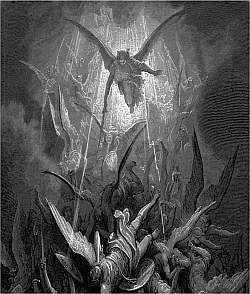
Sometimes, the Devil seems to win.

Trinity Fellowship and the people who comprise it are the product of this writer’s imagination. But they might as well be real, because their stories are. Every Sunday in America, someone, somewhere, is sitting in church wondering how it all went wrong. For some, it’s a question asked many times.

It’s not enough to say we live in a fallen world. That brings no comfort at all. Nor does it make sense of the mountain of Scriptures that say that God rescues His people from calamity. Let’s be honest here: More than once, you’ve wondered why the Scriptures don’t line up with your experience of life.

I’m not wise. I make a lot of mistakes wise people wouldn’t make. But several decades of observation take me back to the same answer for this issue.

The Devil seems to win for one major reason: We don’t pray.

I think we’ve all learned that when someone says he will pray for us, he probably won’t. It’s not a malicious promise, though. The intent is there, but we all know how life intrudes and the best of intentions remains nothing but intentions. Angelic warfareIt seems to be the human condition.

Succumbing to the human condition is not what the Church is supposed to be about, though. Our God is not a god of settling.

I used to think that my condition was largely due to my own prayers—or the lack of them. I don’t believe that anymore.

Sure, what we pray for ourselves matters. But God means the Church to be a Body, a collective, a community that lives and dies by what the whole does. If I’m not praying for you and you’re not praying for me, then the Devil wins.

Several years ago, I attended a Christian Camping International conference, with Leighton Ford as the keynote speaker. He told us about a flight where he sat next to a man who prayed the entire flight. Ford assumed the man feared flying, so he broke in at one point to offer some comfort. Only then did he notice the sheet of paper the man clutched. On it were the names of many prominent Christian leaders. When Ford questioned him about this, the man confessed that he had been praying for the downfall of the people on the list.

Ford informed us that, with the passage of time, all but one of those leaders had seen their ministry—and their personal lives—destroyed.

I don’t think Evangelicals take the Devil seriously. We don’t see life as a battle. We blithely float here and there, mostly prayerlessly, and let the river carry us wherever it may. Then when we wash up on the rocks, we wonder what happened.

It’s not enough that we pray for ourselves. We need others to watch our backs for us, because many times we are too close to our own lives to see where we may be exposed to enemy fire.

People in ministry positions are the prime targets of the Enemy. Take down a pastor and an entire church can go down with him. I recently heard that a thriving, well-known church my wife and I visited a few years back blew up entirely after the pastor screwed up. And don’t think that doesn’t wreck a lot of bystanders, because it does. Maybe not at first, but that kind of disaster eats at people’s spiritual guts, fosters corrosive cynicism, and does enormous damage.

Really, how hard is it to pray for others in our churches, especially for those in prominent roles? Isn’t it much harder to fix the craters and wounds from shrapnel when a life blows up due to the lack of a prayer covering?

Kind of a Pentecostal term there, prayer covering. Regardless of whether or not it’s Christianese, it’s reality. When bad things happen to people, be they lost or saved, the holes in their prayer covering—if they even have a prayer covering at all—may explain everything.

I’m to the point in my life where I honestly believe that almost all of the hardship we see in life is due to a lack of prayer. Those Scriptures that don’t align with life don’t because we’re just not taking prayer as seriously as the Scriptures do.

John Piper’s Prophetic Warning

Standard

Adrian Warnock relays a “prophetic word” from John Piper, who has become the poster pastor for the resurgence of contemporary Calvinism and Reformed theology. Some folks in that movement have problems digesting Piper’s charismatic leanings, so it should be interesting to see how well the warning below goes over:

I find it intriguing that Piper is careful to appease those who might blanch at the phrase “prophetic word” by saying that the warning doesn’t have to be ascribed to a supernatural revelation. Still, it’s progress…I think.

I also find it interesting that as some of the stalwarts of Calvinism age, they become more friendly with charismatic theology (see D. Martyn Lloyd-Jones, for instance). Ironically, the video above appears directed at the very people who would criticize that chumminess.

Anyway, what do you think of Piper’s warning? Do you think it’s true? (I’ll reserve my thoughts for the comments section below…)