
Breaking out of Your Christian Ghetto

Standard

Sometimes, you find yourself in the middle of a ghetto.

I have a friend who—God bless him—has given most of his life to minister to the inner city poor. Too long ago, he and I would occasionally, late at night, walk the streets of his new neighborhood to talk with people.

As two terminally white, bearded guys over 6′ 4″, we sorta stuck out. Because this was the “ghetto.” And all the stereotypes were in play.

Except they weren’t.

On one particular walk, my friend abruptly pulled up and turned around. When I asked why, he surprised me with his answer. “Down that street is Appalachian territory,” he whispered and motioned. “No one goes in there.”

Different ghetto, different hostility.

Ghetto is a word in transition. In the past, it simply meant a part of a city that was dominated by one ethnic group or one way of living. Harlem in New York City always comes to mind, but one could easily argue that Wall Street is its own ghetto, albeit a wealthy one. In the case of the word ghetto, over time, a poverty aspect crept into the meaning, but it hasn’t always been there.

In Christianity, we have built our own ghettos. We call them denominations. Or we add theological labels such as Reformed, Charismatic, Arminian, or Anabaptist. Because labels. Can’t be a good Christian without ’em, right?

Whatever our slant on our Christian ghettos, the same etymological transition is at work: a slide into poverty.

Except in the Christian case, the poverty is in the diversity of ideas. Or on the exclusionary focuses of the faith. Eventually, everyone within that ghetto winds up poorer theologically and relationally. In most cases, they don’t even see it happening.

I see in the modern American Church an increasing tendency to stop at the end of the sidewalk and say, “No one goes in there.” Whoever or whatever lurks there, we’re too afraid to deal with him/her/it.

One of the most insidious examples of this occurs in certain Christian communities often seen online. You probably know them. Certain individuals within a certain group run certain websites that espouse certain theologies. When one of those individuals writes a book, others within that group write the glowing reviews and recommendations. After a while, you see all the same names recommending each other’s books and sites and dissing every book, site, or individual that comes from outside that certain group.

I believe such incestuous, prejudiced thinking and doing borders on dangerous. It creates its own form of unteachability, an imperviousness to greater growth. People trapped within that ghetto never hear any different ideas. If anything, foreign ideas are rejected out of hand. It becomes scary group-think. And naturally, over time, poverty sets in.

Jesus said that we must become like children to enter the Kingdom. Perhaps a children’s book can teach us something about ghettos.

In Charlie and the Chocolate Factory, our kind, gentle, young hero gains admittance to a strange, off-limits ghetto: Willy Wonka’s candy plant. Once inside, Charlie finds the factory’s owner to be absolutely unhinged and perhaps even dangerous. The secluded factory bursts with nonsensical devices a rational person cannot envision. The invitees meet a bizarre tribe that lives in the factory. The tour participants witness things the ordinary person cannot understand and would likely reject for their oddity.

The problem with this and for everyone in the novel: As strange and scary as he and his factory are, Willy Wonka makes the world’s best candy.

Willy Wonka, HomeboyAt the story’s conclusion, Wonka gives his factory to Charlie. And it’s not simply because the boy is the last one standing on the tour but because of Charlie’s humble, gentle, others-centered spirit. Wonka realizes the boy has something he lacks. In the same way, Charlie not only inherits the candy plant, but he also must realize that to continue to make it great, it must retain its weirdness, and he must move beyond being just a destitute, simple boy to embrace some of Wonka’s madness. For the world to become a more wonderful place, both Wonka and Charlie must break out of their ghettos.

Like the Wonka factory, the Christian world has locations within it where too few go and thus never discover a place of genuine, if unusual, excellence. We are impoverished for our trepidation, for our clinging to our own ghetto, for being unwilling to see and explore. Our fear prevents us from becoming all that God would make us.

I think of the foreign-to-the-West thinking of Asian Christian Watchman Nee, who brings a unique Chinese perspective to the Church. Some would warn you not to read him, if only because he doesn’t read like your typical white theologian of any “respectable” bent.

Or Rod Dreher, who writes about ideas that seem liberal but are actually hallmark conservative, and from an Orthodox tradition.

Plenty of other ghetto-breakers exist.

I offer this:

If you’re a Nazarene, read a book by a Pentecostal.

If you’re Reformed, hang out at a few Wesleyan websites—and not just to slam people.

If you’re a Presbyterian, consider what the Medieval mystics wrote about union with Christ.

If you’re a white, American Christian, discover what black, African Christians think about the Faith.

Consider the possibility that everything you know comes solely from your ghetto—and that the Christian world is a much, much bigger place than you realize.

Weird and unfamiliar don’t automatically equal wrong. Sometimes, they form the sidewalk that takes you and me out of our comfortable ghetto to a place filled with utterly foreign wonders.

Sure, quicksand or tigers may lurk down that path, but you’re an adult. Be discerning. Test everything all the time.The presence of threats doesn’t negate what wonders might be discovered. If anything, wonders look threatening to the inexperienced.

Whatever your Christian ghetto might be, break out of it! You’ll be surprised what you might learn about yourself and about the Lord from someone who doesn’t look or think like you.

American Civil Religion vs. True Christianity

Standard

In my previous post, “The Only Martyr’s Death Worth Dying,” I began to explore differences that exist between true Christian faith and the mishmash we often practice in America. A fancy word for this melange exists, syncretism, which is the blending of two different ideas or practices into one. Often those ideas or practices are contradictory, yet the practitioner cannot recognize the inherent contradictions.

Nowhere is this syncretism more apparent than in America. The narrative of our country and the narrative of the Kingdom of God have syncretized so profoundly that the religion far too many self-proclaimed Christians in America practice isn’t true Christianity at all but something I like to call American Civil Religion.

God, Guns & Guts

How this ties into my previous post is that most people who oppose Christianity in America are not haters of true Christianity but of American Civil Religion. Where this is sad for the American Church is that most people cannot tell the difference. They think American Civil Religion (ACR) IS true Christianity.

Part of that confusion is due to the syncretism that spawned ACR. Because some elements of true Christianity are sprinkled throughout ACR, it looks like a twin, but to people who are discerning, the differences are stark.

The funny thing about ACR is that many who embody it are also quick to talk about “another Gospel,” as in this passage:

I am astonished that you are so quickly deserting him who called you in the grace of Christ and are turning to a different gospel— not that there is another one, but there are some who trouble you and want to distort the gospel of Christ. But even if we or an angel from heaven should preach to you a gospel contrary to the one we preached to you, let him be accursed. As we have said before, so now I say again: If anyone is preaching to you a gospel contrary to the one you received, let him be accursed.
—Galatians 1:6-9

Yet which gospel do we Americans actually affirm?

Here are six distinctions between American Civil Religion and true Christianity:

1. Bogeymen

ACR lives and dies by its bogeymen. Someone or something must be opposed and feared. The current president. Illegal aliens. Communism. Tyranny. Standardized testing in schools. Homosexuals. Liberals. Socialists. Blacks. Whites. Jews. Muslims. Middle East dictators. Loss of values. Loss of freedoms. Loss of rights. There is always a threatening bogeyman or two, and this galvanizes those enmeshed in ACR. It’s almost a lifeblood element.

Unlike some of the items on this list, true Christianity does not have an analogous issue. The closest bogeyman the true Christian gets is Satan. Like the decapitated rattlesnake in its death throes that can still bite by reflex, Satan is not safe, but for the true Christian, he is a defeated opponent. And defeated opponents make for lousy bogeymen. The Bible reminds us that our respect and awe are reserved for God alone, and when we abide in Christ, Satan has no power over us. Fearing bogeymen is not a concern for the true Christian. If anything, when ACR’s bogeymen are actual people and groups, the true Christian is called to show love to those bogeymen and pray for them.

2. Fear

Because bogeymen play so well into the ACR narrative, fear must result. Fear is ever-present in the heart of ACR practitioners. They will know they are ACR by their fear.

But true Christians understand that fear and faith don’t mix. The perfect love of God casts out all fear. The true Christian cannot be a slave to fear because he or she abides in Christ. And what can assail Christ? Nothing and no one. They will know they are Christians by their love.

3. Loss

People enmeshed in ACR are obsessed with loss. In America, the ACR narrative forever talks about loss of rights, freedoms, our “Christian heritage,” and so on. Yet above these is the greatest loss of all for ACR proponents: loss of control. Again, this plays into fear.

True Christian faith recognizes that there is nothing to lose because everything has been lost already. “You have died, and your life is now hidden in Christ,” writes the Apostle Paul. “You are not your own; you have been bought with a price,” he adds. Loss means nothing because no one and nothing can take away Jesus. Likewise, the Christian cannot be removed from Him. If anything, loss brings joy in the life of the Christian, because losing the dross of the world means more room to gain Christ.

4. God & ____________

ACR is forever pairing God with something or someone. God & Country. God & Guns. God & Military. God & GOP. We even have a concept in American history that embodies this concept in two words: Manifest Destiny. Want to legitimize any “righteous” cause for the ACR? Pair it with God.

The true Christian avoids creating anything that forces God to share His Glory, because God will not share it, ever. The closest the true Christian gets is to abide in Christ—God & the Church, and even then God remains the sole focus of our worship.

5. Kingdoms

In ACR, it’s America first. Always. When asked their citizenship, ACR believers will respond with “America” and almost never “Heaven.” Still, kingdoms perplex ACR. “King”-anything recalls America’s revolution and smacks of tyranny. That noted, an underlying desire in many ACR proponents is to be a sort of new Kingdom of Israel here in the United States. For this reason, those enmeshed in ACR tend to quote from the Old Testament at the expense of the New in their apologetics. However, while ACR believers will quote Bible verses to support the essentials of their “faith,” those verses often have no structure to undergird the actual Kingdom of God.

In stark contrast, true Christianity recognizes the New Testament’s Kingdom of God as the framework for everything the Christian says and does. Scripture is used in a way that perpetually goes back to this Kingdom and its Now and Not Yet reality. In that reality, Christ is King and Christians are Citizens of a Heavenly Kingdom. America, as a political entity, must always be a distant second in allegiance. The Christian’s ambassadorship is for Christ and His Kingdom alone. (This is a primary area of concern for true Christianity in America because the Church here perpetually struggles with its Kingdom of God narrative, largely due to the nonstop noise coming from ACR.)

6. Self

Self is at the heart of ACR. Our way of living. Our freedoms. Our rights. Our country. Yet even in the midst of all that “our” lies a whole lot of “me.”

Selflessness is at the heart of true Christianity. The Christian esteems others better than himself. She lives for Christ, dies to self, and considers doing so a privilege. The Kingdom of God matters, and the individual Christian within it not so much. Jesus must increase and all who love Him must decrease.

It doesn’t take much effort to see the differences between ACR and true Christianity, yet few of us make the distinction. People who don’t know God can’t make this distinction at all, and this should concern those of us who don’t want to perpetuate ACR. When ACR is mistaken for true Christian faith and practices, everyone loses.

None of this is to say that you and I can’t be Christians and Americans too. Nor does it imply that we can’t be “rah-rah America.” National pride does not negate Christian belief or vice versa. It’s a matter of allegiance. For the Christian, the allegiance is to Christ, and nothing can supercede this. The true Christian’s real citizenship is not in any earthly political entity but in an unseen one in which the Lord rules.

If this post makes you mad, consider that you’re mad because our American Civil Religion is so engrained in everything we say, do, and live in America. Consider that ACR is a false gospel based on fear. Consider its selfishness. Consider that it obfuscates true Christianity. Consider that perhaps it’s what non-Christians hate most of all. Consider that ACR has become your faith and mine instead of true Christianity.

Then, do something about it.

The Only Martyr’s Death Worth Dying

Standard

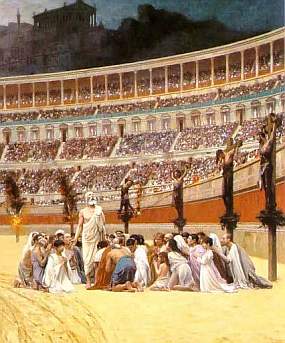
'The Christian Martyrs' Last Prayer' by Jean-Léon GérômeChristians in the United States are increasingly alarmed at the rise of the martyrdom of fellow believers across the world. When dying for our faith comes to our own shores, it’s even more troubling.

Jesus said this:

“If the world hates you, know that it has hated me before it hated you.”
—John 15:18

We often think of the tossing of Christians to the lions in ancient Rome when we think of being hated for the Faith.

A list of Christian faith and practice that drew the attention of the Romans:

  • Rapidly spreading the Faith throughout Rome
  • Caring for infants otherwise left to die
  • Caring for the sick, infirm, and elderly
  • Affording women rights ordinarily not given to them
  • Expressing monotheistic beliefs about the nature of God

Only one of the above, though, convinced Roman leaders to send Christians to die a martyr’s death in the Colosseum.

Today, the following beliefs and practices of Christians in the United States raise the ire of those who might hate us:

  • Espousing a pro-life / anti-abortion stance
  • Supporting conservative politicians and politics
  • Opposing same-sex marriage
  • Making wild predictions about End Times
  • Opposing permissive cultural mores

Can you spot the telling difference between the two lists?

What got Christians martyred in Rome? Their monotheistic view of God. It was how Christians depicted the nature of God that Roman leaders saw as an immediate threat. The other factors may have contributed, but they were not the final cause. (I would recommend Rodney Stark’s The Triumph of Christianity for further details.)

Today, fellow believers in other countries are martyred for the same reason as ancient Christians in Rome. Consider too the message of the apostles. It was their view of who God is, talking about Jesus, and putting Him above all else that enraged others enough to kill them.

If you and I must die a martyr’s death, the only real martyrdom, the only genuine reason to die for the Christian faith, is the person of Jesus. Be hated because we believe Jesus Christ is Lord.

Being hated for anything on that second list is not the point. Being hated for being opinionated about social issues, or voting for conservative politicians, or for homeschooling, or for anything else that is not Jesus is not martyrdom for the Faith.

Meditate on that earlier Bible verse for a moment.

I write this today because of my concern that we may be unclear on this. The way we talk about why people might hate Christians has little to do with the person of Jesus Christ and what we think about Him. Instead, it seems to be about our opinions on everything else.

There’s enough scandal in the person of Jesus and what He said and did to rock anyone’s world. But, in the United States, is Jesus truly the primary reason people hate Christians? If not, then we need to change the focus of our rhetoric.

One day, if they do come us, let’s ensure we die for the right reason.