
In my previous post, “The Only Martyr’s Death Worth Dying,” I began to explore differences that exist between true Christian faith and the mishmash we often practice in America. A fancy word for this melange exists, syncretism, which is the blending of two different ideas or practices into one. Often those ideas or practices are contradictory, yet the practitioner cannot recognize the inherent contradictions.
Nowhere is this syncretism more apparent than in America. The narrative of our country and the narrative of the Kingdom of God have syncretized so profoundly that the religion far too many self-proclaimed Christians in America practice isn’t true Christianity at all but something I like to call American Civil Religion.

How this ties into my previous post is that most people who oppose Christianity in America are not haters of true Christianity but of American Civil Religion. Where this is sad for the American Church is that most people cannot tell the difference. They think American Civil Religion (ACR) IS true Christianity.
Part of that confusion is due to the syncretism that spawned ACR. Because some elements of true Christianity are sprinkled throughout ACR, it looks like a twin, but to people who are discerning, the differences are stark.
The funny thing about ACR is that many who embody it are also quick to talk about “another Gospel,” as in this passage:
I am astonished that you are so quickly deserting him who called you in the grace of Christ and are turning to a different gospel— not that there is another one, but there are some who trouble you and want to distort the gospel of Christ. But even if we or an angel from heaven should preach to you a gospel contrary to the one we preached to you, let him be accursed. As we have said before, so now I say again: If anyone is preaching to you a gospel contrary to the one you received, let him be accursed.
—Galatians 1:6-9
Yet which gospel do we Americans actually affirm?
Here are six distinctions between American Civil Religion and true Christianity:
1. Bogeymen
ACR lives and dies by its bogeymen. Someone or something must be opposed and feared. The current president. Illegal aliens. Communism. Tyranny. Standardized testing in schools. Homosexuals. Liberals. Socialists. Blacks. Whites. Jews. Muslims. Middle East dictators. Loss of values. Loss of freedoms. Loss of rights. There is always a threatening bogeyman or two, and this galvanizes those enmeshed in ACR. It’s almost a lifeblood element.
Unlike some of the items on this list, true Christianity does not have an analogous issue. The closest bogeyman the true Christian gets is Satan. Like the decapitated rattlesnake in its death throes that can still bite by reflex, Satan is not safe, but for the true Christian, he is a defeated opponent. And defeated opponents make for lousy bogeymen. The Bible reminds us that our respect and awe are reserved for God alone, and when we abide in Christ, Satan has no power over us. Fearing bogeymen is not a concern for the true Christian. If anything, when ACR’s bogeymen are actual people and groups, the true Christian is called to show love to those bogeymen and pray for them.
2. Fear
Because bogeymen play so well into the ACR narrative, fear must result. Fear is ever-present in the heart of ACR practitioners. They will know they are ACR by their fear.
But true Christians understand that fear and faith don’t mix. The perfect love of God casts out all fear. The true Christian cannot be a slave to fear because he or she abides in Christ. And what can assail Christ? Nothing and no one. They will know they are Christians by their love.
3. Loss
People enmeshed in ACR are obsessed with loss. In America, the ACR narrative forever talks about loss of rights, freedoms, our “Christian heritage,” and so on. Yet above these is the greatest loss of all for ACR proponents: loss of control. Again, this plays into fear.
True Christian faith recognizes that there is nothing to lose because everything has been lost already. “You have died, and your life is now hidden in Christ,” writes the Apostle Paul. “You are not your own; you have been bought with a price,” he adds. Loss means nothing because no one and nothing can take away Jesus. Likewise, the Christian cannot be removed from Him. If anything, loss brings joy in the life of the Christian, because losing the dross of the world means more room to gain Christ.
4. God & ____________
ACR is forever pairing God with something or someone. God & Country. God & Guns. God & Military. God & GOP. We even have a concept in American history that embodies this concept in two words: Manifest Destiny. Want to legitimize any “righteous” cause for the ACR? Pair it with God.
The true Christian avoids creating anything that forces God to share His Glory, because God will not share it, ever. The closest the true Christian gets is to abide in Christ—God & the Church, and even then God remains the sole focus of our worship.
5. Kingdoms
In ACR, it’s America first. Always. When asked their citizenship, ACR believers will respond with “America” and almost never “Heaven.” Still, kingdoms perplex ACR. “King”-anything recalls America’s revolution and smacks of tyranny. That noted, an underlying desire in many ACR proponents is to be a sort of new Kingdom of Israel here in the United States. For this reason, those enmeshed in ACR tend to quote from the Old Testament at the expense of the New in their apologetics. However, while ACR believers will quote Bible verses to support the essentials of their “faith,” those verses often have no structure to undergird the actual Kingdom of God.
In stark contrast, true Christianity recognizes the New Testament’s Kingdom of God as the framework for everything the Christian says and does. Scripture is used in a way that perpetually goes back to this Kingdom and its Now and Not Yet reality. In that reality, Christ is King and Christians are Citizens of a Heavenly Kingdom. America, as a political entity, must always be a distant second in allegiance. The Christian’s ambassadorship is for Christ and His Kingdom alone. (This is a primary area of concern for true Christianity in America because the Church here perpetually struggles with its Kingdom of God narrative, largely due to the nonstop noise coming from ACR.)
6. Self
Self is at the heart of ACR. Our way of living. Our freedoms. Our rights. Our country. Yet even in the midst of all that “our” lies a whole lot of “me.”
Selflessness is at the heart of true Christianity. The Christian esteems others better than himself. She lives for Christ, dies to self, and considers doing so a privilege. The Kingdom of God matters, and the individual Christian within it not so much. Jesus must increase and all who love Him must decrease.
It doesn’t take much effort to see the differences between ACR and true Christianity, yet few of us make the distinction. People who don’t know God can’t make this distinction at all, and this should concern those of us who don’t want to perpetuate ACR. When ACR is mistaken for true Christian faith and practices, everyone loses.
None of this is to say that you and I can’t be Christians and Americans too. Nor does it imply that we can’t be “rah-rah America.” National pride does not negate Christian belief or vice versa. It’s a matter of allegiance. For the Christian, the allegiance is to Christ, and nothing can supercede this. The true Christian’s real citizenship is not in any earthly political entity but in an unseen one in which the Lord rules.
If this post makes you mad, consider that you’re mad because our American Civil Religion is so engrained in everything we say, do, and live in America. Consider that ACR is a false gospel based on fear. Consider its selfishness. Consider that it obfuscates true Christianity. Consider that perhaps it’s what non-Christians hate most of all. Consider that ACR has become your faith and mine instead of true Christianity.
Then, do something about it.
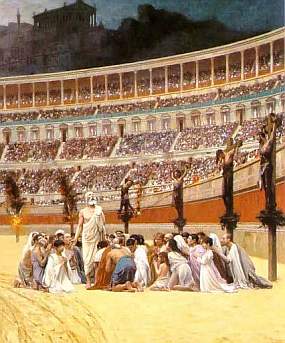 Christians in the United States are increasingly alarmed at the rise of the martyrdom of fellow believers across the world. When dying for our faith comes to our own shores, it’s even more troubling.
 One of the ways social media may harm the Church (and society as a whole) occurs when Christians rush to comment on news stories and issues of social importance.