
Waiting

Standard

Wait for the LORD; be strong, and let your heart take courage; wait for the LORD!
—Psalms 27:14 ESV

The LORD is good to those who wait for him, to the soul who seeks him. It is good that one should wait quietly for the salvation of the LORD.
—Lamentations 3:25-26 ESV

Then they believed his words; they sang his praise. But they soon forgot his works; they did not wait for his counsel.
—Psalms 106:12-13 ESV
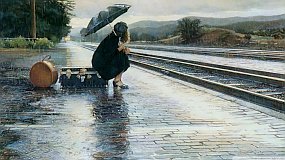
WaitingI’d like to believe that the American Church is filled coast to coast with people who wait patiently on the Lord. I’d like to believe that.

I know better, though. The part of American Church that causes problems is the American part. In America, we don’t want to wait for anyone or anything. To wait is to waste time when something can be done. Doing is all that matters. Or as it is in many cases, talking about doing, even if the doing never happens.

Here’s a line you never hear from the pulpit in America: “We’re not moving ahead on this until God gives us the OK. Until then, we wait.

For the Christian, waiting doesn’t mean doing nothing. Prayer and faith together make a difference. In fact, prayer and faith might just be what God is waiting to experience from us before the awaited result comes. Two little practices, yet how we forget to do them.

Whatever it is that we’re forgetting, our porous memory hurts our waiting.

The Psalm 106 passage quoted above shows that forgetfulness and impatience go together. We know what the Bible says, and we sing about God’s care for us, but we forget what He has done nonetheless, and therefore we charge forward, as if THIS time is the time in which He will not come through in his perfect timing. So, we grease the rails and proceed full steam ahead anyway.

Regular readers will recognize this familiar lament: The good is the enemy of the best. In the American Church, that should be engraved on every church doorway lintel.

Impatience yields not only bad results but good. The problem is that we get satisfied with good results and never give God the opportunity to deliver mind-blowing results. All because we could not wait on Him. All because we had to make something happen.

None of that is of faith, though. And sometimes, the result is devastating.

I wonder how much we miss as a Church in the United States due to impatience. I wonder how many once-vibrant churches no longer meet because they didn’t wait on God.

Or perhaps they did and were so enamored of one type of answer that they missed God’s answer when it finally came. Either way, the best didn’t happen for them. So they grumble and blame God for not coming through on their timing. Except He did; they just weren’t attuned to Him.

Impatience and an inability to hear God when He does speak in His timing are epidemic in today’s noisy, “make something happen” churches. Will it take an ethereal hand writing on the wall to get us to pay attention and listen?

I’d say that’s something worth waiting for, except we all know how it turned out.

The Gospel, Millennials, Vocation, and How to Be a Real Christian

Standard

I was ill late last week with an annoying head cold, so I decided to take Saturday off and heal.

Lately, I’ve been listening to the weekly Phil Vischer Podcast, which talks from a Christian perspective on issues facing American culture and Christianity. Vischer, best known as the creator of VeggieTales, offers the comic relief and pushes the conversation forward, but his co-hosts, Christian Taylor and Skye Jethani, offer the more serious insights.

Jethani, in particular, gets me thinking. I was familiar with his writings at “Out of Ur” (now called Parse) and have read them occasionally, but he comes across better in recordings than in print. Also intriguing to me: He graduated from a college in my area and now lives in Wheaton, Ill., and routinely interacts with students from my alma mater and examines those interactions.

Anyway…

Jethani is a pastor and current editor for Leadership Journal, which is a satellite magazine of Christianity Today intended for Christian leaders. I watched several videos featuring Jethani on Saturday and was blown away by how good they are, not only in their spiritual content but in their conciseness in teaching. Jethani gets to the point and makes it live.

Below are three video links from Jethani that I think everyone should watch. I can’t stress enough how excellent they are. And again, he gets right to the point.

Jethani wrote a book called With: Reimagining the Way You Relate to God, and in the following video, unpacks the main points in 19 minutes. This video was so good, I sat down with my 13-year-old son to watch it together. He was touched by it in a way I’ve never seen.

This second video, about 50 minutes long, is aimed more at church leaders and talks about how ministry models must change to better present Jesus to people who are dissatisfied with current church programming and intent. It’s dead on and reflects many of the themes I’ve discussed here.

Finally, in 45 minutes, Jethani cuts through all the noise and confusion and gets to the heart of life: What is the Gospel? (Unfortunately, this video link can’t be embedded, so you’ll have to go to YouTube to watch it.)

Skye Jethani—What is the Gospel?

I hope you have an opportunity to watch these videos. I think you’ll be remarkably blessed.

Lastly, I want to recommend an exceptional book that is not by Jethani but further expands his thoughts on vocation in the second video above:

The Other Six Days: Vocation, Work, and Ministry in Biblical Perspective by R. Paul Stevens.

It’s not only a fantastic look at how the modern Church has totally misunderstood genuine community but also how Christian ideals of community give meaning to people’s vocations, especially those careers that are NOT in “full-time Christian ministry.” This is one of the best Christian books I’ve read in the last five years. A little more academic, but it’s powerful nonetheless.

Have a blessed week.

Out of the Shallows

Standard

Lighthouse at sunsetYesterday, I switched the wallpaper on my computer. It shows lighthouses now.

I didn’t know a computer desktop wallpaper could be prophetic, but this morning, while praying, God showed me something, and when I looked up, I saw the lighthouse on the screen.

I am fully convinced that we as a Church are running out of time to get things right. We haven’t reached the end yet, but it’s nearer than ever.

We Christians in America have put ourselves in a place where we are like toddlers splashing in the water’s edge at the beach. Oh, look! A starfish. Oh, over there! A sand dollar. The water is warm. Mom waves to us. Look how clear the sky is. The water comes up to our knees.

That’s how we may think of shallow water.

But while that may be a comforting place for the small, it’s disastrous for anything larger—like the American Church.

I didn’t set out to think about lighthouses. It was only after prayer that the lighthouse made sense.

The Bible says that “deep calls to deep.” Out in the deep is where the unknown lurks. The deep is off limits to anyone but the experienced. The line of transition from the toddler splashing in the shallows to the salt-encrusted face of the grizzled sea captain extends from the shore to that great emptiness that stretches from horizon to horizon, where the land goes missing, and all points of reference vanish.

We use the lighthouse as a symbol of Christ guiding us home, but that’s a mistake. The lighthouse exists to warns of the shallows, to force us to head out to deeper water. The real danger is not in the great emptiness out at sea, it’s from being dashed to pieces in the shallows when the conditions turn against us.

As a Body of Christian Believers, the American Church needs to steer away from the shallows. We’ve been in them for far too long. We see them as safety, but that’s where the rocks are, and when the surf rises, and the winds along with them, the shallows are the most dangerous place to be.

God wants us deeper. We have to move away from our natural home on land. We must familiarize ourselves with the denizens of the deep in their natural environment and know their sonorous callings. We must become comfortable navigating by the stars and their dim, often difficult to read, guidance. We must see the lighthouse not as an inviting light, but as a warning to drive us to the real place of safety, even if that place doesn’t look safe on the surface.

Church, we must move out of the shallows. We must learn to navigate the ocean and its depths. We must know how to be at peace, even when no land is in sight. The times demand it.

In closing, this came to mind: