
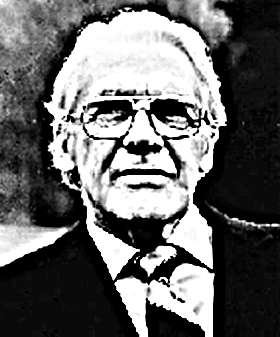
Leonard Ravenhill

Standard

Leonard RavenhillMatt Self over at The Gad(d)about, besides having the common sense to pick drums over all other musical instruments, also has the brains to quote Leonard Ravenhill. Good for Matt. The American Church needs to hear more Ravenhill.

If you haven’t been around Cerulean Sanctum very long, you’ll get to know Ravenhill soon enough. He and A.W. Tozer are the “patron saints” of this blog. No one in the last century wrote blistering words like Tozer and no one preached with more fire than Ravenhill. That they were friends in real life is the icing on the cake.

I don’t do a lot of imploring on this blog, but if you’ve never heard Ravenhill preach, I implore you to go to SermonIndex.net and check out the Ravenhill section at this link (with videos at this link).

Ravenhill was more than a preacher, though; he may have been the last true English-speaking revivalist with roots that went back to the Welsh Revival. He passed away in 1994, and one of the greatest losses in my own life is that I mismarked a calendar and missed him preaching at a local church. He passed away not too long afterward.

Yet he lives on in his teaching tapes, and most of them are incendiary. Not only did Ravenhill handle the Scriptures in a way unmatched today, but he could draw parallels and bring two disparate Biblical concepts together like no other preacher I’ve ever heard. He not only knew the ins and outs of the Bible, but hundreds of hymns, too. Best of all, he had a solid understanding of how the charismata work today. He was the total package. Listening to him is so convicting I find it hard not to keep from rending my clothes and pouring ashes on myself. If you want to know that “Sinners in the Hands of an Angry God” may have sounded like to Jonathan Edwards’ listeners, check out few of the highest-rated Ravenhill sermons on SermonIndex.net, especially those before he was slowed by a stroke in the mid-1980s.

God knows that we need another like him to rouse the Church in 2006.

And though it’s a shame to limit the breadth of Leonard Ravenhill’s wisdom to a few zingers, I’ll end with some of his more pithy statements:

The only time you can really say that ‘Christ is all I need’ is when Christ is all you have.

If Jesus had preached the same message that ministers preach today, He would never have been crucified.

A popular evangelist reaches your emotions. A true prophet reaches your conscience.

The last words of Jesus to the church (in Revelation) were ‘Repent!’

A true shepherd leads the way. He does not merely point the way.

Your doctrine can be as straight as a gun barrel…and just as empty!

John the Baptist never performed any miracles; yet, he was greater than any of the Old Testament prophets.

I doubt that more than two percent of professing Christians in the United States are truly born again.

Our God is a consuming fire. He consumes pride, lust, materialism, and other sin.

There are only two kinds of persons: those dead in sin and those dead to sin.

[Concerning the darkness that has enveloped most of Christendom:] When you’re sitting in a dark room, you can either sit and curse the darkness, or you can light a candle.

Children can tell you what Channel 7 says, but not what Matthew 7 says.

Some women will spend 30 minutes to an hour preparing for church externally (putting on special clothes and makeup, etc.). What would happen if we all spent the same amount of time preparing internally for church, with prayer and meditation?

Maturity comes from obedience, not necessarily from age.

What good does it do to speak in tongues on Sunday if you have been using your tongue during the week to curse and gossip?

The Bible is either absolute or it’s obsolete.

Why do we expect to be better treated in this world than Jesus was?

Today’s church wants to be raptured from responsibility.

Testimonies are wonderful. But so often our lives don’t fit our testimonies.

[Concerning one of the new movements in the church that was causing a stir among Christians:] There’s also a stir when the circus comes to town.

My main ambition in life is to be on the Devil’s most wanted list.

You can’t develop character by reading books. You develop it from conflict.

When there’s something in the Bible that churches don’t like, they call it ‘legalism.’

We can’t serve God by proxy.

We must do what we can do for God before He will give us the power to do what we can’t do.

There’s a difference between changing your opinion and changing your lifestyle.

Our seminaries today are turning out dead men.

How can you pull down strongholds of Satan if you don’t even have the strength to turn off your TV?

Everyone recognizes that Stephen was Spirit-filled when he was performing wonders. Yet, he was just as Spirit-filled when he was being stoned to death.

If a Christian is not having tribulation in the world, there’s something wrong!

[Concerning the fixation that today’s church has with numbers, with growth at any price:] The church has paid a terrible price for statistics!

Any method of evangelism will work if God is in it.

Church unity comes from corporate humility.

You can have all of your doctrines right, yet still not have the presence of God.

Many pastors criticize me for taking the Gospel so seriously. But do they really think that on Judgment Day Christ will chastise me, saying, ‘Leonard, you took Me too seriously’?

You can know a lot about the atonement and yet receive no benefit from it.

If the whole church goes off into deception, that will in no way excuse us for not following Christ.

You never have to advertise a fire. Everyone comes running when there’s a fire. Likewise, if your church is on fire, you will not have to advertise it. The community will already know it.

When Believers Stumble: Perfectionism

Standard

PerfectionistRecently, I confessed that I was fed-up with sports and was probably going to skip the Olympics this year, even though I love the Winter games. Well, my wife was so enthusiastic about them that I got sucked back in and have watched just about every second of the prime time broadcast. My initial complaint is the same, but one interview has made me rethink my position on sports.
A few nights ago, Apolo Ohno won bronze in a short track speedskating race. Bob Costas spoke to him afterwards and you could feel the tension in the air before the interview because it was a bronze medal around Ohno’s neck, not a gold. But immediately Ohno noted that in his discipline anything can happen on any day; any medal was a great accomplishment, not just gold. And he meant it, too. He was excited to win bronze and you could see it on his face.

You can see that on the faces of a lot of other athletes, too, especially the European skiers. Silver and bronze aren’t considered losses, especially to folks who are out there on the World Cup circuit day in and day out. You’re on fire one day and the next you’re looking to just get down the mountain.

The Wall Street Journal had an intriguing article last week in their sports section (betcha didn’t know they had one), covering the most successful NASCAR racers. Everyone talks about Richard Petty’s greatness, but Petty only won a race every 0.169 starts. Jeff Gordon is the modern leader with a 0.167 winning average. In baseball, a batting average like that would get a you a trip to the minors, but here it’s the epitome of success—one time in six.

We Americans love a winner. Greatness is our national drug. Right now there’s a TV show (that a lot of Christians are commenting on) that takes a couple dozen singers and whittles their numbers down until one is left standing. It’s not called American Idol for no reason, is it? That kind of show epitomizes everything we believe in America. Our attitude is the same as a famous line from the movie The Highlander: There can be only one.

The Bible has this to say:

Again I saw that under the sun the race is not to the swift, nor the battle to the strong, nor bread to the wise, nor riches to the intelligent, nor favor to those with knowledge, but time and chance happen to them all.
—Ecclesiastes 9:11 ESV

Apolo Ohno may have been the fastest guy on the track, but he didn’t place first that day. Jeff Gordon loses five races for every one he wins.

One of the disturbing trends in Christianity that I don’t remember seeing growing up is this emphasis on “Christian Excellence.” I blogged about this a few months ago, but wanted to return to it because it’s such an insidious problem. Our emphasis on excellence, in many cases, turns out to be a form of veiled perfectionism, a trait I find in more Christians than in non-Christians.

The late Christian musician Keith Green still ministers to me. One of my favorite songs of his is “When I Hear the Praises Start”:

My son, my son, why are you striving?
You can’t add one thing to what’s been done for you;
I did it all while I was dying.
Rest in your faith, my peace will come to you.

The sad truth in the lives of many Christians today is that striving is what we’re all about. We’re expending considerable energy attempting to win every race, no matter how small, even if that race has no spiritual significance. We not only want to have a gold star on our Sunday School attendance chart, but we want the rest of the box the gold star came in, even if that means no one else gets one.

Our obsession with being perfect can be seen in your average Christian bookstore (and I’m cueing up a “More Cowbell Award” for Christian bookstores in the days ahead.) The bestseller list consists of one tome on being successful after another. Your marriage must be perfect. Your finances must be perfect. Your children must be perfect—and they must be homeschooled because only homeschooling is the perfect way to the perfect college and the perfect career. The irony is that the rest of the bestsellers consist of books consoling Christians when everything doesn’t turn out perfect: the perfect church splits, the perfect daughter dies in a car wreck, the perfect husband’s career goes awry, the perfect wife struggles with an imperfect eating disorder while trying to be perfect. It’s either Your Best Life Now or it’s Every Man’s Battle. God help us!

Can’t we see the snare in this? How many Christians have we known who kept up the illusion of perfection, only to crash and burn in a conflagration that torched dozens of lives around them?

…for all have sinned and fall short of the glory of God….
—Romans 3:23 ESV

I’m not certain the one at the middle of the flaming wreck believed that verse or what comes after it. The ellipses are a clue that there’s more:

…and are justified by his grace as a gift, through the redemption that is in Christ Jesus, whom God put forward as a propitiation by his blood, to be received by faith. This was to show God’s righteousness, because in his divine forbearance he had passed over former sins. It was to show his righteousness at the present time, so that he might be just and the justifier of the one who has faith in Jesus. Then what becomes of our boasting? It is excluded. By what kind of law? By a law of works? No, but by the law of faith.
—Romans 3:24-27 ESV

Did you catch that little word “grace” in there? Five letters, but it means so much! It not only gives life, but it destroys our boasting in any self-righteous perfection we’ve created around us.

But Dan, you say, doesn’t the Bible include this?

You therefore must be perfect, as your heavenly Father is perfect.
—Matthew 5:48 ESV

That’s the “life verse” of Christian perfectionists and it’s followed by this one:

Examine yourselves, to see whether you are in the faith.
—2 Corinthians 13:5a ESV

You have to live in a cave to miss that medical authorities are wild about self-examination. For women there are self-performed breast exams and for men testicular. A sensitive kind of test, for sure, and certainly a good idea to do. But the proper context for them is key. You wouldn’t do a self-exam like that in the middle of a crowded shopping mall, right? You’d wind up in jail if you did!

Too many of us have put ourselves in a jail of perfectionism by improper examination. We have the Bible in one hand—and that’s as far as many perfectionists go—but we also need to have God’s grace in the other. Grace is the curtain around us that allows for proper self-examination. It’s also the chemotherapy we need when the Lord illuminates cancer in our souls.

There are two ways that we tend to react to this examination. We can either “let go and let God” deal with it, or we can start a disciplined chipping away at revealed sin. The sanctification process for people tends to be one or the other. Disciplined people like the idea of “working out their salvation” while others go for the more “without Him we can do nothing” approach that throws more weight onto God to do the work.

Perfectionists tend to camp out on the side of rolling up their sleeves and making themselves better. More prayer. More Bible study. More, more, more. And while they may like it that way, too often they’ve assumed the role of God in the sanctification process. Scratch a Christian perfectionist and you tend to find underneath a person who hates himself one second and loves himself for always being “righteous” the next. I understand that’s a gross simplification, but it holds true for many Christians stuck in a pattern of “it’s never enough.”

The perfectionist Christian struggles in a few areas:

    Fear of failure. Remember Romans 3:23. Perfectionists are so loathe to fail that they take control of their lives away from God and never learn from their mistakes. So much for grace! And so much for sanctification, because if God disciplines us through our mistakes, then we’ll never learn any deeper lessons if we never wind up in the dirt once in a while.Fear of non-acceptance. That’s a perfectly legitimate fear for Christians in legalistic churches. While the Church is charged with disciplining the unrepentant, repentance is not normally the issue for perfectionists—it’s accepting grace. If you’re a Christian stuck in a church where you think you’ll be savaged if you confess your sins, then you’re in the wrong church.

Fear of losing control. Who’s in control, the perfectionist or God? Who does a better job? Come to the cross; dying to self is a good thing.

“Should-ing” on others. Perfectionists use the word “should” like a battering ram, always telling people what they must do, particularly themselves. Often that thing that “should” be done is not necessarily in keeping with God’s idea of what must be done.

To all of this God speaks grace. Or as Paul writes:

But he said to me, “My grace is sufficient for you, for my power is made perfect in weakness.” Therefore I will boast all the more gladly of my weaknesses, so that the power of Christ may rest upon me. For the sake of Christ, then, I am content with weaknesses, insults, hardships, persecutions, and calamities. For when I am weak, then I am strong.
—2 Corinthians 12:9-10 ESV

To the perfectionist, there is nothing so humiliating as weakness, but weakness is the very thing that is needful! Perfectionists too often create for themselves a Christianity of rules without the relationship with God. The Gospel becomes a duty rather than the core of a relationship.

What’s the fix? Letting God shoulder some of that load. We know the first part of this next verse by heart, but do the perfectionists out there see that word again?

And I am sure of this, that he who began a good work in you will bring it to completion at the day of Jesus Christ. It is right for me to feel this way about you all, because I hold you in my heart, for you are all partakers with me of grace, both in my imprisonment and in the defense and confirmation of the gospel.
—Philippians 1:6-7 ESV

We are partakers of grace. Christ speaks grace to strivers, saying that He will be faithful to complete His good work in us if we let Him.

If we’re perfectionists, if only the gold medal is good enough, it’s time to lay ourselves down and let God work. Too much of our own work can often counter what God is trying to do. If we’ve got our future sanctification journey planned out on a timeline, today’s entry on that timeline says, “Burn the timeline.” It’s one thing to be disciplined, which I am all for, and another to let that discipline crowd out the Savior.

Don’t think that happens? More often than not the guy or gal in church on Sunday with the perpetual long face is the perfectionist who lost track of the Lord amid the duty. They’ve become a sort of spiritual Martha running around doing Christian works because they are supposed to; that’s just legalism in a holy disguise. Perfectionists need to slow down and sit at the feet of Jesus.

Sometimes “Let go and let God” isn’t a cliché.

When Believers Stumble: Trusting Our Senses Over God’s Truth

Standard

Peter sinksI’ll start by giving credit where credit is due. The pastor of my church preached on the Numbers and Judges passages below, so credit goes to Mark Otten for inspiring part of this post. Yet because this fits so well with the posts to come—and is an issue discussed recently on other blogs—I felt it was a great place to start this mini-series, “When Believers Stumble.”

We say it’s always about faith, but anymore, I wonder just how much faith we really have. How many people who claim to be Christians are willing to ask themselves the tough question: Do I really have enough faith? You’d be hard pressed to find a die-hard Christian who would admit that they don’t have enough faith to believe for the most impossible situations. I think that our classification of what is “impossible” is slipping, though. Skimming through about a hundred Godblogs shows a remarkable amount of “We believe, but….”

Why is it so hard to take God at His word? If someone says that the Bible isn’t inerrant, most of us will protest vociferously. But press us on which parts we actually believe and the flopsweat forms and the excuses flow.

This isn’t self-righteousness on my part. I struggle with truly believing some parts of the Scriptures. Mentally, I can assent to everything, but when push comes to shove, some parts are almost too good to be true. Now before someone labels me just another wolf in sheep’s clothing, my defense is that I’m in good company.

Take Gideon for example. Some people might call his actions “discernment,” but I read this passage and see a guy with a bagful of “buts.” And before whom is he pulling them out? God Himself:

Now the angel of the LORD came and sat under the terebinth at Ophrah, which belonged to Joash the Abiezrite, while his son Gideon was beating out wheat in the winepress to hide it from the Midianites. And the angel of the LORD appeared to him and said to him, “The LORD is with you, O mighty man of valor.”

And Gideon said to him, “Please, sir, if the LORD is with us, why then has all this happened to us? And where are all his wonderful deeds that our fathers recounted to us, saying, ‘Did not the LORD bring us up from Egypt?’ But now the LORD has forsaken us and given us into the hand of Midian.”

And the LORD turned to him and said, “Go in this might of yours and save Israel from the hand of Midian; do not I send you?”

And he said to him, “Please, Lord, how can I save Israel? Behold, my clan is the weakest in Manasseh, and I am the least in my father’s house.”

And the LORD said to him, “But I will be with you, and you shall strike the Midianites as one man.”

And he said to him, “If now I have found favor in your eyes, then show me a sign that it is you who speaks with me. ”
—Judges 6:11-17 ESV

Things have been so bad for so long, that Gideon can’t let it go. God’s talking to him and he’s so stuck in a rut that it doesn’t seem to matter. He vents like a pent-up volcano. Even when God says He’s going to make it all better through Gideon, the puniest guy in the tribe of Manasseh just won’t drop the disbelief. His eyes tell him all he needs to know. He’s seen the Midianite oppression and no one, not even God, is going to convince him of another truth.

Now the happy ending of the story has Gideon eventually triumphing over the Midianites, but I’ve got to think that God wasn’t entirely happy with his pushback.

It gets worse when all of Israel is called to believe:

At the end of forty days they returned from spying out the land. And they came to Moses and Aaron and to all the congregation of the people of Israel in the wilderness of Paran, at Kadesh. They brought back word to them and to all the congregation, and showed them the fruit of the land. And they told him, “We came to the land to which you sent us. It flows with milk and honey, and this is its fruit. However, the people who dwell in the land are strong, and the cities are fortified and very large. And besides, we saw the descendants of Anak there. The Amalekites dwell in the land of the Negeb. The Hittites, the Jebusites, and the Amorites dwell in the hill country. And the Canaanites dwell by the sea, and along the Jordan.”

But Caleb quieted the people before Moses and said, “Let us go up at once and occupy it, for we are well able to overcome it.”

Then the men who had gone up with him said, “We are not able to go up against the people, for they are stronger than we are.” So they brought to the people of Israel a bad report of the land that they had spied out, saying, “The land, through which we have gone to spy it out, is a land that devours its inhabitants, and all the people that we saw in it are of great height. And there we saw the Nephilim (the sons of Anak, who come from the Nephilim), and we seemed to ourselves like grasshoppers, and so we seemed to them.”
—Numbers 13:25-33 ESV

God came out and said, “I’m giving you a land flowing with milk and honey,” and the response was “We’ll be crushed like gnats by those sons of a Nephilim!” One man here, Caleb, believed God despite what his eyes told him. It didn’t matter how big the giants were; those monsters were the real gnats because Caleb’s God can’t be contained by the whole universe. Caleb’s eyes were focused on a world bigger than the one the rest of the spies saw, his ears attuned to a promise everyone else drowned out with cries of doubt. “Let us go up at once….”—is there a speck of unbelief in that statement? None that I can find.

What is particularly sad about this is what follows in Numbers 14. Read it and ask what happens when God speaks and the people would rather believe their senses than the Author of Truth. We know the wandering that results from this distrust. We know that God let an entire generation of faithless people pass on before the Israelites took possession of that golden land. We can’t believe how crazy they were not to believe, but at the same time, we squirm in our seats.

Lastly, we come to Peter, one of Jesus’ handpicked, the brashest of the bunch:

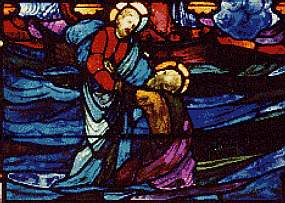
And in the fourth watch of the night he came to them, walking on the sea. But when the disciples saw him walking on the sea, they were terrified, and said, “It is a ghost!” and they cried out in fear.

But immediately Jesus spoke to them, saying, “Take heart; it is I. Do not be afraid.”

And Peter answered him, “Lord, if it is you, command me to come to you on the water.”

He said, “Come.”

So Peter got out of the boat and walked on the water and came to Jesus. But when he saw the wind, he was afraid, and beginning to sink he cried out, “Lord, save me.”

Jesus immediately reached out his hand and took hold of him, saying to him, “O you of little faith, why did you doubt?”
—Matthew 14:25-31 ESV

Why is this passage in the Scriptures? It wasn’t only for the early Church. What does it say to us in 2006?

The Lord commanded Peter and he came, but looked at the waves.

The Lord commanded the Israelites and they looked at the giants.

The Lord commanded Gideon and he looked at his circumstances.

They all had their senses attuned to the natural world, not the supernatural. They could see past their noses, but not past their preconceptions. They heard God, but relegated Him to a distant second place, choosing instead their fallen, shrill cry of faithlessness.

We are very much like them.

What troubles me is that we don’t have to be. God can do so much more if we believe:

When he entered Capernaum, a centurion came forward to him, appealing to [Jesus], “Lord, my servant is lying paralyzed at home, suffering terribly.”

And he said to him, “I will come and heal him.”

But the centurion replied, “Lord, I am not worthy to have you come under my roof, but only say the word, and my servant will be healed. For I too am a man under authority, with soldiers under me. And I say to one, ‘Go,’ and he goes, and to another, ‘Come,’ and he comes, and to my servant, ‘Do this,’ and he does it.”

When Jesus heard this, he marveled and said to those who followed him, “Truly, I tell you, with no one in Israel have I found such faith. I tell you, many will come from east and west and recline at table with Abraham, Isaac, and Jacob in the kingdom of heaven, while the sons of the kingdom will be thrown into the outer darkness. In that place there will be weeping and gnashing of teeth.” And to the centurion Jesus said, “Go; let it be done for you as you have believed.” And the servant was healed at that very moment.
—Matthew 8:5-10

Jesus, say the word and it will be done. No hesitation on the centurion’s part, none on the Lord’s in answering. And here’s the part that really wows: The centurion’s faith was so strong that Jesus didn’t even have to be in the presence of the centurion’s slave in order to heal.

How easy it is when we believe!

Times are not going to get easier for us Christians, though. There’s no cruise control on this car. Honoring Christ means believing the whole counsel of Scripture, not the parts that are easy to grasp, convenient to believe. Moving beyond our senses is at the core of Christian maturity.

One of the charismata is the gift of faith. You’ll get arguments from theologians as to what exactly that gift entails, but the one thing I know is that we all need to be praying that God would pour it out on us in full measure. We’ll need it in the days to come.