
Waiting

Standard

Wait for the LORD; be strong, and let your heart take courage; wait for the LORD!
—Psalms 27:14 ESV

The LORD is good to those who wait for him, to the soul who seeks him. It is good that one should wait quietly for the salvation of the LORD.
—Lamentations 3:25-26 ESV

Then they believed his words; they sang his praise. But they soon forgot his works; they did not wait for his counsel.
—Psalms 106:12-13 ESV

WaitingI’d like to believe that the American Church is filled coast to coast with people who wait patiently on the Lord. I’d like to believe that.

I know better, though. The part of American Church that causes problems is the American part. In America, we don’t want to wait for anyone or anything. To wait is to waste time when something can be done. Doing is all that matters. Or as it is in many cases, talking about doing, even if the doing never happens.

Here’s a line you never hear from the pulpit in America: “We’re not moving ahead on this until God gives us the OK. Until then, we wait.

For the Christian, waiting doesn’t mean doing nothing. Prayer and faith together make a difference. In fact, prayer and faith might just be what God is waiting to experience from us before the awaited result comes. Two little practices, yet how we forget to do them.

Whatever it is that we’re forgetting, our porous memory hurts our waiting.

The Psalm 106 passage quoted above shows that forgetfulness and impatience go together. We know what the Bible says, and we sing about God’s care for us, but we forget what He has done nonetheless, and therefore we charge forward, as if THIS time is the time in which He will not come through in his perfect timing. So, we grease the rails and proceed full steam ahead anyway.

Regular readers will recognize this familiar lament: The good is the enemy of the best. In the American Church, that should be engraved on every church doorway lintel.

Impatience yields not only bad results but good. The problem is that we get satisfied with good results and never give God the opportunity to deliver mind-blowing results. All because we could not wait on Him. All because we had to make something happen.

None of that is of faith, though. And sometimes, the result is devastating.

I wonder how much we miss as a Church in the United States due to impatience. I wonder how many once-vibrant churches no longer meet because they didn’t wait on God.

Or perhaps they did and were so enamored of one type of answer that they missed God’s answer when it finally came. Either way, the best didn’t happen for them. So they grumble and blame God for not coming through on their timing. Except He did; they just weren’t attuned to Him.

Impatience and an inability to hear God when He does speak in His timing are epidemic in today’s noisy, “make something happen” churches. Will it take an ethereal hand writing on the wall to get us to pay attention and listen?

I’d say that’s something worth waiting for, except we all know how it turned out.
Doom, and How God Frustrates It

Standard

Elijah didn’t die but ascended to God in a flaming chariot. Most of us know the story. Elijah was certainly a man of God.

Elijah was also something of a depressed prophet. He was always complaining about apparent circumstances, what he believed to be true about his situation. No matter the case, though, God never abandoned Elijah—far from it—and yet Elijah kept up the doom-saying.

One of Elijah’s “personal doom scripts” that kept running through his head was that the bad guys had killed all the other prophets and he alone was left. You read the life of Elijah in 1 Kings, and he repeated that script a lot.

God finally had enough of it:

[Elijah] said, “I have been very jealous for the LORD, the God of hosts. For the people of Israel have forsaken your covenant, thrown down your altars, and killed your prophets with the sword, and I, even I only, am left, and they seek my life, to take it away.” And the LORD said to him, “Go, return on your way to the wilderness of Damascus. And when you arrive, you shall anoint Hazael to be king over Syria. And Jehu the son of Nimshi you shall anoint to be king over Israel, and Elisha the son of Shaphat of Abel-meholah you shall anoint to be prophet in your place. And the one who escapes from the sword of Hazael shall Jehu put to death, and the one who escapes from the sword of Jehu shall Elisha put to death. Yet I will leave seven thousand in Israel, all the knees that have not bowed to Baal, and every mouth that has not kissed him.”
—1 Kings 19:14-18 ESV

And Elijah never again beefed about being the last one left.

God had His 7,000. God even had a successor to Elijah lined up. Despite Elijah’s office as prophet, he seemed blind to those possibilities. All he could focus on was the doom.

God has his 7,000 at all times. In your life and in mine, God has a form of that 7,000 on-hand and ready to supply.

Even if you don’t see it, that reserve exists. God had fed Elijah by ravens, but the prophet, so stuck in his doom, was unable to understand that provision or believe that God might have preserved other faithful followers to stand with him. All Elijah could see was his personal circumstance. God had to enlarge his vision.

Funny thing is, the prophet who followed in Elijah’s footsteps inherited nothing of his mentor’s doom and shortsightedness. A classic instance of how Elisha did better than his predecessor is found in 2 Kings 6. The king of Syria was frustrated because someone seemed to be telling all his plans to the king of Israel. Eventually, a servant told the Syrian king that Elisha was receiving this info supernaturally. The enraged king decided to put an end to that:

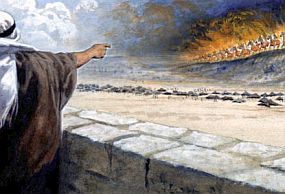
Elisha protected by GodSo he sent there horses and chariots and a great army, and they came by night and surrounded the city. When the servant of the man of God rose early in the morning and went out, behold, an army with horses and chariots was all around the city. And the servant said, “Alas, my master! What shall we do?” [Elisha] said, “Do not be afraid, for those who are with us are more than those who are with them.” Then Elisha prayed and said, “O LORD, please open his eyes that he may see.” So the LORD opened the eyes of the young man, and he saw, and behold, the mountain was full of horses and chariots of fire all around Elisha. And when the Syrians came down against him, Elisha prayed to the LORD and said, “Please strike this people with blindness.” So he struck them with blindness in accordance with the prayer of Elisha.
—2 Kings 6:14-18 ESV

Elisha understood that even in the midst of apparent doom, the apparency was an illusion. Something greater from God was present, and all it took was a greater vision of what God was doing. Elisha knew and could see what Elijah failed to: God frustrates doom.

Doom will never win because God is greater. Today, make that your personal script.

Three Faith Films–And What They Fail to Say about Faith

Standard

They’ve been calling 2014 the Year of the Faith Film. I know that in the evangelical community I tend to find myself thrust into, people were pumped about that. Perhaps Hollywood was waking up from its superhero love fest and rediscovering that the Good Book has its own caped crusaders (well, toga-ed, or whatever it is that they wore—you get the point) that can teach us about life.

So far, I’m not sure the Year of the Faith Film is delivering on its promise. And I wonder what that says about our understanding of what faith really is.

Three of those films have hit the cineplexes in recent weeks. I haven’t seen any of them. I’m not sure I would ever want to.

Noah has been called by its director “the least biblical biblical film ever made,” and at achieving this he seems to have succeeded, pulling from just about any ancient text outside the Bible that even hints at a flood narrative. He then offers us a man of “faith” whose righteousness appears to derive from despising anything that isn’t a fuzzy bunny, himself included. Rather than the LSD Methuselah slipped into Noah’s tea, Prozac may have been a better choice. Some have wondered if the director culled more from the works of J.R.R Tolkien and Timothy Leary than from the Jews.

God’s Not Dead is evangelicalism’s answer to Noah, pitting its faithful-to-a-fault, Christian-American, teen apologist against the evil college professor in a battle of hermeneutics, which everyone knows is the most gripping plotline any moviegoer could possibly hope for. And yes, there are other subplots, but they all add up to what amounts to an evangelical snuff film, where the most anyone can long for in life is to get one’s “fire insurance” and avoid hell. Should have titled this God’s Not Dead, But You Will Be.

Son of God purports to be about the life of Jesus. I heard a rumor that Justin Beiber plays Jesus. Or is it Zach Efron? Being a wizened curmudgeon, I get my teen heartthrobs mixed up. I also hear they cut out the devil because he looked too much like our current president. Also purportedly, the filmmakers saved time and cash by filming this movie alongside the making of their made-for-TV pseudo-epic The Bible. I think from what I’ve written, you get an idea of how unchallenging this film is. That I can’t recall anyone from my church claiming to have seen it may be the most damning statement I can make about it.

What these three films tells us about the state of faith in America 2014 is that no one, especially Hollywood, has one lick of an idea what it means to be faithful in the every day. God exists at the periphery of life, relegated to weirdos or to the moment of death or to some milquetoast interpretation of “faith” that has nothing to do with the guy who wakes up in the morning and hopes to connect to God amid the daily commute, a pile of unpaid bills, and the American Dream. Perhaps the superhero love fest does have more say to us (heck, even God Is Not Dead features the actors who played Hercules and Superman).

The reality of faith in God that the Bible holds out to each one of us is that it IS relevant to the mundane day-to-day. No sacred/secular divide exists, and Christianity is filled to the brim with truth that suffuses every part of life, which is what makes it worth living. God isn’t just there in the flood. He’s not just there when we die. He’s not a cleverly marketed and filmed made-for-TV-but-shown-in-the-theaters side project. God intends to be there in everything we do and to give those activities meaning.

Henry David Thoreau said that the mass of men lead lives of quiet desperation. If these three “faith” movies were the only gauge to what faith in God is all about, I can understand that desperation.

Perhaps it’s not possible to encompass the richness of a life found in Christ and jam it into a two hours of screen time. Filmmakers will keep trying, though. And I suspect they will keep failing.

Perhaps we don’t know what a genuinely Christian life looks like in America 2014. Certainly, a lack of models is one reason. We’ve made strange alliances with worldliness and can no longer extricate that worldliness from truth. Sometimes, we even call evil good and good evil.

The God of the Bible offers abundant life. His word speaks to all parts of human existence. He is our God both when we are kneeling in church and when we’re sitting on the john. All of life, especially the middle we can’t seem to ascribe to Him, is filled with His Life.

How we make that true and real to most of us has yet to be filmed. Or in America 2014, lived.