
I was called a “religious totalitarian” yesterday by a commenter on the Facebook page of my former pastor.
Anyone want to venture a guess why?
I’ll wait here for a second—
{“Final Jeopardy!” music plays while Dan hums the tune—}
Okay, time’s up.
I’ll preface the answer by saying that people can call me whatever they wish. I’m not zealous for my name but for the name of Jesus. And it’s for His name that I am shaken to the core by the reason why I got labeled a religious totalitarian.
My crime? I had the nerve to suggest that perhaps we need to work harder to teach Christians the Bible.
Yeah, my jaw dropped too.
There’s a growing trend in the Church that on the surface is a wonderful direction. More and more people are saying that when it comes down to it, knowing Jesus is what it’s really all about. If you’ve read my recent post on how to become a Christian, you’ll know that I end it with that same admonition. Eternal life is knowing Jesus.
Which is why I’m troubled by folks who go on and on about knowing Jesus yet have this perverse idea that they can get there by bypassing the Bible. 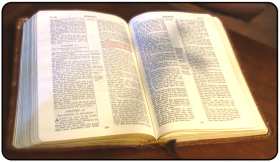 You’ve got to wonder what it is about the Bible that makes them so reticent to want to know it or have it taught. Even more so, you’ve got to wonder what is going on inside them that the mere mention of knowing the Bible throws them into hysterics.
I believe this reticence about knowing the Bible well enough to understand the overarching story, the major themes, and particulars about who Jesus is, why He came, how the Church should act, and how Christians should live is a frightening trend. People who are supposedly the People of the Book seem to not want to have anything to do with the Book itself.
But we can’t tell God how we want to grow. He’s already shown us in the Bible. Just three simple verses encapsulate it:
“Only be strong and very courageous, being careful to do according to all the law that Moses my servant commanded you. Do not turn from it to the right hand or to the left, that you may have good success wherever you go. This Book of the Law shall not depart from your mouth, but you shall meditate on it day and night, so that you may be careful to do according to all that is written in it. For then you will make your way prosperous, and then you will have good success. Have I not commanded you? Be strong and courageous. Do not be frightened, and do not be dismayed, for the LORD your God is with you wherever you go.”
—Joshua 1:7-9How can a young man keep his way pure? By guarding it according to your word. With my whole heart I seek you; let me not wander from your commandments! I have stored up your word in my heart, that I might not sin against you.
—Psalms 119:9-11All Scripture is breathed out by God and profitable for teaching, for reproof, for correction, and for training in righteousness, that the man of God may be competent, equipped for every good work.
—2 Timothy 3:16-17
Many of you know these passages. In fact, if you have ever memorized Scripture according to the Navigator’s Topical Memory System, they are key.
What cannot be escaped in these three is the power of the words of God. Power for courage and strength. Power for the avoidance of sin. Power for doing good works for the Lord.
People don’t give the 2 Timothy passage, as familiar as it is, enough power. Want to serve God? Know the Bible. Even if it’s the lowliest service there is, know the Bible. Did Stephen, who waited on tables in service to his Lord, give that profound testimony during his stoning based on ideas he pulled out of nowhere? No! He knew the Scriptures, and the Holy Spirit set fire to that knowledge even as the stones fell down upon that saint!
If God asks that of a waiter, how can we possibly say that we, who too often consider ourselves above that position, are exempt from knowing the Bible? And if we don’t know the words of God in the Bible, what kind of strength and courage do we expect to summon when the mob comes, rocks in hand, for us?
The fiasco at Lakeland, Florida, that happened last year (anyone still remember the hoopla?) centered around a man who claimed he could take people to the third heaven.
Want to go to the third heaven? I can tell anyone exactly how to get there (and beyond) and I don’t need a circus around me to do it. Start by building a foundation on the word of God. Know it. Live it. Breathe it. Then when we’ve mastered the fundamental core of it, we”ll see we’ve built a ladder to the very bosom of God Himself. And that’s a whole lot higher than any third heaven.
The context in which I got called a religious totalitarian was evangelism. The idea that had been floated was that evangelism is a mindset/paradigm and not a program.
Evangelism is a mindset, to a point, but the reason we have people in the Church who are scared to death to evangelize others is primarily because they don’t know the Bible.
If I claimed to be a nuclear physicist and was subsequently asked, based on the credentials I claimed for myself, to speak at a conference on the topic of string theory, do you think I’d be a little panicked if I knew nothing about that basic topic? Yet that is the case with most Christians. We have no ease in talking about the Faith because the most obvious revelation of that Faith, the Bible, remains a mystery to us.
How much easier would it be for us to talk about being a Christian if we better knew the Book that outlines the entirety of our Faith?
We can’t know God if we don’t know what He has said to us through the Bible.
We can’t know Jesus if we don’t know what the Bible says about Him.
We can’t discern right from wrong if we don’t know the Bible.
We can’t know how to live as a Christian if we don’t know the Bible.
We can’t know how to determine which spirits are truthful and which are liars if we don’t know the Bible.
We can’t know the voice of God if we don’t know the Bible.
We can’t make any progress in the Faith if we don’t know the Bible.
God has graciously given us His words because He has ordained that our growth toward knowing Him comes through those life-giving words He Himself spoke.
If you and I want to know Christ and to come to a place of deeper revelation, we simply can’t skip over the most clear document presented to us on how to begin that journey of knowing. That totality of knowing rests on growing in knowledge of God through the Bible. It’s the springboard for every aspect of growth we Christians may achieve.
So something is seriously wrong when Christians go on and on about their deep relationship with Jesus, yet they have a strange reluctance to embrace disciplined study of Scripture. You simply can’t have one without the other.
Several years ago at the church pastored by the pastor whose Facebook forum started all this, we started Wednesday night classes for adults. I offered to teach a course in the basic truths of the Bible. I had originally called it “Theology 101,” but I was told the word Theology was too loaded, so it was changed to something less high falutin’. Other classes were taught that night, about four or five, so people could choose which to attend.
I covered the basics in my class, like the nature of God, why Jesus is the sole way to salvation, and core doctrinal theology. Though scores of people in the church were new to the Faith, I had only a half dozen in my class. The class that got 95 percent of the many adults who attended Wednesday nights was “How to Move in the Power of the Spirit.”
When the three months of classes were over, I had one student left who had not jumped to the “Power of the Spirit” class. She was very grateful and blessed me mightily. When I confessed to her that I had not seen her around church, she told me she attended a different church, but that a friend from my church had told her about the class.
I learned a great lesson that day. Every Christian wants to jump straight to the third heaven, everyone wants to move in power, everyone wants to be a great saint, but next to none want to lay the actual groundwork that will get them to that place. They’re sitting in “How to Move in the Power of the Spirit” class, yet they don’t even know what God has revealed to us about His Spirit in the Book that He gave us.
In a previous post in this series, I said that you can trace a lack of dying at the cross to the reason that so many Christians burn out, walk away from the Faith, or never achieve great things for the Lord. I have to add ignorance of the Bible to that post mortem also.
If I claim to move in great charismatic gifts, I can erect a tent and people will fill it; but if I say that I know the Bible inside and out, no one’s going to toss Franklins into an offering plate on my behalf and tell me how wonderful I am.
The genuine way of Christ isn’t flashy. It happens in back rooms devoid of glory and acclaim, at kitchen tables wet with morning tears. It happens in the hearts of people who know there’s no way to cheat on God’s test to get that A+, so they study to show themselves a workman approved, even if that study demands some discipline and commitment.
So here’s to the so-called religious totalitarians who believe you can’t get to heaven on a roller skate. If that’s you, keep on keeping on, because your final reward will be incredible.
 Simple people often work simple jobs also, the kind that don’t get them a cover story on Business Week. Simple people who farm the land or work as greeters at WalMart aren’t the ones that churches push front and center when the photo op comes; they’ll choose the captain of industry with the Harvard M.B.A. And when Christian publishers fight to place another Christian Living bestseller on the top shelf of the local bookstore, they’re not beating down the doors of the old waitress at Denny’s, no matter what 50 years of walking close to the heart of Jesus has taught her. No, they want legitimacy, the kind found in clobbering home runs, or running a megachurch empire, or having once been a cohost on The 700 Club.
 I’m sure each of us could draw up a list packed with names of people or groups we would deem enemies of Christ.