
Afterward Jesus found him in the temple and said to him, “See, you are well! Sin no more, that nothing worse may happen to you.”
—John 5:14
Jesus stood up and said to her, “Woman, where are they? Has no one condemned you?” She said, “No one, Lord.” And Jesus said, “Neither do I condemn you; go, and from now on sin no more.”
—John 8:10-11
A long while ago—at least in the history of this blog—I wrote a piece called “Whatever Happened to Sin?” CMM adherents will recognize the title as being from an old Steve Taylor song. Jesus adherents will simply ask the question again. See, they remember sin.
In an age where Osteen-ism rules the land, we don’t hear much about sin anymore. Church growth pundits suspected sin didn’t play in Peoria, so they found a way to dismiss it. This explains why Christians crash and burn more frequently today than I remember. Or else their faith doesn’t hold up when the time of testing comes.
An ancient weapon used in war, the caltrop is a nasty piece of work. Throw them on a path or road and they land with a vicious spike always pointing straight up. History says the Romans came up with caltrops to permanently remove chariots from the battlefield.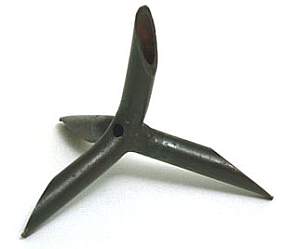 Wouldn’t want to be the horses—or the pitched rider.
The kind shown at right does its work on tires. Hollow, it allows air to rapidly escape even from self-sealing tires. Run your Pirellis over a few of these and you can forget your Roman Holiday.
Sin is like caltrops. Every time we sin, it’s like tossing a bucket of caltrops behind us. But what’s behind us is behind us, right?
Funny thing about life is we sometimes must revisit the way we came to get to where we’re going. And those sins we left behind? Well, they’re sitting in the middle of the road, sharpened steel tips up, waiting to put a halt to our journey—or at least make it nastier.
Weirder yet, sin’s caltrops have a way of landing behind us, yet winding up ahead of us at the same time. They get you coming and going. The double-whammy. They seem to to multiply ahead, too. Sow a bucket of caltrops behind, reap a highway-full ahead.
So when one of us finds our plans and dreams going up in smoke, when adopting that Osteen positive attitude makes no difference in the face of despair, do we ever take a step back and wonder if our sin finally caught up with us? I don’t hear people saying that this setback or that can be attributed to personal sin. Do you?
Sure, it might be obvious in the promiscuous girl who gets pregnant and lands in a beat-up trailer with an abusive Cro-Magnon of a husband got on the end of Daddy’s shotgun. But is it so obvious in the lives of mature Christians who stuff it down in hopes that no one will ever find out?
I’ve got to believe that at least some of the grief in your life and mine comes from running over the caltrops of sin we scattered on the road to glory. But where’s the sermon on fleeing sin? On repentance? On restitution?
Too outré? Too pietistic?
Perhaps we need some good old pietism in the Church today. After all, Jesus Himself confronted two folks in His part of the world and told them outright, “Stop sinning.”
I don’t know about you, but I don’t see any addenda from the Lord on that command. No “Only by God’s grace and power” or “You’re not the one in control, God is” or even a “You can’t do it in your own strength.” I just see the admonishment to stop sinning.
We used to revere men and women who wised up and stopped sinning. Now we try to find something wrong with their theology. Or we use that our own brand of theology to make excuses when one of us today tries the same approach only to fall back into sin. I’m beginning to wonder if folks two hundred years ago who turned and shunned their sin and never looked back AREN’T better people than we are today. They sure seemed to take God’s wrath a lot more seriously than we do.
After a promising start down the life’s highway, are we staring at four Bridgestones that look like deflated porcupines? Did we run over the consequences of our own sin, those nasty caltrops we sowed, the ones we thought would never catch up to us? They did, didn’t they?
Well, let’s not just sit there moping because past sins caught up with us. Clear the road! If we made the mess, we need to deal with it. And stop throwing the caltrops down, too! Yes, Jesus provides forgiveness. He forgave the man at the pool of Bethesda who tried to game the old familiar system. He told the hooker He didn’t accuse her. But He also told them both to stop sinning.
If life’s not treating you the way you want it to, stop sinning. And if not for you, then for your progeny. Because the sins of the fathers have a way of working themselves down through the generations. That promiscuous girl in the trailer with the abusive husband? Chances are that’s how her own mother got started. We can’t think our kids won’t inherit our little problems. (Note: Lying to oneself is a sin.)
So stop sinning. No excuses.
 I talk with a baby Christian who doesn’t have his doctrine down right and “I’m better than you” rattles around in my head, bouncing off every slightly off statement that newbie pronounces. I consider all the things I own, then look to some poverty-stricken soul in Africa, and I start singing the “I’m better than you” song.