
Doctrinal Silence and Spiritual Abuse

Standard

There are times when I think Jesus’ spitting on the ground and smearing the resulting mud over the blind man’s eyes gave too many Christians a supposed license to be weirdos in church on Sunday.

I’m not saying Jesus was out of bounds (He enjoyed perfect communion with the Father, remember), only that I wish more Christians showed wisdom in how they dealt with others.

So a guy comes up for healing prayer and is told to lie down while the people stack Bibles on him and then walk around him seven times while chanting. Did the Holy Spirit really direct the people praying to do this? REALLY? And was that direction verified, not only beforehand by checking with the elders but also by noting whether such an odd means of dealing with the problem actually resulted in a positive outcome?

Spiritual abuse has many forms. From bizarre charismania passed off as ministry to the cult of personality favored by some church leader “celebrities,” one can find some type of spiritual abuse in nearly every church. It’s just that most churches and the people in them are often too timid to point out their own failings. And the beat goes on…

While it may be easy for outsiders to walk into a church and immediately notice what might be “off,” people are far better at noticing a present problem than recognizing what is absent.

The issue for us as Christians today is what might be absent may form a more egregious example of spiritual abuse than the presence of any obviously bizarre practice.

Over at Church A, everyone talks about finding freedom in Christ (present) but no one ever talks about the perseverance of the saints (absent). Likewise, at the Church B, the talk is always that the shed blood of Christ on the cross bought healing from sin (present), but no one ever hears the blood and cross bought us healing from physical illness and disease (absent).

At Church A, the people there live in constant fear of losing their salvation. At Church B, people wrongly make peace with their physical sufferings and never take hold of the healing Christ bought them.

When we do not preach the whole Gospel to the whole man, are we not perpetrating spiritual abuse?

I’ve long been a fan of Leonard Ravenhill, the British revivalist. One of his consistent jabs was to call denominations “abominations” and then “correct” himself, as if he’d made a slip of the tongue. Let the nervous tittering commence.

When you get to the heart of this issue, though, the truth hurts, and I think that Ravenhill was closer to the truth regarding denominations than some think.

I enjoy musical theater, and one of my favorite musicals is South Pacific. The theme of that musical concerns racism and its devastating warping of people’s thoughts. The highlight song of that theme is “You’ve Got to Be Carefully Taught” (see video).

The problem with denominationalism and the conformance to one ingrained “brand” of Christianity over another is that such adherence not only teaches through the presence of ideas, it also teaches by absence. You’ve got to be carefully taught, and in many cases what is not taught is as important as what is. And it is the absent teaching that most often rattles people when they encounter other Christians who are content with a valid, present theological concept the “lackees” have never heard (or have been told doesn’t matter). More divisiveness enters the Church for this reason than any other.

If we are not preaching and teaching the entirety of the Gospel, if we pick and choose our theology so as to create doctrinal silence here and there, then it is likely that we are spiritually abusing those charged to our care.

The Wrong Kind of Hope for the Weak

Standard

Joe’s car broke down for the third time. He was late to work as a result, so he lost yet another job. To add to the insult, the power company turned off his electricity.  You know this because he’s posting online asking for help.

Again.

And his teen daughter is a skank who can’t keep her legs together. Everyone in the church knows how that will end.

Ox-sized Joe shows up in church wearing the most hideous clothes that look slept in. You wonder if he passed out on the couch. You wonder what may have lubricated that slide into unconsciousness.

Still, Joe occupies the same pew week after week, skanky daughter in tow. Part of you feels for the guy. His wife died of cancer at 30, and Joe never was much in the parenting skills department. Look what he has to work with too.

But week after week, Joe’s in crisis. He’s an embarrassment when you get right down to it. The neediness never ends.

Really, the man should learn some boundaries. What’s next? Whatever the issue, it will probably arrive in five, four, three…

Every church has a guy like Joe. Or three or ten. Bad luck seems to shadow those folks. Their laments come one after another, and your compassion tank has run dry. Just bringing up their names elicits squirms and eye rolls. Isn’t it the responsibility of the mature to force folks like that to stand on their own two feet? Isn’t it high time for the tough love?

Paul wrote this:

The eye cannot say to the hand, “I have no need of you,” nor again the head to the feet, “I have no need of you.” On the contrary, the parts of the body that seem to be weaker are indispensable, and on those parts of the body that we think less honorable we bestow the greater honor, and our unpresentable parts are treated with greater modesty, which our more presentable parts do not require. But God has so composed the body, giving greater honor to the part that lacked it, that there may be no division in the body, but that the members may have the same care for one another. If one member suffers, all suffer together; if one member is honored, all rejoice together.

—1 Corinthians 12:21-26 ESV

Weak brotherWhen we start talking about the weak, we rarely think of folks like Joe. Our thoughts go to the boy with cerebral palsy or the granny in the wheelchair, especially if that boy and granny don’t demand too much from us. As long as we don’t have to bail them out of endless predicaments, we can deal with their kind of weakness.

Fact is, that boy or granny may be stronger than Joe. Our opinion of problem people like Joe and his daughter and our thoughts they might be served better at another church may signal they are the weakest of all.

Every church has problem people we would rather avoid. If we were serious about what we believe, though, I think we must ask ourselves if it may be the “problem people” Paul intends for us to honor. Not the folks who would make good poster fodder for charities, but the ones who wouldn’t. The people who aggravate us. The ones who don’t know about “boundaries.” The ones we hope would go elsewhere for their spiritual food.

Do we have that wrong kind of hope for the weak? Do we hope the problem people would vamoose? Do we like to define who we think the weak are rather than letting God define them for us? Does God truly love the luckless Joes of this world and their skanky daughters?

Or does God only look proudly on the respectable people like us, the ones who can handle our own affairs without any help (thank you very much)? The ones who live as if we don’t need Him for anything.

You and I don’t get a say as to whom God declares weaker. Ours is but to do His will and make certain we honor those weaker people we sometimes wrongly hope would go away.

How to Ruin the Recipe for a Good Church

Standard

The Girl Scout cookies had arrived.

They say that the way to a man’s heart is through his stomach, and to this I must attest. At least for this man. In part, anyway.

Samoas are the bullet train between my cardiac and GI functions. All toasted coconut, chocolate, overcooked caramel goodness in a cookie.

I opened the box and examined the current iteration of the cookie.

Disappointed.

See, I remember back to the days of Ronald Reagan’s “America,” when a Girl Scout Samoa was a thing of epic scrumptiousness. A big ring of coconut not only run through with veins of caramel love, but at its core a solid ring of caramel that threatened to choke you to death if you ate the cookie too fast. As thick as an index finger, too, and the chocolate drizzled over that recipe of Samoa was substantial enough to be tasted in its own right. This was heaven’s own cookie.

Which is why the pathetic replica facing me disappointed so. That chewy ring of caramel? AWOL. Just a few streaks of caramel remained. The waxy chocolate barely made a difference in taste. The whole thing served only to remind me how badly this current cookie failed to live up to the gustatory genius of its forerunner.

It’s not a matter of cost, either. I think those of us who loved Samoas would have paid twice as much to get the old version that enslaved us so. I would.

No, it’s just the spirit of the age. More of that lowest common denominator decent into blandness and underperformance.

Some soulless bean counter sat in on a meeting somewhere and said, “People won’t miss _______ if we concede to cost realities.” He had to. Because that’s what bean counters do. Marketing then finds a way to spin the change when they should be the line of defense to say, “Whoa, Nelly!”

There’s always a way to make something worse. That the way to worse is so easy to find and implement…

The lesson for the Church  is to think and pray hard before jettisoning ANYTHING that is part of the recipe of the Church. If God is not specifically speaking by His Spirit to leaders regarding some big plan those leaders envision, just STOP. Chances are high that what comes out of the oven will be a tasteless disappointment.

Make a little change to a recipe and at first glance nothing may seem awry. Substituting corn oil for lard doesn’t seem wrong. Besides, it’s easier to find AND cheaper.

Tell that to the tasters when the goods are served.

But the neighbor’s recipe used oil!

The surest way for a local church to fall into the pit of lowest common denominator is to copy other churches.

Recipes are tricky. To replicate a successful one requires the precise amounts of the exact ingredients.

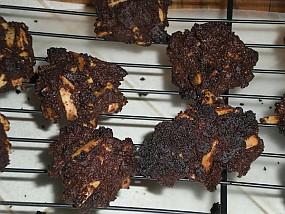
The same holds true for churches. Yet the conditions that led to success in one church are NEVER identical to the conditions at a different church. The Bible even notes this. Bad, burned cookiesWhen Christ speaks to the churches in Revelation, each has its own flavor, it’s own ingredients, it’s own challenges. The wrong mix of components (or the right components baked the wrong way), and the result is a flavorless brick. While flavorless bricks may sell to the unknowing, they are not satisfying.

Never replicate another church’s recipe. Doing so is the shortest route to the bottom.

Again, church leaders MUST listen to the Holy Spirit because He alone has the directions a local church must take. And those directions will most likely NOT look like the directions of some other church, no matter how successful the recipe at that other church might be.

Nor can a church make concessions. All of the world, society, and the forces of hell are allied in whittling down the Church one issue at a time.

Cheapen the ingredients. Call bad good. Cut corners in the recipe. Do what’s easier. Avoid the hard work. Rush the process. It’s what everyone else is doing anyway.

No one else will know, right?

Right?

Conceding to the spirit of the age leads only to a lowest common denominator Church, a bad, tasteless replica of the real thing.

I see the Church in America rushing toward the lowest common denominator. The converse, authenticity in Christ, is hard to develop and maintain, though. I realize that, but it’s what we need to aim for. Authenticity almost never looks cookie-cutter, which is why authentic churches have their own flavor and zest. Their ingredients are unique and hard to come by, but they follow God’s recipe to the T, and the result is delicious, just what the Master Chef intended.

Today’s church landscape is littered with a homogeneous blandness and lack of discernment toward the rapid approach of the lowest common denominator. If what was once perfectly salty becomes tasteless, what good is it except to be tossed out?