
Unless…

Standard

Unless...My favorite Dr. Seuss book is The Lorax. The eponymous main character looks something like an angry groundhog with a walrus mustache. Claiming to speak for the mute trees, he stands in the gap when the story’s narrator, The Once-ler, rides into the pristine forest with profit on his mind. As the Once-ler has his way with the world, despoiling every last square inch of land, chopping down every tree, forcing the forest creatures out, only the Lorax remains to stand up to him.

Many years later, in relating the sad tale of the destruction of the last truffula tree to a boy, the chastened Once-ler speaks these haunting words:

The Lorax said nothing. Just gave me a glance…
just gave me a very sad, sad backward glance…
as he lifted himself by the seat of his pants.

And I’ll never forget the grim look on his face
when he heisted himself and took leave of this place,
through a hole in the smog, without leaving a trace.

And all that the Lorax left here in this mess
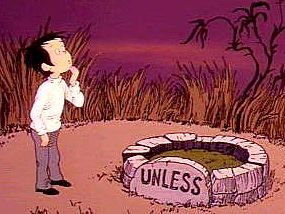
was a small pile of rocks, with one word…
UNLESS.
Whatever that meant, well, I just couldn’t guess.

That was long, long ago. But each day since that day
I’ve sat here and worried and worried away.
Through the years, while my buildings
have fallen apart, I’ve worried about it
with all of my heart.

But now, says the Once-ler,
Now that you’re here, the word of the Lorax seems perfectly clear.
UNLESS someone like you cares a whole awful lot,
nothing is going to get better.
It’s not.

The lesson of The Lorax goes far beyond a simple environmental message. It reinforces a Biblical truth that today’s Church in America best heed—the reality of UNLESS.

UNLESS we Christians share the message of Christ with the lost, they’ll endure eternal punishment for all eternity.

UNLESS we feed the hungry, they’ll succumb to malnutrition.

UNLESS we fight for justice for the disenfranchised, they’ll continue to be exploited.

UNLESS we visit the prisoner, they’ll die in a prison of their own loneliness.

UNLESS we minister to the sick, they’ll get sicker and perish, forgotten.

UNLESS we show the world love, it’ll never know what true love is.

UNLESS….

We can fill in a thousand statements behind that UNLESS, can’t we? The job Christ left us to do is vast and not getting any less so. We are the Body of Christ—His hands, His feet. And UNLESS we do the work He’s called us to, it simply won’t get done.
The Dry, Weary Land

Standard

Our grass is brown.

I don’t expect to see that the first week of June. Around these parts, May’s the wettest month of the year. Looking back over the month, though, I suspect we got about a fifth of what we normally get rain-wise.

Being of a profession—farming—that makes one acutely aware of a lack of precipitation, I recalled the pastor’s plea on Sunday for rain. All the farmers around here wear that same scrunched-face-to-the-sky look, as if squinting at the lack of clouds will somehow unloosen the water troughs of heaven. They know what’s at stake. Some people can trot out a garden hose to water their backyard gardens, but when you’ve got acre upon acre to “de-parch,” suddenly relying on the mercy of God to send rain moves into the realm of the essential.

So I spent most of the day watching the heavy clouds roll in—only to witness them lightly sprinkle, as if to spite the dessicated soil. An hour of churning skies yielded forty-seven seconds of piddly rain, not enough to be declared a moistening, much less a genuine rainfall. I could literally watch the tiny dark spots on the patio burn off with one blast of rays from the trailing sun. Repeat this three more times today and you get the climatological picture.

A Psalm of David, when he was in the wilderness of Judah. O God, you are my God; earnestly I seek you; my soul thirsts for you; my flesh faints for you, as in a dry and weary land where there is no water.
—Psalms 63:1

I know many Christians who seem just as dry and dusty on the inside as the landscape around here. And it’s not by choice. None desires that state of dessication. Sure, some people exist to soak up pity, but most Christians in those dry places are staring at the heavens with scrunched-up faces, wondering just what the deal is.

Hezekiah encountered the same dryness. Immediately following his healing from what appeared to be a terminal illness, we read this:

And so in the matter of the envoys of the princes of Babylon, who had been sent to [Hezekiah] to inquire about the sign that had been done in the land, God left him to himself, in order to test him and to know all that was in his heart.
—2 Chronicles 32:31

What an arid landscape, the human heart left to its own devices by a God who seems to have gone MIA.

Elsewhere, Job speaks:

“Behold, I go forward, but he is not there, and backward, but I do not perceive him; on the left hand when he is working, I do not behold him; he turns to the right hand, but I do not see him. But he knows the way that I take; when he has tried me, I shall come out as gold.”
—Job 23:8-10

The Lord promises to transform us into gold, from one degree of glory into another. But the process takes us through the dry, weary land, where bones bleach in the sun and every oasis mocks us.

Around 7:30 PM, we got our last drizzle. This one at least painted the gravel driveway a dark gray. The forecast calls for a week of blistering sun. I joined the chorus of farmers around 7:50 as we collectively sighed and wondered how a forecast of three days of thunderstorms yielded 0.1″ of rain.

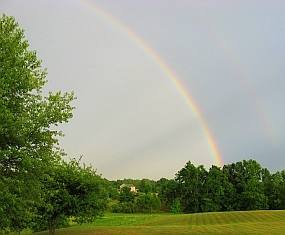
Mid-headshake, my son came into the house, face beaming, telling me he saw “a double.” A double what?, I thought.

On the south side of Edelen Acres, A double rainbow over Edelen AcresRoy G. Biv hunkered down alongside his twin brother. Two arcs of inverse colors bent across the sky.
I took this time to remind my son of the promise behind the sign, a promise that states that because of His covenant promise, God’s wrath turns away when He gazes from heaven upon the bow stretching across the sky. With all promises come hope, what lingers when all the prayers have been said and the mustard seed of faith is left to sprout in the soil moistened by God’s provision.

It’s a dry, weary land, but it won’t always be.

Tag, We’re It

Standard

Depending on which source you consult, the Baby Boomer generation ended in 1962 or 1964. I was born in the tail end of ’62. The Cuban Missile Crisis had my parents thinking they’d never see their first child born, but JFK held firm and the Russians blinked.

I don’t consider myself a Boomer, though. I never saw much boom. The world doesn’t cater to me the way it did for the real Boomers. If anything, my life experiences have reflected the Buster generation more than the one I supposedly belong to.

I say that because the Boomers are on the wane. They’ve run the Church in this country for the last twenty years. And their legacy…well, let’s just say it hasn’t been stellar. No matter what polling data you consult, the facts are in: the American Church isn’t doing well.

Funny how that is, though. Time and Newsweek run cover articles trumpeting the ascendancy of Evangelicalism at the same time that thinking Evangelicals are scratching their heads trying discover ways to stem the pervasive rot within. If it wasn’t so sad it would be a good snicker.

But as the Boomers ride into the sunset—at least the first wave of them—it strikes me that we’re it. Those of us in the 35-50 year old range are the new leaders.

How will we lead? Or are we even in position to lead at all?

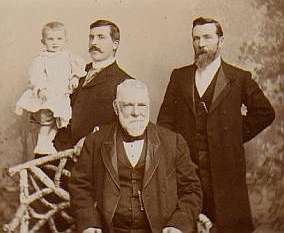
Some in the previous generation simply won’t budge, nor do they wish to share the stage with the up-and-comers. Four generationsThe Boomers won’t go quietly. Heck, they don’t do anything quietly, so why should they yield gracefully, especially with “The Legacy” issue still in place.

I think for a lot of Boomer leaders in the Church, their legacy stands incomplete so they’re going to stick around as long as they can. They’re seeing that their seeker-friendly churches cannibalized existing congregations more than they added new converts. And the converts they got through their dumbed-down Gospel haven’t really produced a lot of fruit. Those Boomer leaders tried but largely failed. And none of them want to leave on a down note.

A few young bucks decided to strike out on their own rather than labor in the shadow of some Boomer reluctant to give them a shot. I see guys like Mark Driscoll, Dan Kimball, and Rob Bell and wonder if they’re going to be the John Piper, Bill Hybels and Rick Warren of the future. Perhaps they already are, though they look little like their Boomer examples.

As for the rest of us in that 35-50 age group, folks, we’re it. Now’s the time for us to lead. We can’t be sitting around waiting for someone to mentor us. We need to be the visionaries. We need to be the ones mentoring. It’s grown-up time and we need to display some maturity. We can’t be sitting around soaking up the leftovers of the generation that came before us. We need to be seeking God for His direction through us.

By God’s grace, the Church is in our hands. What next?