

Skinless

Standard

Human head, skin removedMy wife is fond of saying that when particularly bad things happen, they leave you walking around as if you had no skin on.

I like that metaphor. To skinless people, even the most helpful touch is painful. Skinless people react to everything as if it were a threat. Many end up in a perpetually wounded state, which they grow to embrace, and any attempt to talk rationally with them fails miserably.

Long ago, being thick-skinned was a virtue. But somehow, in our enlightened day and age, the skinless person rules. They are the true untouchables. Because they blanch at every word and cry out when even a hint of salt comes near them (for their entire self is a great wound), they are the equivalent of the victimized fortress, impregnable by its very sensitivity to everything.

I look around and it just boggles my mind how skinless we are in the United States. It has become impossible to carry on a conversation with anyone who differs from you on a subject or  who needs vital correction. The skinless person howls in pain the second you open your mouth to speak.

When a skinless person makes like a banshee, all important conversation grinds to a halt. We have been culturally conditioned stop everything we are doing, because the skinless person has a right to remain skinless, to dwell in a constant state of vigilance against the salty words of the wise.

The conservative-liberal conversation is a skinless one that somehow finds a way to lose even more skin as years go by. And sadly, skinlessness exists in record amounts in the Christian Church in America.

“Touch not the Lord’s anointed” is bandied about by the most skinless in our churches. Plenty of leaders hide behind those words. They stand afar off, immune to correction, and their flocks suffer for it.

We have a tendency to also treat as skinless those “weaker parts” about which Paul writes (1 Corinthians 12:22), though some skinless people are legitimately so. Yet in too many cases, skinless people hide behind their skinlessness and never make any attempt to rectify their condition. They set about them a cabal of supporters who will testify to their skinless state and why it must be respected. Such skinless people and their enablers become the logjam in the Holy Spirit’s flowing river.

How do we in the Church in this country accomplish anything with so many skinless people around? They’re everywhere. And as long as they’re occupying space, the French saying applies: Plus ça change, plus c’est la même chose.

Dying of Thirst in the New Social Desert

Standard

My neighbor told me a few weeks ago that he bought his fifth-grade son a cell phone. As my neighbor is a bit of a Luddite and has resisted such things in the past, I was surprised. What surprised me more was his reasoning, which was nowhere on my radar screen.

Seems he bought the phone because his popular son had seen that popularity dwindle to zero.  And that sudden dive was strictly because the son was out of the texting loop. No cell phone meant no connection to the social structure of today’s tweens and teens. In reality, the boy had ceased to exist.

This last year has seen a sea change in social connection here at the Edelen household:

1. A Christian small group we were a part of for eight years ceased to exist. One by one, families dropped out until there were just two, each unsure what to do going forward. That group now no longer meets.

2. Another Christian small group we are a part of has now decided not to meet during the summer. That it also seems not to meet during the winter holidays means it’s  meeting only half the year now. Given that scheduled meetings are only twice a month anyway, that translates into about a dozen meetings a year total.

3. The writers group I am a part of has had its meeting schedule disrupted from the last Monday of each month to whenever we have enough submission work to warrant a meeting. The meetings have grown more and more sporadic as a result.

4. The worship team at my church attempted a regular practice schedule, but work responsibilities, involvement in outside sporting events for children, and on and on have translated into two practices in the last six months.

5. The Audubon group I’m a part of (as treasurer) had no scheduled events for spring and nothing scheduled so far for summer, the first time that has happened that I can recall.

The irony of all this is that many of the people in the groups mentioned above have joined Facebook in the last six months. We seem to have no trouble meeting in cyberspace.

I know that I’m kind of a crank on this subject, but do a handful of less than a hundred word comments on Facebook constitute social connection?

We all know this passage:

And let us consider how to stir up one another to love and good works, not neglecting to meet together, as is the habit of some, but encouraging one another, and all the more as you see the Day drawing near.
—Hebrews 10:24-25

I can’t read that passage and not shake my head. We seem to be becoming the some mentioned, the ones we are cautioned against.

When an 11-year-old boy vanishes from the social network of an elementary school for no other reason than his lack of a cell phone, something is horribly wrong. A dry, weary place without waterWhen we begin  to retreat into electronic worlds, abandoning the real one, we have, perhaps, reached that point of no return.
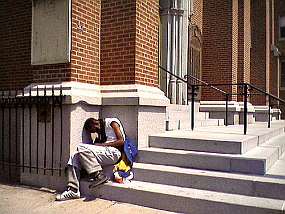
A child who merely wishes to put together a game of Kick the Can finds no playmates in the real world. Either the play is regimented according to schedule (organized kids sports) or relegated to an online world (Neopets, Webkins, et al.). Without a cell phone, even a child becomes a non-entity.

In recent days, I have considered seriously whether to begin extricating myself from the online system. While that will effectively make me invisible in today’s world, I wonder how much more of this we can take before we are no longer a society. If most communities go from face to face to virtual, I believe we will lose the very cues by which we understand each other.

Yet some are preferring this distant means of interacting. Tweet me, baby.

I don’t believe the new thing is better. While it may serve some basic purpose in communicating brief bursts of info, those brief bursts are increasingly ousting the longer forms of communication that define us as human beings. We are preferring them to meeting together face to face. We no longer assemble.

Our faith in rapid bits of impersonal communication may very well be creating a new social desert. Twitter’s 140 characters  cannot replace genuine interaction, though, despite how much some laud it.

I don’t have an answer for this. My thoughts on the subject swim against an increasingly powerful stream that is sucking everyone in. Going against the flow means becoming even less “connected,” even if that connection is all smoke and mirrors anyway. At least a mirror reflects something, even if it’s just an illusion.

You’d think the Church in America would have something to say about this. It has: satellite churches that beam the televised service to different substation halls. And people are eating that up. Rather than getting together during the week, some Christians prefer to connect online. So much for the real definition behind assembling.

Our society is already at that “every man for himself” stage. If we lose what little genuine community we still have, I don’t see how that will ever turn around.

Laying Down “Us” to Reach “Them”

Standard

If you were to ask me right in this moment what one thing I would really like to see change in the American Church, it would have to be our devotion to the cause of Us vs. Them.

More and more, it sticks in my craw when I am with fellow Christians and the Us. vs. Them talk starts up. Who are Them ?

Political liberals

Homosexuals

Abortion supporters

Jews

Muslims

Immigrants

Other races

Mainline Protestants

The promiscuous

The homeless

The poor

The lost

And so on

That list will look different for different people, but in short, Them are those people who are not Us.

You get into strange conversations with people who always think in terms of Us vs. Them. Try talking with an Evangelical who claims to love Israel yet complains about all the Jews running Hollywood, with its family-unfriendly movies filled with bad language and smutty imagery. A homeless man sleeping outside a churchOr the folks who go on and on about reaching the lost or ministering to the poor, yet who wish the Mexicans would go back where they came from. The disconnect is head-scratching.

I once had lunch with someone who made no pretenses to being a Christian. When I asked her why she liked living where she did, she said it was because the residents were so tolerant of others, not like those rednecks in the Midwest.

Too many American Christians have that same mentality. Its not only irrational, it’s ugly too. And its a large reason why so many people have tuned out the Church here. They know us by the culture war. They know us by whom we oppose. They have no idea of whom we are for. And if they’ve heard that old ’60s-era song “They’ll Know We Are Christians by Our Love,” they wonder inside when it was ever true. (Maybe back in the ’60s. But then, didn’t we all love each other back in the ’60s?)

Look, there’s not a Christian alive who hasn’t heard the parable of the Good Samaritan. Three-year-old kids who still wet their pants from time to time know that story. How come so little of it ever sinks in? The Us passed by. The Them loved. Jesus smashed the stereotype of Us vs. Them to smithereens in that parable.

Many of the greatest novels ever written contain the archetypal story of the hero who does good because he remembers his roots. He never lets himself forget his humble origins, and that remembering helps him change the world for the better.

I think that one thing Jesus Christ would like to impress upon many American Christians is that each of Us was once Them. And that the people who are most effective for the Kingdom of God are those people who never let themselves forget that truth.

The time of forgetting we were once lost is past, folks. It’s time to start laying down Us to reach Them.