
Thanksgiving? Thank the Lord

Standard

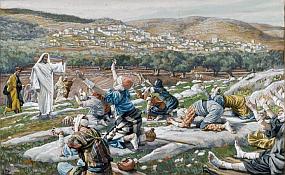
'The Healing of Ten Lepers' by James TissotOn this Thanksgiving, I will forgo commentary on the wickedness of keeping nonessential retail stores open this day or on the craziness of Black Friday. Instead, let’s consider this:

On the way to Jerusalem [Jesus] was passing along between Samaria and Galilee. And as he entered a village, he was met by ten lepers, who stood at a distance and lifted up their voices, saying, “Jesus, Master, have mercy on us.” When he saw them he said to them, “Go and show yourselves to the priests.” And as they went they were cleansed. Then one of them, when he saw that he was healed, turned back, praising God with a loud voice; and he fell on his face at Jesus’ feet, giving him thanks. Now he was a Samaritan. Then Jesus answered, “Were not ten cleansed? Where are the nine? Was no one found to return and give praise to God except this foreigner?” And he said to him, “Rise and go your way; your faith has made you well.”
—Luke 17:11-19 ESV

All our healing, all our hope, is found in Jesus. Not some, but all.

How can we not be thankful? How can we not be weeping with gratefulness?

More than anything I want my weeping to be in gratefulness to God for what He has given me despite my frailty, cravenness, and thoughts of self-worth. There is none worthy of those riches, not one. Not you. Not me.

I think much good would come if we Americans wept today because we are not worthy to have received all that we now possess. And it may be that unless we weep we may very well lose all those wonderful gifts because we have been so ungrateful, so unwilling to say that our own cleverness or resourcefulness has NOT gotten us those things apart from God’s mercy.

Don’t waste your thankfulness giving thanks to an ideal or a philosophy or your own talents. Give your thanks to the Lord. Be that tenth leper who was smart enough to know his source of blessing and come back to the feet of Jesus with praise and tears.
Real Christian Life–And Why Americans Are Missing It

Standard

Synchronicity is a funny thing.

Been wanting to write this post for a few days, but put it off. Then, on a “lark,” I listened to the podcast of Phil Vischer (of Veggie Tales fame). Having never heard the podcast before, I hoped it might nonetheless prove enlightening, especially since it talks about contemporary issues in the Church. And hey, so do I.  😉

Phil and cohosts Christian Taylor and Skye Jethani discussed a Hell House, the Christianized version of a haunted house, and how kits are now available to help churches use this “evangelistic tool.” Jethani notes that when we see the Gospel presented in Acts and Paul’s outline in 1 Corinthians 15, the apostles “fail” to mention hell or heaven, nor is sin discussed in the majority of presentations, yet what we preach today would focus on all three. Why is our presentation so unlike that of the apostles?

That in itself is a loaded question, but then Jethani hits my issue.

A speaker from Gospel for Asia came to my church Sunday. I support that organization (see the sidebar) because it’s doing a great work getting native missionaries to remote areas in Asia untouched by the Gospel. The numbers the speaker quoted regarding how many are coming to Christ in Asia were staggeringly large. And yet, all the while this man spoke, I kept wondering how it is that America never sees anything like that kind of explosive growth despite having so many “native” missionaries. How is it that we can’t preach the Gospel in a way that resonates with lost Americans?

The podcast clip below starts as Jethani and Taylor discuss what is not working with our Gospel presentation.

Jethani references the late Dallas Willard’s Vision, Intention, and Means concept to explain how Americans Christians are overloaded with means for growing in Jesus. The problem is that we lack vision for who Jesus is and subsequently have made pale substitutions of practical desires.

Yes.

If we Christians in America do not have a clear vision of who Jesus is, then we cannot communicate that vision to anyone else. As a result, if people already have a means for achieving personal desires, they won’t consider Jesus at all.

And this is the problem we find ourselves in.

Worse, Christians who default to seeing Jesus solely as a means for achieving personal desires (even the desire of heaven) will be unable to communicate the Gospel to people because that means of achieving those desires may not be as effective as the means chosen by that lost person. In short, we set ourselves up for having to be seen as a greater success in life than that lost person or else our “gospel” will fail. I’ve written about this before, but Jethani puts it all into the proper “lack of vision of Jesus” framework.

If the Church can’t communicate a real vision for Jesus and downplay this mentality of Jesus as desire-granter, then we will never understand what the Christian life is genuinely about.

Note that I did not say that Jesus never grants people’s desires. But any desire outside of Jesus as our unequaled primary desire is going to distort and weaken the Gospel message.

The American Church has got to stop with all the self-help and personal fulfillment junk and get back to raising up Jesus and focusing on relationship with Him. Nothing else matters.

Praying in Tongues

Standard

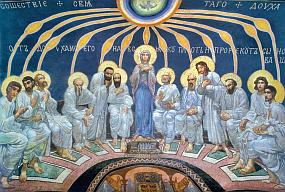
'Descent of Holy Spirit on the Apostles' by Mikhail Vrubel, 1885Speaking in tongues.

Just mentioning tongues gives many people pause. Tell others you speak in tongues and the stares come out. Talk about glossolalia (the fancy term for speaking in tongues) in polite company (heck, any company) and you’ll be branded forever. It’s not enough that being a Christian separates you from other people, speaking in tongues separates you from other Christians, as a minority of Christians today in the West care to deal with tongues. In short, if you’re in a group and desire to be left alone, talk excitedly about speaking in tongues.

What the Bible says:

To each is given the manifestation of the Spirit for the common good. For to one is given through the Spirit the utterance of wisdom, and to another the utterance of knowledge according to the same Spirit, to another faith by the same Spirit, to another gifts of healing by the one Spirit, to another the working of miracles, to another prophecy, to another the ability to distinguish between spirits, to another various kinds of tongues, to another the interpretation of tongues. All these are empowered by one and the same Spirit, who apportions to each one individually as he wills.
—1 Corinthians 12:7-11 ESV

Now you are the body of Christ and individually members of it. And God has appointed in the church first apostles, second prophets, third teachers, then miracles, then gifts of healing, helping, administrating, and various kinds of tongues. Are all apostles? Are all prophets? Are all teachers? Do all work miracles? Do all possess gifts of healing? Do all speak with tongues? Do all interpret?
—1 Corinthians 12:27-30 ESV

For one who speaks in a tongue speaks not to men but to God; for no one understands him, but he utters mysteries in the Spirit. On the other hand, the one who prophesies speaks to people for their upbuilding and encouragement and consolation. The one who speaks in a tongue builds up himself, but the one who prophesies builds up the church. Now I want you all to speak in tongues, but even more to prophesy. The one who prophesies is greater than the one who speaks in tongues, unless someone interprets, so that the church may be built up.
—1 Corinthians 14:2-5 ESV

I thank God that I speak in tongues more than all of you.
—1 Corinthians 14:18 ESV

So, my brothers, earnestly desire to prophesy, and do not forbid speaking in tongues. But all things should be done decently and in order.
—1 Corinthians 14:39-40 ESV

Likewise the Spirit helps us in our weakness. For we do not know what to pray for as we ought, but the Spirit himself intercedes for us with groanings too deep for words. And he who searches hearts knows what is the mind of the Spirit, because the Spirit intercedes for the saints according to the will of God.
—Romans 8:26-27 ESV

For if I pray in a tongue, my spirit prays but my mind is unfruitful. What am I to do? I will pray with my spirit, but I will pray with my mind also; I will sing praise with my spirit, but I will sing with my mind also.
—1 Corinthians 14:14-15 ESV

{emphases mine…see below}

I quoted a lot from 1 Corinthians. In truth, reading chapters 12-14 of that book are  essential for understanding the Bible’s teaching on this spiritual gift of tongues (and the other gifts too).

Unpacking truths and realities about speaking in tongues

  • 1 Corinthians 12:7-11 and 1 Corinthians 12:27-30 seem clear to me (though not to all Pentecostals, for certain) that the spiritual gifts a person receives from God vary according to God’s purposes. God apportions gifts as He alone sees fit. Paul’s many “do all?” qualifiers appear to me quite obvious that the answer to his rhetorical question is no. No, not everyone fills every Church office or has every spiritual gift. So despite what many of my Pentecostal brethren believe, I don’t think that tongues is an automatic gift for everyone. Paul’s desire that everyone speaks in tongues may be wish fulfillment more than anything else given that he already notes that Spirit-endowed believers don’t always manifest all the gifts. That the early Church had its clear prophets and nonprophets says that when Paul wishes everyone would prophesy, that was not the case for everyone either. Feel free to disagree with me here, but I don’t see those verses mentioned as supporting all gifts for all people at all times. And that includes tongues.
  • That said, we should always desire all the gifts, even if we do not receive them all. I can’t support this thought fully from Scripture, but I would not rule out that God may impart a gift for a season or for a specific need at a specific time—but don’t quote me on that.
  • As for “my spirit prays but my mind is unfruitful,” science actually backs this up. PET scans of tongue-speaker’s brains shows none of the intense activity related to language when a person is speaking in tongues. Even more surprising is that a person faking speaking in tongues DOES show high-level language activity. So clearly, something is going on that is beyond natural when a person speaks in tongues. (See “A Neuroscientific Look at Speaking in Tongues” and “Why We Talk in Tongues,” both New York Times articles and NOT from Charisma Magazine.)
  • That latter NYT article above notes a recent Pew Research Center  survey that claimed 18% of Americans spoke in tongues several times in a year. If so, that’s one of the most underreported spiritual facts I’ve ever noted. We’re talking almost one-fifth of the American populace—and that’s just those who self-reported.
  • Paul writes, “Do not forbid speaking in tongues.” That ends any arguments right there. Sadly, that may be the most ignored Scriptural command in the Bible.
  • Tongues comes last or near last in lists of spiritual gifts in the Scriptures. While it’s the most obvious supernatural gift due to its vocal nature, Paul also downplays some of its importance by placing it a distant finisher in importance to prophecy.
  • While the most commonly considered use of tongues is to build up the Church through the combo gift of the interpretation of tongues (so the tongues may bless everyone, even those who do not understand them otherwise), Paul also mentions praying in tongues. And that’s the gist of this post.

Praying in tongues: the what, the why, and three benefits

What is praying in tongues? It’s using the gift of tongues in one’s prayer life, whether in private or in public prayer for others. Pretty simple.

Why pray in tongues? Well, we have the example of Paul and his other notes to us on the function of this gift. Since Paul writes his readers that he is worthy of being imitated (1 Corinthians 4:16), if he prays in tongues, then so should we.

And what are some benefits of praying in tongues?

  • Praying in tongues is a means of continuing in prayer when normal words fail. I endorse that fully. Sometimes, as the Scriptures say, we don’t know how to pray. Tongues removes that roadblock. As noted, the language centers of the brain get bypassed, going around the roadblock. This is a truly spiritual event. It’s the Spirit of God in us teaming with our spirit to connect with the Father and get to the root of a matter. Think of it as broadband rather than dial-up. (I will add that for those who do not have the gift of tongues, perhaps their normal prayer life is naturally more fruitful as is OR they are less likely to find themselves stymied in prayer.)
  • Praying in tongues regularly produces immediate well-being. Though I should be used to it by now, I am regularly surprised how quickly praying in tongues can improve a situation, especially if it is personal and related to mood or physical health. “The one who speaks in a tongue builds up himself” is most definitely true! When praying in tongues by oneself, peace is often the first feeling encountered. This reflects God’s mercy and is one of the strongest reasons that we should pray in tongues. Heaven knows we all need more peace in our lives.
  • Praying in tongues will take us deeper. Because this is spirit to Spirit communication, and the Spirit of God searches all things, praying in tongues may address deep-seated issues in an individual. This includes granting spiritual healing and release from habitual sin. Those roadblocks mentioned earlier? Not all are language. They may be keeping spiritual ground from being plowed, unusable as is for planting good things from God. Tongues cut through and may help break up that fallow ground in a person’s life. Much good comes from allowing God to work in us through tongues. Again, we allow God to build us up through this gift.

Many more benefits exist for praying in tongues, but as I see it, these three are indisputable and indispensable. Please feel free to share your wisdom in this or your own positive personal experiences with tongues in the comments below.