Largest Churches in America, 2013 Edition

Standard
Largest Church in America? Lakewood Church

Largest Church in America? Lakewood Church in Houston

The Outreach Magazine 2013 list of 100 largest churches in America is out. This year, it also features a second list for fastest growing.

What’s immediately notable to me is not which churches are on the list but the ones missing. Outreach says that churches voluntarily report through its survey, so it may be the case that a church secretary left the envelope sitting on her desk a little too long. Still, off the top of my head, these half dozen notable churches (with reputed membership numbers) are not on the list:

LifeChurch.TV, Craig Groeschel, pastor – 40,000

World Harvest Church, Rod Parsley, pastor – 30,000

Cornerstone Church, John Hagee, pastor – 17,000

First Baptist Church of Hammond, John Wilkerson, pastor – 17,000

Mars Hill, Mark Driscoll, pastor – 13,000

Church on the Move, Willie George, pastor – 12,000

In fact, the Outreach list contains few controversial churches. Missing are the largest Word of Faith churches, and many with charismatic/Pentecostal roots. Fundamentalist churches are missing. While this may be by design, it still makes me wonder.

I’m not endorsing any particular church, but if we want a genuine feel for what is happening out there, that I can think immediately of a half dozen churches not on that list makes its usefulness as a data source suspect.

I also wonder at this fascination with gigachurches (as megachurch is passé). While they tend to have a lot of clout when it comes to producing slick programming, I wonder how many new converts they generate per person attending. This list of gigachurches forces me to ask if unreported revival has broken out in America, since the country is able to sustain all these monster-sized churches. And yet, a simple looksie at the state of America shows us less spiritually attuned than we once were, given that our country is becoming more tolerant of sinful behavior as time passes. So what, if anything, are these gigachurches accomplishing?

Thoughts?
Is Today’s Church in the Grip of a New Christian Romanticism?

Standard

As I was doing the nightly cleanup at home and prep for the next day, I was struck by a thought.

In the mid- to late 19th century, Christianity in America was in the grip of a post-war romanticism. The following were characteristics of the Church in that era:

Devotion to social issues, particularly justice for groups deemed oppressed

God as lover and wooer

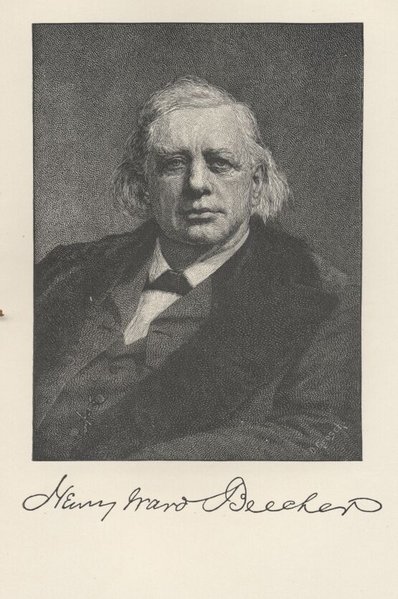
Henry Ward Beecher

Henry Ward Beecher

Hymnody that captured the romance between God and Mankind

Pastors with national followings and “fans”

Dramatic presentations of the Christian message

Emphasis on the role of women in religious service and leadership

Concessions to contemporary science and pseudoscience

Concessions to cultural and societal “progress”

Questioning of traditional models of Christian thought and practice

Infatuation with End Times prophecies and fulfillment

Henry Ward Beecher was the pastoral icon of that era, and his views were strongly in accordance with those characteristics above. Indeed, he was called the Most Famous Man in America for promulgating his new “brand” of Christian faith.

When I look at “Christian” America today, so much of it parallels that time of Reconstruction between 1865 and 1890, it’s scary.

In what ways do you think we are (or are not) seeing a revisiting of Christian romanticism with the features noted above? Who would you nominate as the Beecher of our day?

What Is the “World System”? And Why Should Christians Be Wary of It?

Standard

Earth from Apollo 17I’ve been reading the New Testament out loud with my son this summer. We are working  through each book in as large a chunk as we can so that we retain the original intentions of the writers.

One of the things I’ve noticed more deeply as we’ve moved rapidly from epistle to epistle is that most every writer warns believers about the world system. We all know that warning exists, but a quick move from one book to another really drives home that these writers were deeply concerned about that world system and how it negatively impacts the Christian life.

Here is a classic example of such a warning, but in a slightly different translation (J.B. Phillips’s New Testament in Modern English, the one we are reading) than some are used to:

Never give your hearts to this world or to any of the things in it. A man cannot love the Father and love the world at the same time. For the whole world-system, based as it is on men’s primitive desires, their greedy ambitions and the glamour of all that they think splendid, is not derived from the Father at all, but from the world itself. The world and all its passionate desires will one day disappear. But the man who is following God’s will is part of the permanent and cannot die.
— 1 John 2:15-17 (NTME)

We tend to make the world system in that verse into little more than some bad things that we shouldn’t do, usually associated with the “flesh” and any sin that directly proceeds from our physical bodies. Today, abortion, sex outside marriage, and homosexuality would immediately be lumped into that world system as things we Christians should avoid—and rightfully so.

But that’s too simplistic an understanding of the world system. The NT writers ask for us to be wary of much deeper issues.

My question for readers:

What parts of our daily existence do we NOT question

as to their place in the present world system?

Is it possible that Christians make peace with parts of that world system because those parts make us comfortable? How much of daily living in the United States circa 2013 embraces the world system without our acknowledgment—or our ire?

Given how often the NT writers address this issue (a brief overview of which can be found through Xenos Christian Fellowship), are we paying less attention to it than we should? And if so, what do we do about correcting that lack?

Your thoughts and insights are greatly appreciated.