
When Christian Celebrities Crash and Burn

Standard

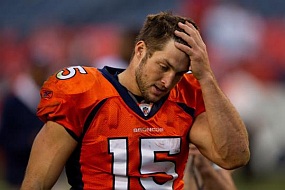
Tim TebowWith a recent long losing streak and a new coaching philosophy in New York, Linsanity is dead.

As of yesterday, Tim Tebow is riding the bench again and likely will be traded.

Two evangelical sports stars are now no longer lighting up the heavens. And that’s OK.

Well, it’s OK with me. Some other people may be taking Tebow’s and Lin’s descents hard. Seems we have a way of doing that when it comes to Christian celebrities. Christian sports stars are particularly ripe sources of adoration, but as the old axiom goes, the bigger they are, the harder they fall.

There is something desperate in evangelical Christian circles to be both taken seriously and liked enormously. Whenever a Christian “comes out” in Hollywood, it gets trumpeted in every Christian media outlet that follows popular culture. Somehow, it becomes news by the sheer force of will of people who are struggling to hold onto the idea that Christians are just as cool as everyone else—and possibly cooler. Like moths to a flame, Christian media outlets stampede to dub some Christian sports, music, political, or film sensation the next Great Christian Hope and the model for us all to emulate. That many of these celebs have a Q Score in single digits and often show up in a higher number of direct-to-DVD film productions seems not to trouble the true believers.

And then there are the celebrity pastors/preachers and their all-too-visible ministries.

Aside from the B-list nature of most Christian celebrities in the entertainment industry, once in a while we get some notable Christians in sports, with Jeremy Lin of the NBA Knicks and Tim Tebow of the NFL Broncos being the latest headline grabbers. Tebow has endured a level of scrutiny I wouldn’t wish on a presidential candidate, while Lin suddenly had all of Asian sports hopes dropped on his Ivy League shoulders. We Christians only made the hype worse, finding ourselves compelled to comment and to wish the very best for these golden representatives of Our Side®.

Then comes the inevitable fall. In the case of Christian celebs, that fall comes in the form of either some sin that becomes public or a rapid descent into averageness or irrelevancy.

This troubles the true believers to their cores because, honestly, their true believerdom is much shallower than they care to admit. It is as if the success of a Christian celebrity somehow is essential to proving true our Christian beliefs. Sadly, the triumph of a Christian in the public eye is too often seen as validation not only of the existence of God, but also that He favors us Christians above all other people.

I’ve been around a while, and I can say with all assurance that more often than not, our dependence on Christian celebrities to confirm our beliefs fails. And often fails spectacularly. We may no longer trust in chariots (Psalm 20:7), but we still trust in humans to meet our need for validation. Yet there is no more fragile receptacle for faith than fame. That it gets in the way of the Gospel far more often than it boosts it should be obvious to most Christians. Yet when the latest celeb comes around, we’re hopping on the bandwagon in droves. If experience should have taught us anything, it is that such bandwagons have an affinity for cliffs.

We won’t know who the real superstars in the Faith are until we get to other other side. Curiously, the overwhelming majority will be folks we never heard of. I suspect that’s the way the Kingdom works best. God doesn’t need celebs to advance the Gospel. He needs dedicated, mostly average, anonymous people who aren’t impressed by worldly accolades. In America 2012, those folks are rare indeed.

So please, can we stop with the hero worship? Clay feet are part and parcel of this world, and too many of the modern Christian heroes of our own creation come equipped with deluxe models. No one should be surprised, yet we always are, which only makes us look silly when a Christian celebrity we hyped to the max crashes and burns.

We don’t need celebrities to prove our beliefs true. Jesus more than validated Himself. Of course, God added the “This is my beloved Son, with whom I am well pleased. Listen to Him!” If we can’t trust God, then what’s the point?

Jesus had no need for a Q Score, and neither should we.

Grown-Cold Love

Standard

And Jesus answered them, “See that no one leads you astray. For many will come in my name, saying, ‘I am the Christ,’ and they will lead many astray. And you will hear of wars and rumors of wars. See that you are not alarmed, for this must take place, but the end is not yet. For nation will rise against nation, and kingdom against kingdom, and there will be famines and earthquakes in various places. All these are but the beginning of the birth pains. “Then they will deliver you up to tribulation and put you to death, and you will be hated by all nations for my name’s sake. And then many will fall away and betray one another and hate one another. And many false prophets will arise and lead many astray. And because lawlessness will be increased, the love of many will grow cold. But the one who endures to the end will be saved.
— Matthew 24:4-13

Anymore, I’m always hearing about these being the last of the Last Days. With the Mayan calendar nonsense sucking in Christians and with handwringers already lamenting the as-yet-undecided outcome of the 2012 presidential election, apocalypse now isn’t just a movie title.

cold heartOne of the characteristics most noted of the degenerates that will run amok during the Last Days is the fact that their love for God will have grown cold.

But wait a second. As much as we can’t stop talking about Those Other Guys Who Are Most Definitely NOT Us and their grown-cold love for God, are we reading that passage correctly?

Does it really say that the love of many for God will grow cold?

No, it doesn’t delineate what that love is or for whom. We are the ones reading God into that passage.

The fact is, the Bible never attempts the fission of love into factions, love for God versus love for people. Indeed, it explicitly states we must avoid that separation:

If anyone says, “I love God,” and hates his brother, he is a liar; for he who does not love his brother whom he has seen cannot love God whom he has not seen.
— 1 John 4:20

Could that possibly be more clear?

So how is it that we almost never talk of falling away from God in terms of falling away from loving other people?

And how is it that the comments on so many Christian websites are filled with supposed lovers of God channeling their ire toward their brothers and sisters in clearly hateful ways? How is it that supposed lovers of God can so gleefully rejoice when a foe gets his comeuppance? How is it that supposed lovers of God can be downright cheerful at the prospect of bombing other people “back to the Stone Age”?

I would suggest that perhaps the better way to determine if our love has grown cold is to ask how much we love people outside our immediate families, especially those we view as sinners. Even better, how much do we love our enemies? If the answer is not much, then perhaps we have already fallen away, no matter how loudly we sing in church or how many chapters of our Bibles we read religiously each day.

If we want to take the pulse of our times, if we want to be on the cutting edge of calling these the last of the Last Days, then perhaps the reality that most of us can’t get along with other people at all says more about the state of our souls than any other test for Christian perfection.

Because it’s not enough to talk about love for God growing cold. If those of us who claim we love God can’t even muster a warm smile for the checkout girl at the grocery store, then all the claims for loving God we espouse till we’re blue in the face won’t hide the fact that we have fallen away and don’t even know it.

The $1,551,466 Christian

Standard

The Christian Church spends $1,551,466 to make one convert.

That figure comes from the World Christian Encyclopedia published by Oxford University Press in 2001. Accurate or not, even if the number were a tenth that, it’s still staggering. Remember also that it’s 2012, and money doesn’t go as far today, so the figure would be even higher now.

Only Apple has the warchest to spend that kind of money to get a customer. Even then, at that rate, its half-trillion dollars wouldn’t last long enough to generate a sustainable client base.

Simply put, if the Church were a business, it would be bankrupt. Marketing and sales would get the blame.

But the Church isn’t a business; it’s a collection of people joined by Jesus Christ, empowered by the Holy Spirit, and tasked with a mission to make disciples. Given that $1,551,466 figure, the inescapable conclusion is that someone is not doing his part of the mission. Or is at least doing a mind-bogglingly ineffective job of it.

So, what is the fix?