
An Old Guy Listens to Branded by Undercover

Standard

It says something about my taste in Christian rock/pop that I stopped buying most of that genre’s music sometime during the mid-90s.

As for the oldies, I get them out every once in a while.

The other day I had to take a little trip, so I went down into the musical vault and pulled out a helping of Undercover, the seminal Christian “punk pop” band of the 80s. Yes, 80s. (To show my advanced age, I actually still own a Living Epistles T-shirt emblazoned with “No Surfing in Hell,” which I was told was a riff on one of Undercover’s tunes. And yes, I’m a bit embarrassed now that I was once dying to own a T-shirt like that.)

Anyway, I used to really enjoy Undercover’s happy, surf-skater-punk sound. Then they got a new lead singer and moved the band in a harder, darker, more introspective direction.

That direction produced the 1986 album Branded (link to lyrics). If you were to ask me what the top three Christian rock albums of all time were, Branded would have to be on that list.

I got out the Undercover, Anthology 1 double-CD the other day. It contains all of Branded, plus the previous three albums by the band.

Wow. I still love Branded. A great collection of music. Not a bad track on the entire disc.

{Update: I removed the link to my favorite song off Branded, “Where Can I Go,” because of questions of the legality of the source on YouTube. I talked with a copyright expert who let me in on all the weirdness and exceptions regarding such things, but I felt that discretion won out here, so I took down the embedded video.}

What are your favorite Christian “oldies” from the 70s and 80s?

Bunnies at the Tomb

Standard

That’s no ordinary rabbit! That’s the most foul, cruel, and bad-tempered rodent you ever set eyes on!
—The Wizard Tim, Monty Python and the Holy Grail

Santa Claus I can deal with. The Easter Bunny drives me nuts, though.

At least with Santa you can trace him back to an old Christian saint. The Bunny, however, exists solely as a fertility symbol that has been traced back to the murky, disputed goddess Eostre and pagan celebrations of springtime among Germanic peoples.

It’s possible to play down Santa Claus for Christmas. But the eggs, chicks, and bunnies are everywhere.

Last weekend, my son won a game at the YMCA that was manufactured by a historically conservative Christian publishing house. easter_bunny.jpgThe game talked explicitly about the Resurrection, but it married Easter eggs, chicks, and bunnies to that story so intimately that it was impossible to extricate the two. In the end, it came down to battling messages, Jesus’ gory and brutal, with the bunnies’ all warm and cuddly.
Though I had an Easter basket as a child and participated in more than my fair share of egg hunts, I didn’t become a druid. I don’t go on a yearly pilgrimage to Stonehenge.

Still, it bothers me that it is so hard to cut through the competing messages to find what is real. My own son seemed to get plenty geared up for egg hunts and bunny-related ideology, but the resurrection didn’t garner the same enthusiasm.

“Our triumphant holy day” is how my favorite Paschal hymn labels it. That the highest holy day in Christianity must compete with foggy imagery from a forgotten diety of questionable origin bugs me to no end.

Unlike some other nations where a dictator makes proclamations that determine practice, Americans watch what is best and brightest in our culture and body politic erode through the constant dripping of one watery drop of concession after another. In time, the end result is a canyon. Our reaction? “Wow, now where did that come from?”

Maybe I’m just an excessive, joyless crank, but when you see the end result, when it becomes impossible to separate the resurrection of Christ from bunnies and chicks, it’s hard not to think that the goddess and her barnyard have won the war in the hearts of too many people.

Farewell, Shekinah

Standard

Around Holy Week, we reflect on the passion of Christ and read the historical record of His death and resurrection. And every year I am struck by this verse:

And the curtain of the temple was torn in two, from top to bottom.
—Mark 15:38

While many note that the rending of the curtain signifies that we could now approach God wholly on our own through Jesus, I also see in that singular act a devastating indictment and warning. For with the curtain’s tearing came the departing of God’s shekinah glory from the temple.

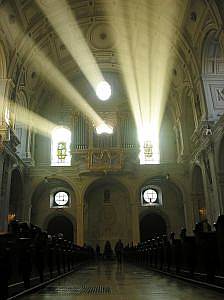
What staggers me in that departing is that for nearly forty years afterward, until the destruction of the temple in A.D. 70, Elsewhere, the light is shining...the Jews continued to perform their religious duties in the temple as if nothing had changed!

Didn’t anyone notice that the glory of God no longer dwelt there? No one? Didn’t the high priest say to himself, “You know, something’s different”?

If a history book exists that details the angst the Jewish priesthood felt in the aftermath of the curtain’s tearing, I haven’t read it.

No, the shekinah glory of God departed and no one seemed to notice.

Read that again. Seriously.

We need to ask ourselves this: If the Jews of that day, who were a stringently devout people in practice, didn’t sense that the glory of God had departed, what does that imply of people who are barely spiritually aware?

Though God no longer dwells in temples made by human hands, abiding instead within each believer, a symbol of the shekinah light exists in the New Testament:

Remember therefore from where you have fallen; repent, and do the works you did at first. If not, I will come to you and remove your lampstand from its place, unless you repent.
—Revelation 2:5

Might the Lord remove His lampstand from among the unrepentant today? (Would anyone care to test Him? I certainly don’t.)

But the greater question here is, If God so removed His lampstand, would we even notice? I mean, are we that much more spiritually aware than those post-torn-curtain religious leaders of the Jewish nation circa A.D. 33?

As for me, I wouldn’t gloat by saying yes. As it is, our churches and our people today don’t seem much like the vibrant, miracle-filled, God-aware believers found in the Book of Acts.

Which leads me to wonder where that puts the American Church circa A.D. 2009. Declining attendance figures, worldliness, no love for the lost, unrepentant and divided hearts—has the lampstand already been removed? And if so, would we even know it?

Or might we simply continue performing our little religious rituals week after week, never realizing that the shekinah glory of God has moved on to a better place.