

Unless…

Standard

Unless...My favorite Dr. Seuss book is The Lorax. The eponymous main character looks something like an angry groundhog with a walrus mustache. Claiming to speak for the mute trees, he stands in the gap when the story’s narrator, The Once-ler, rides into the pristine forest with profit on his mind. As the Once-ler has his way with the world, despoiling every last square inch of land, chopping down every tree, forcing the forest creatures out, only the Lorax remains to stand up to him.

Many years later, in relating the sad tale of the destruction of the last truffula tree to a boy, the chastened Once-ler speaks these haunting words:

The Lorax said nothing. Just gave me a glance…
just gave me a very sad, sad backward glance…
as he lifted himself by the seat of his pants.

And I’ll never forget the grim look on his face
when he heisted himself and took leave of this place,
through a hole in the smog, without leaving a trace.

And all that the Lorax left here in this mess
was a small pile of rocks, with one word…
UNLESS.
Whatever that meant, well, I just couldn’t guess.

That was long, long ago. But each day since that day
I’ve sat here and worried and worried away.
Through the years, while my buildings
have fallen apart, I’ve worried about it
with all of my heart.

But now, says the Once-ler,
Now that you’re here, the word of the Lorax seems perfectly clear.
UNLESS someone like you cares a whole awful lot,
nothing is going to get better.
It’s not.

The lesson of The Lorax goes far beyond a simple environmental message. It reinforces a Biblical truth that today’s Church in America best heed—the reality of UNLESS.

UNLESS we Christians share the message of Christ with the lost, they’ll endure eternal punishment for all eternity.

UNLESS we feed the hungry, they’ll succumb to malnutrition.

UNLESS we fight for justice for the disenfranchised, they’ll continue to be exploited.

UNLESS we visit the prisoner, they’ll die in a prison of their own loneliness.

UNLESS we minister to the sick, they’ll get sicker and perish, forgotten.

UNLESS we show the world love, it’ll never know what true love is.

UNLESS….

We can fill in a thousand statements behind that UNLESS, can’t we? The job Christ left us to do is vast and not getting any less so. We are the Body of Christ—His hands, His feet. And UNLESS we do the work He’s called us to, it simply won’t get done.
Tag, We’re It

Standard

Depending on which source you consult, the Baby Boomer generation ended in 1962 or 1964. I was born in the tail end of ’62. The Cuban Missile Crisis had my parents thinking they’d never see their first child born, but JFK held firm and the Russians blinked.

I don’t consider myself a Boomer, though. I never saw much boom. The world doesn’t cater to me the way it did for the real Boomers. If anything, my life experiences have reflected the Buster generation more than the one I supposedly belong to.

I say that because the Boomers are on the wane. They’ve run the Church in this country for the last twenty years. And their legacy…well, let’s just say it hasn’t been stellar. No matter what polling data you consult, the facts are in: the American Church isn’t doing well.

Funny how that is, though. Time and Newsweek run cover articles trumpeting the ascendancy of Evangelicalism at the same time that thinking Evangelicals are scratching their heads trying discover ways to stem the pervasive rot within. If it wasn’t so sad it would be a good snicker.

But as the Boomers ride into the sunset—at least the first wave of them—it strikes me that we’re it. Those of us in the 35-50 year old range are the new leaders.

How will we lead? Or are we even in position to lead at all?

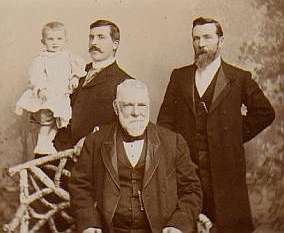
Some in the previous generation simply won’t budge, nor do they wish to share the stage with the up-and-comers. Four generationsThe Boomers won’t go quietly. Heck, they don’t do anything quietly, so why should they yield gracefully, especially with “The Legacy” issue still in place.

I think for a lot of Boomer leaders in the Church, their legacy stands incomplete so they’re going to stick around as long as they can. They’re seeing that their seeker-friendly churches cannibalized existing congregations more than they added new converts. And the converts they got through their dumbed-down Gospel haven’t really produced a lot of fruit. Those Boomer leaders tried but largely failed. And none of them want to leave on a down note.

A few young bucks decided to strike out on their own rather than labor in the shadow of some Boomer reluctant to give them a shot. I see guys like Mark Driscoll, Dan Kimball, and Rob Bell and wonder if they’re going to be the John Piper, Bill Hybels and Rick Warren of the future. Perhaps they already are, though they look little like their Boomer examples.

As for the rest of us in that 35-50 age group, folks, we’re it. Now’s the time for us to lead. We can’t be sitting around waiting for someone to mentor us. We need to be the visionaries. We need to be the ones mentoring. It’s grown-up time and we need to display some maturity. We can’t be sitting around soaking up the leftovers of the generation that came before us. We need to be seeking God for His direction through us.

By God’s grace, the Church is in our hands. What next?

Modern Evangelicalism: An MAO Inhibitor?

Standard

A pharmacological cornucopia!I rarely watch more than two hours of TV a month, so I’m no expert on ads or what’s happening in the TV scene. No matter how little TV you may consume, it’s darned near impossible not to encounter a plethora of Big Pharma ads hawking this prescription drug or that. See enough of those ads and its clear that every single drug on the market comes contraindicated whenever the prospective user’s downing MAO inhibitors, a type of antidepressant that comes with some serious side effects and warnings.

MAO is monoamine oxidase, an enzyme in the body critical for proper neurological functioning, hence the use of MAO inhibiting drugs for treating nervous system diseases. Are you yawning yet? Ready for the tangential slide?

Okay, here it comes…

The Godblogosphere’s been bloated with enough posts on “returning to Rome” to gag the Pope and all his Cardinals. A few noted Evangelical leaders jumped the Reformation Ship and the handwringing, fingerpointing, and accusations flew. In other words, typical Evangelical Sturm und Drang.

Amid the voluminous posting on this leap from Evangelicalism into the Roman Catholic Church (heck, one post I read even had Elisabeth Elliot pining for the papacy), plenty of volcanic theological discourse erupted, but I heard very little about MAO—the other MAO, that is.

The MAO I speak of is Mystery, Awe, and Otherness. You know, the stuff modern Evangelicals jettisoned on their way to a bookshelf full of systematic theologies, dusty pages of do’s and dont’s, and three-points-and-a-conclusion sermons. In their rush to be real and down to earth, Evangelicals found a way to make God dull. In short, modern Evangelicalism has become a theological MAO inhibitor.

I can’t help but think that most of these “un-converts” who fled to Rome did so in part because of the radical vivisection Evangelicalism got away with concerning the Body of Christ. I happen to believe that God placed in each one of us a yearning for mystery, awe, and otherness. That desire drives us to God as the source for all meaning, even if that meaning can never be fully grasped. This isn’t postmodernism’s vacuous “There can be no absolute truth” stupidity, but a genuine recognition that God is wholly other and therefore contains an element of mystery that generates awe in those who encounter Him.

How so? Remember when you basked in the throes of the first ache of passionate love? The object of your affection seemed like some strange creature from another planet that you’d walk across burning coals to know, even if that knowledge was little more than a favorite book he or she loved. Remember that first kiss? The electricity! That mystery, awe, and otherness found in the kiss of your beloved! (Song of Solomon explodes with mystery, awe, and otherness, doesn’t it?)

Now imagine kissing your sister. (Or your brother, as the case may be.) Where’d all that passion go? Now imagine Evangelicalism turning every day supposedly devoted to passion into just another day of kissing your sister. Now who can blame anyone for bolting that dry familiarity for a place that still kindles mystery, awe, and otherness?

Don’t get me wrong. I’m solidly in the Reformation camp. I see the RCC as a dead-end and always have. I feel sorry for anyone so seduced by a need for mystery, awe, and otherness that they’ll abandon truth for it.

Yet I still understand why they do it.

So plenty of Evangelicals go slack-jawed at these bolters who make for the Seven Hills. They’ll go on and on with analyses—psychological, theological, and otherwise—in their attempts to understand why they couldn’t keep ’em down on the Reformation farm. But sadly, they’ll never ask “What did we do wrong?” See, that question begs an answer and the answer gets a bit too close to the heart of the problem. Evangelicals today are loathe to put the words we and wrong in the same sentence, so they affix blame anywhere they can so long as that anywhere doesn’t involve looking in a mirror.

In the end, it does little more than make me tired. The false either/or propositions about what we should do and believe. The tired arguments against emotion. The constant sniping about mystery. If Evangelicals want to drive it all out, then they shouldn’t be surprised that people go elsewhere looking to fill that God-given need for mystery, awe, and otherness. Folks will go to the RCC, to the Orthodox, to whatever source fills that vital need. They’ll look for a way to stop taking the MAO inhibitors the self-appointed “doctors” of the Evangelical Church prescribed.

And someday Evangelicals will scratch their heads and wonder where all their adherents went.