Last year, the well-known physicist Stephen Hawking admitted he was wrong about one of his pet theories concerning black holes. In the rarefied academic air, this amounted to a near recanting of biblical proportions. But Hawking’s admitting that his formulas can’t accurately describe what takes place in the physics world within a black hole was no death knell for his career. The truth is, no one has been able to accurately describe what happens on the brink of a quantum singularity.
If you don’t already know, black holes form when very large stars die and collapse in upon themselves, creating an incredibly dense piece of matter—a quantum singularity—whose mass is so enormous that it warps the fabric of space itself into a giant, nearly bottomless well. If you’ve ever seen one of those parabolic coin games where you roll a coin along the edge and it progressively travels in tighter and tighter circles until finally falling into a hole at the end of the funnel, then you’ve seen the basics of a black hole at work. Once matter gets trapped beyond a certain point of the black hole’s tug of gravity (the “event horizon”), that matter, be it dust or even a massive star, can’t escape the gravity grip of the singularity, in the process possibly being totally destroyed even down to the subatomic level.
Physicists for years have tried to explain the physics behind black holes and their singularities with astonishingly little success. The problem is that all the physics we hold dear (from Einstein’s relativity theories to Maxwell’s equations) cease to work the closer one gets to a quantum singularity. Physicists see cracking the physics behind a black hole as one of the true Holy Grails in physics. Whoever manages to do it will join the pantheon of greats right up there with Albert E. himself.
This brings us to John Calvin and Jacobus Arminius.
You’ve probably heard those names tossed about if you’ve been a Christian longer than a year or two. Both of these men proffered different takes on the “quantum singularity” of Christian theology, how people technically come to (and stay with) Christ.
Let’s take a look at the basics of each:
Five Points of Arminianism
- Conditional Election – Election is based on the faith or belief of men.
- Universal Atonement – The atonement is for all, but only believers enjoy its benefits.
- Saving Faith – Man, unaided by the Holy Spirit, is unable to come to God.
- Resistible Grace – The drawing of the Holy Spirit can be resisted.
- Uncertainty of Preservation – This doctrine was left open to inquiry.
Five Points of Calvinism
- T = Total Depravity – Man is completely a sinner, without any hope of helping himself.
- U = Unconditional Election – God elected saints to salvation when they had no merit at all. God did not look down upon the earth and see some sinners believing, therefore elected them to salvation, but He looked down upon the earth, and saw all were sinners, therefore elected some to salvation.
- L = Limited Atonement – The atonement is limited to the elect.
- I = Irresistible Grace – It is impossible for a sinner to resist salvation once the Holy Spirit begins drawing him.
- P = Preservation – A saved person will be saved forever, and will live a holy and Godly life.
(Thanks to Pastor Wayne Reynolds for the quick overviews of Calvinism and Arminianism.)
These two streams of belief divide the Protestant world almost in half (there are other belief systems that don’t adhere perfectly to either stream, but they are not majority groups.) Most American denominations that arose out of the Second Great Awakening follow Arminianism and, technically at least, are the Evangelicals we hear so much about. Churches like The Assemblies of God or Methodists are representative. The “Old Line” Presbyterian or Reformed churches are Calvinist, but have muddied the water by occasionally assuming the title “Evangelical” in order to sound like they are up to date with the rest of the Protestant churches out there.
These two streams have slugged it out for a long time. Interestingly enough, the blogosphere is becoming a battleground for these two points of view, with blogrolls developing that highlight bloggers who ascribe to one view or another. I have read so many blog posts lately that can be condensed to “Only Calvinism is Truth” that I have lost count. Anyone who has stumbled into such a debate can attest to the viciousness that often results in defense of one position or another.
Now comes the point in this post where I alienate every single one of my readers.
A physicist like Stephen Hawking is brilliant enough to be able to describe the way virtually all of the universe works from a physics standpoint. He can tell you how it is possible to hit a kilometer-wide target on a moving planet, something NASA does effortlessly (most of the time). He can tell you how gravity works, and light, and the weak force, and electromagnetism…in short, virtually everything we know about how the universe works, he can explain. But he can’t explain what happens on the brink of a quantum singularity.
Likewise, I wonder if John Calvin and Jacobus Arminius are not in the same bind as Hawking when it comes to theology. I contend that perhaps what Calvin and Arminius are trying to describe are the edges of where Jesus wants His true followers to be. It is possible I think, that God never intended us to be hanging out at the brink of the theological quantum singularity Calvin and Arminius address.
Another way of looking at this: If you have teenagers or have ever worked with them, you know that on the issue of sex it is inevitable that you will get asked the question, “Well, how far is too far?” Wise people understand that this is actually the wrong question, but the kids don’t. I suspect that this may be the case in the Calvin/Arminius debate, too.
Take a look at the issue of Preservation of the Saints, for instance. Arminians typically believe it may be possible to wander away from God and lose one’s salvation. Calvinists would argue that this is impossible, contending that if such a thing were to happen the original nature of a person’s “conversion” would be suspect.
But isn’t this like the black hole issue? Jesus calls us to be His disciples and the point of being a disciple is to stay at the Master’s feet, not to toy around with “How far can I wander away and still be saved?” Nor is it a matter of saying, “I can get away with just about anything because He won’t cast me out.” Don’t we see how both of those are skirting the edges of where we need to be as disciples? Those are “brink of the quantum singularity” thoughts—not where the Lord wants us to focus. Sadly, a lot of people get sucked out of the rest of the Christian universe and get stuck at the event horizon of such ideas, forever trapped by the power of one stream or the other. This results in a great number of causalities out there in the pews.
We all know people who have been crushed by their struggles at the brink of this theological quantum singularity. But there is a whole universe of faith as a disciple where those forces don’t have to tug us down a hole. In truth, they may very well be moot points for a person who seeks only to please the Lord in all he or she does.
Ours is a love relationship with the Lord of the Universe. This is more important than the mechanisms that get us there and keep us there. Discipleship is like a marriage between Christ and the disciple—divorce is out of the question and the engagement is merely a formality once the marriage is consummated. We can’t live like the man who asked to bury to his parents, or the one who looks back over his shoulder at what is being left behind.We simply cannot live at the brink; true disciples want to be in the center of the Lord’s will. We do what the Lord asks and are content in doing so.
And maybe that is where the Lord would prefer we all be.
I know this is a contentious issue. R.C. Sproul is probably already scratching my name off his mailing list. So if you have comments, please feel free to leave them—with all humility and love for the brethren, of course. (In other words, take a deep breath and count to ten before you post!)

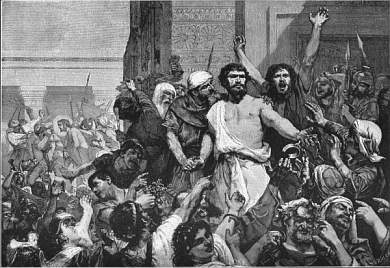 Those in the crowd knew the reputation of the man called Barabbas—as well as the reputation of the innocent man who stood in contrast to him on Pilate’s dais. They knew that Barabbas had victimized others through robbery, murder, and general thuggery. The other man, however, had taught them, healed them, given them hope, and relentlessly pointed them to God.
 Everyone’s favorite Vulcan, Star Trek‘s Mr. Spock, was forced to deal with illogical humans on a daily basis. But as any casual observer of the show knows, Spock was routinely stymied by the fact that the illogical humans got results. He was even forced to think like them on occasion. In one classic episode, Spock blew the mind of some robots even more logical than himself by resorting to illogic in order to save the crew of the Enterprise.