
Review: The Simple Faith of Mister Rogers

Standard

I’m so convinced that the space between the television set and the viewer is holy ground, and that what we put on the television can, by the Holy Spirit, be translated into what this person needs to hear and see.
—Fred Rogers

It was not originally my intent to blog about Mister Rogers twice in ten days, but when I saw the new book The Simple Faith of Mister Rogers by Amy Hollingsworth, I had to bite. As a child I had watched Rogers’s show without fail. As an adult, I actually lived down the street from Fred Rogers when I attended Carnegie Mellon University in the early ’80s. As the Pittsburgh PBS station where he filmed his show was right next to my dorm, Rogers would religiously walk by my window in the morning on his way to work. I ran into him a few times and he was always gracious and granted you his full attention. With Fred Rogers, you were always the most important person in the world for the time he gave you in conversation.

The Simple Faith of Mister RogersAs author Hollingsworth so duly notes, my experience was the norm. After having interviewed Rogers in 1994, she began a correspondance and friendship with him that lasted until his death in 2003. What passed in many of those exchanged letters comprises much of the book, Hollingsworth letting us see the faith of the man behind the TV show, behind the ministry it was to him, and behind the simple way in which he treated the stranger as his neighbor.

Part biography, part devotional, and part a memoir of the author, this book’s core shows how Fred Rogers lived out the Gospel by caring for others in the gentle way that often made him the butt of jokes from people who could not understand what he was doing. That this should be a reflection of the Savior is no coincidence, for Rogers was an ordained minister in the United Presbyterian Church. Confounding his seminary profs, Rogers sought that ordination despite having no intention of pastoring a local congregation. But when he made the case that every child, every adult who tuned into his show was his church, the seminary granted him ordination.

Rogers’s vision for reaching people through the medium of television fill this book. In one case—a real hankie moistener—a boy who was horribly abused by his parents tells the author that his one respite was Mister Rogers’ Neighborhood. The boy never lost hope that there were good people in the world because he saw how much everyone cared for and respected each other on the show. Lauren Tewes, cruise director “Julie” of The Love Boat fame, relates that the Rogers’ show actually helped her heal from an addiction to cocaine. No chapter goes by without some person telling how Rogers transformed life through his show.

Mister Rogers’ Neighborhood ran for 900 episodes and Fred was the the creative spark behind every one. A trained pianist, he provided the background piano music for the show, and wrote over two hundred songs. His earlier experience with puppets in a show that ran before Neighborhood allowed him to communicate in a language children could relate to. It was his willingness to be vulnerable and to discuss difficult issues—my son and I watched the “Death of a Fish” episode recently—that made him like Jesus to everyone who tuned in.

Like the Lord, Rogers was a man of prayer who rose every morning at 5 a.m. to pray and read the Scriptures. Like the Lord, Rogers understood that silence is a critical part of a deep life, and he was unafraid to model silence and quiet for children. Like the Lord, Rogers saw potential in even the most scarred person, unfraid to reach out to the hurting, no matter what anyone else thought. Like the Lord, he wanted the little children to come to him and be loved, in spite of their circumstances. His greatest hope was that viewers would grow up to be all that God imagined they could be.

What you bring to this book will determine what you can hope to receive in reading it. Because of her close personal relationship with Rogers, the author writes with a tear in her eye that shows on every page. The book is so personal in countless ways that it is virtually impervious to critique. Fred Rogers comes off as a mythic person, saintly in a way that the vast sea of Mankind is not—Superman in a zippered cardigan and Keds. I suspect readers of this book who were impacted by Rogers’ show will see it as true to its subject, but naysayers will find all the treacle they know is inevitable in a book written about someone who was almost too good to be true.

Even if you don’t know which category you are in, give this swiftly-read book a try. Somewhere in its 165 pages it’s guaranteed to soften even the most hardened curmudgeon.
The Message of Salvation in a Nutshell

Standard

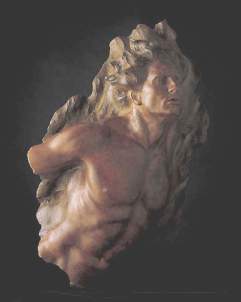
Frederick Hart's 'Ex Nihilo Fragment Five'A few days ago, I posted The Christian Walk in a Nutshell. Well, after someone in another forum asked to sum up the message of salvation, I decided to answer with as terse a layout of that message as I could—right from the Bible. I hope all who visit this blog will find this very simple (and easily memorized) collection of passages to be helpful in sharing with others:

For all have sinned and fall short of the glory of God….
—Romans 3:23

For the wages of sin is death, but the free gift of God is eternal life in Christ Jesus our Lord.
—Romans 6:23

This is the second death, the lake of fire. And if anyone’s name was not found written in the book of life, he was thrown into the lake of fire.
—Revelation 20:14b-15

But God shows his love for us in that while we were still sinners, Christ died for us.
—Romans 5:8

“For God so loved the world, that he gave his only Son, that whoever believes in him should not perish but have eternal life. For God did not send his Son into the world to condemn the world, but in order that the world might be saved through him. Whoever believes in him is not condemned, but whoever does not believe is condemned already, because he has not believed in the name of the only Son of God.”
—John 3:16-18

Jesus said to him, “I am the way, and the truth, and the life. No one comes to the Father except through me.”
—John 14:6

And Peter said to them, “Repent and be baptized every one of you in the name of Jesus Christ for the forgiveness of your sins, and you will receive the gift of the Holy Spirit.”
—Acts 2:38

Therefore, if anyone is in Christ, he is a new creation. The old has passed away; behold, the new has come.
—2 Corinthians 5:17

And this is the testimony, that God gave us eternal life, and this life is in his Son. Whoever has the Son has life; whoever does not have the Son of God does not have life. I write these things to you who believe in the name of the Son of God that you may know that you have eternal life.
—1 John 5:11-13

{All passages taken from the English Standard Version of the Bible.
Photo: Frederick Hart‘s “Ex Nihilo, Fragment Five”}

Doubt: The New Faith?

Standard

There’s a new phenomenon sweeping the Church in America, the Gospel of Doubt. Questioning the veracity of the Bible, questioning whether doctrine has any worth today, and questioning the need to live out the traditional bedrock assumptions of the Faith have all become standard fare for today’s Christians.

In what has become almost a fad among the spiritually trendy, Doubt has become the new Faith. The heroes of the faith today are not those who stand firm in the midst of trials, but those who quiver with doubt that anything good can come out of tough times. Job’s cry of faith, “I know that my Redeemer lives,” has been replaced with “There is a chance my Redeemer may actually not live.”

We are watching a revisioning of what is worthy of admiration occur in just a decade. Those who routinely express their doubts are now considered the most spiritually mature, the most worthy of imitation. This trend is so new that the language of doubt is still wet on the page, but look for more nominally Christian books discussing it to show up on the shelves of your local bookstores soon.

Postmodernism is partly to blame for this trend. The rejection of assurance in a relativistic age makes heroes of self-proclaimed seekers and villains of those who advocate any kind of certainty. But did our Lord hold up doubt as something to admire? His words say otherwise:

Then [Jesus] said to Thomas, “Put your finger here; see my hands. Reach out your hand and put it into my side. Stop doubting and believe.”
—John 20:27 NIV

Then Peter got down out of the boat, walked on the water and came toward Jesus. But when he saw the wind, he was afraid and, beginning to sink, cried out, “Lord, save me!” Immediately Jesus reached out his hand and caught him. “You of little faith,” he said, “why did you doubt?”
—Matthew 14:30-31 NIV

Jesus replied, “I tell you the truth, if you have faith and do not doubt, not only can you do what was done to the fig tree, but also you can say to this mountain, ‘Go, throw yourself into the sea,’ and it will be done. If you believe, you will receive whatever you ask for in prayer.”
—Matthew 21:21-22 NIV

The New Testament has other admonitions:

For in the gospel a righteousness from God is revealed, a righteousness that is by faith from first to last, just as it is written: “The righteous will live by faith.”
—Romans 1:17 NIV

Without weakening in his faith, [Abraham] faced the fact that his body was as good as dead—since he was about a hundred years old—and that Sarah’s womb was also dead. Yet he did not waver through unbelief regarding the promise of God, but was strengthened in his faith and gave glory to God, being fully persuaded that God had power to do what he had promised.
—Romans 4:19-21 NIV

But we are not of those who shrink back and are destroyed, but of those who believe and are saved.
—Hebrews 10:39 NIV

If any of you lacks wisdom, he should ask God, who gives generously to all without finding fault, and it will be given to him. But when he asks, he must believe and not doubt, because he who doubts is like a wave of the sea, blown and tossed by the wind. That man should not think he will receive anything from the Lord…
—James 1:5-7 NIV

Clearly, we do understand that people who are unquestionably Christians do doubt from time to time. But we should never make an altar to doubt. Doubt is the shadow of faith and is, therefore, a pale reflection of the truth. We need to resist it, not make it a virtue lest we find ourselves to be a powerless Church. We must remember that it was in Jesus’ own hometown that we see the fruition of doubt:

He could not do any miracles there, except lay his hands on a few sick people and heal them. And he was amazed at their lack of faith.
—Mark 6:5-6 NIV

We should not be surprised, though, at this elevation of doubt over faith. It is the sign of the times and will persist till He comes again, for the Lord Himself warns:

However, when the Son of Man comes, will he find faith on the earth?”
—Luke 18:8b NIV

If we Christians make doubt the new faith, the answer to Jesus’ question is sadly obvious.