
Is Church for Believers Only?

Standard

Reading an intriguing post about Ted Haggard and his return to the role of pastor triggered a long-held belief of mine:

Church is meant for believers only.

When I consider the state of the American Church, I’ve got to think that our emphasis on encouragingSainte-Chapelle church stained glass lost people to come to our church meetings has only succeeded in diluting our ultimate effectiveness. As it is said: The good is often the enemy of the best.

The early Church model was to send believers out, beyond the doors of the assembly. They shared Christ out in the streets. When the lost outside responded to the message and became believers, they were brought into the church assembly proper.

Today, though, we have believers bringing the lost into the church assembly with the hopes that the church leaders will convert them.

I believe this is a grave error for the following reasons:

1. All teaching and preaching within the church ends up dumbed down. Whether intentional or not, the tendency is to preach and teach to the lowest common denominator—which in this case are the lost. This robs the believers of their opportunity to “go to the next level.”

2. The church remains in justification mode and never moves into sanctification mode, so long-term discipleship suffers. Momentum for mission is lost when unbelievers in the seats cause problems within the church assembly, especially if they have been attending a long time and remain steadfast in their unwillingness to repent and come to Christ. They drain resources that may best be spent elsewhere.

3. The believers in the seats can punt their need to understand the salvation process and how to present the Gospel to others, instead relying on their leaders to do that work through the Sunday meeting. This robs everyone of growth and aborts one of the major bedrock gains of the Protestant Reformation: the priesthood of all believers.

I see this time and again, yet the modern model remains.

What if we made it known that our church was meant for believers only ? How would it change the way we function, grow, and meet the needs of the lost?
No More Touchdown Jesus

Standard

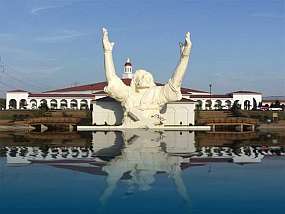
Touchdown Jesus, Big Butter JesusIf you’ve not yet heard (despite the fact that it was the #1 Googled phrase on the Web so far today), the massive Jesus sculpture on I-75 north of Cincinnati burned to the ground last night after being hit by lightning.

Some have called this “Touchdown Jesus” for the pose. Others labeled it “Big Butter Jesus” for its odd, buttery color.

Now it’s just a pile of ashes.

As I live in the area, I’ve driven by the statue many times. Like many people I’ve talked with, I feel strange about it. While I know other Christians who find it a source of inspiration, I was always uncomfortable when I saw it. To me, it depicted not the Savior of the World but the worst of Evangelical excess and misdirection.

At the risk of sounding like Judas, I’ve always been struck by the question, “Couldn’t this money have been used in a better way?”

I mean, I live in Ohio. Forbes.com noted recently that most of the major cities in Ohio made their Top 20 Most Miserable Cities list (including all the major cities in northern Ohio). With all that misery here in one state, you’d think Christians would have something to say—and do—about it.

Instead, we got a fiberglass and steel sculpture.

I dunno. Maybe I’m just a soulless crank. Still, I’ve got to pose that Judas question again.

Because, to me at least, nothing speaks faith more than Christians investing their time and money in the imperishable Kingdom, sowing into people’s lives in an unforgettable way.

The statue cost Solid Rock Church a quarter million dollars to build. Recently, it was repainted and repaired—more money.

Consider just these few ways the church could have used that money:

1. To help members adopt children currently living in orphanages or extended foster care.

2. To start an outreach to the many Ohio unemployed.

3. To plant churches in countries where no church previously existed.

4. To work toward racial reconciliation in downtown Cincinnati.

5. To provide loans to local people in poorer areas so they could start their own companies and break the grinding cycle of poverty.

Those are just five ways. Millions more exist.

The name “Touchdown Jesus” pokes fun at the depiction of our Lord with outstretched arms. But whenever I saw the 6-story sculpture, only one not-so-funny verse spoke to me:

I spread out my hands all the day to a rebellious people, who walk in a way that is not good, following their own devices…
—Isaiah 65:2

Right now, the loss of this statue seems to me to be a metaphor. A few years ago, Evangelicals were crowing about their newfound power and prestige. Now we seem to be on the ropes. And it is mostly our own doing, as we have forgotten what we’re truly to be about. We got enamored of earthly kingdoms, and the only true Kingdom was left to fend for itself.

Perhaps, yesterday, that Kingdom fended for itself in an unusual way. And perhaps that message needs to sink into our hearts just a little bit deeper.