A man comes up to you and says, “This is the world’s finest car.”
Now imagine these two contexts:
1. You are in the International Automobile Museum in Munich, Germany, an architectural masterpiece of modern design. Glass, aluminum, and chrome details make the place look like it materialized out of The Jetsons. The man, each hair on his head perfectly in place, wears a bespoke suit and silk tie. He sports a badge that reads Johannes Karlsburg, Director. Others in the museum gaze with wonder upon the object of Karlsburg’s comment.
2. You are in a used car lot. A sweaty man in a bad polyester suit left over from the 1970s chomps on his cigar and adjusts his silvered aviator glasses as he talks with you about the car upon which his hand now rests. You can see through the dusty glass of the lot’s office and notice the office has a fake bearskin rug on the floor before a desk that must have come from the public school they closed down a decade ago. A cigar store Indian stands inside the office doorway. A Snap-On Tools pinup calendar on the wall is stuck on last month. And the car? It has a windshield soaped to read $599, NO MONEY DOWN!
Notice that the message of both men is identical. Only the contextual details and settings are different.
Now which man are you more likely to believe?
I have been a part of many churches over the years. I have carefully observed their messages and how they present them. What unified every church was an almost desperate desire to present the Gospel to lost people and to do that Gospel justice. Commendable, all of them.
Sadly, many of those churches crashed and burned in their efforts. Not because they stopped preaching the Gospel, but because contradictory, invisible, subcontextual messages presented by those churches overwhelmed that supposedly primary Gospel message.
This is not to say that the Gospel cannot stand on its own. It can. It does.
But God did not design us to hear only the obvious, pure, spoken text of messages. Indeed, the majority of our communication (with some researchers claiming as much as 80 percent) is understood through nontextual, unspoken means. God Himself made us to sense more than the obvious. He made us to “read between the lines.”
We are fearfully and wonderfully made.
However, churches often forget the complexity of human comprehension and understanding. They believe “the main and the plain” are all we spot.
And this is a grave, grave error.
***
A story…
First Baptist Church notices something going on at Second Baptist Church across the street. Building crews. Vans from Lowe’s. A dumpster filled.
Deacon Fred heads across the street to check it out.
Inside, Fred sees that Second Baptist has updated the sanctuary by removing the stained glass windows, stashed away the large wooden cross at the altar, removed the banners that lined the sanctuary walls, changed the altar area into a stage, swapped out the pews in favor of theater-like seats, and installed a digital sound system with computer-controlled lighting.
Fred reports this back to Pastor Joe. Pastor Joe suggests Deacon Fred do a little more spying this Sunday. So rather than taking his typical spot in First Baptist’s doorway handing out bulletins, Deacon Fred surreptitiously takes his place in the seats at Second Baptist.
Gone are the hymnals he once remembered (since Fred once attended Second Baptist before settling on First). In their place is a giant screen behind the stage. Words to songs he hears on the Christian radio station flash by along with a background video of waterfalls and sunsets.
A young man with an electric guitar seems really into the worship music he strums, backed by a band. Fred thinks he knows the band members from the local country band that plays the fair circuit and all the school proms. Maybe some of the bars too, though Fred wouldn’t know that for sure.
Following the worship time, which Fred notices is only 15 minutes, down from a half hour, a video plays and talks about all the wonderful programs Second Baptist now offers. This is followed by another video about an upcoming conference that costs $159, which everyone should attend. And yet another video, a funny one, says something side-splitting about how Christians talk and confuse people with their “members-only” language. Fred thinks the videos are all in “high-def,” a term his son often drops in casual conversation.
Fred spots Old Edna a couple seats over. She looks more ragged than he remembers. Fred wonders if her long-running money troubles are taking their toll.
Fred also notices how dark the sanctuary is now. Feels like a theater.
Pastor Glen, who used to wear a clerical collar and polyester pants, comes out in a Hawaiian shirt and jeans. He sits on a stool on stage and chats up folks for a while. Tells a joke or two. Everyone laughs. He then talks about how Jesus matters more than everything else in the world. He talks about Jesus’ death on the cross and its importance. He talks about being born again and not being like the world. Ends it all by saying the clock says it is time to wrap things up. Fred feels it was a good message.
After the message, which Fred thinks is much shorter than he remembers, everyone reaches to the arm of his or her seat and removes a small plastic cup with some juice inside and a plastic-enclosed wafer sealing the top, all sanitary and convenient. A few words are spoken as an invocation. Everyone trashes the empties as they leave, and the band plays one last song, which Fred thinks is an old Beatles number. Something about love being all you need.
On his way out, he glances into the Children’s Church area. It looks like something from a discotheque. The loud music can’t be ignored, the kids doing that pogo dance thing Fred heard about once, pumping their fists as they jump in the air. Some young guy with a guitar is yelling, “Jesus is awesome,” over and over.
Fred reports his findings to Pastor Joe. Three months later, Fred and Joe notice the parking lot is being expanded over at Second Baptist. Within a couple more months, even that expansion is full.
The board of First Baptist Church makes a decision.
Six months later, First Baptist looks a lot more like Second Baptist. They expand their parking lot too.
And it, too, fills like Second Baptist’s once did. Once, since Fred now notices more empty spaces in Second Baptist’s lot.
Then, Fred begins to notice them in First’s.
And so it goes.
Soon, all the fancy, costly programs at First Baptist run into a financial crunch because giving is down along with the attendance figures. The extra staff they hired get that dreaded pink slip. The mood changes in the church. There’s a sense that the good days are in the past.
***
Those two churches never strayed from preaching the Gospel. They didn’t water down their messages.
But other messages intruded.
In taking down the religious symbols…
Intended message: Our church is contemporary and speaks a modern language.
Unintended message: Religious symbols are old fashioned.
Worse unintended message: Religious symbols are meaningless.
In converting the sanctuary into a theater-like auditorium…
Intended message: Our church is contemporary and relates to what modern people understand.
Unintended message: We are here to entertain you, just as if you are at a rock concert or movie theater.
Worse intended message: What we do here has no more meaning than other forms of consumable experiences.
In moving toward a more professional caliber of musician…
Intended message: We are professional, and we Christians can excel too.
Unintended message: We are professionals and you aren’t.
Worse unintended message: Don’t bother to serve here, because you aren’t professional enough.
In moving toward worship that consists of top 40 Christian songs heard on the radio, with words displayed on big screens…
Intended message: We are aware of what is excellent and noteworthy, plus we understand what resonates with you and is convenient for you.
Unintended message: What we believe is worthwhile is ever-changing.
Worse unintended message: Everything is transitory and disposable, even our worship of God.
In moving toward videos for connecting with people…
Intended message: We can be as professional as a TV show. Hey, we get this YouTube thing too.
Unintended message: Church is meant to be entertaining. People who run this church are as approachable as TV celebrities (which is not very).
Worse unintended message: Our message is worthwhile only if it entertains you.
In spending a large sum of money to renovate and “improve the church”…
Intended message: What we do here is valuable, so we need to spend money to be relevant to you and to our message.
Unintended message: Money really, really, really matters here. Just like it does out there in the world.
Worse unintended message: Money, and what we do with it here, matters more than Old Edna. And you either.
In the pastor’s new wardrobe…
Intended message: Hey, we’re just like you.
Unintended message: Hey, we’re no different than the rest of the world.
Worse unintended message: We’re just as fake as everyone else. And possibly even more so.
In delivering the Gospel unflinchingly, but compactly…
Intended message: We may have changed a lot about how we deliver our message, but it’s the same message.
Unintended message: Hey, look at the clock…
Worse unintended message: While this message is important, it’s not as important as your busy lives.
In upholding the supremacy of Jesus and our unity in Him through the Lord’s Supper…
Intended message: Jesus is all that matters. His sacrifice for us is infinitely valuable. And so are you to Him.
Unintended message: Look how we have packaged Jesus’ Body and His blood for your convenience and ours.
Worse unintended message: Jesus is a commodity to be prepackaged and consumed with an eye toward convenience and easy disposal. If that’s how we think about Him, then that’s how we think about you.
In “pumping up” Children’s Church…
Intended message: Kids, Christianity is cool and fun! You can have just as much fun in church as your unsaved friends have in the world.
Unintended message: Christianity is as much a fad as anything else.
Worse unintended message: When Christianity ceases to be fun, it ceases to be worthwhile and meaningful.
Everything a church does in its practice and expression of the Faith either reinforces or detracts from the Gospel message. Our unintended messages often eclipse the Gospel message for this reason: Because we are more focused on those countermessages than the Gospel itself.
We cannot practice the Faith in a vacuum. EVERYTHING we do matters, not just what we say. And honestly, in a world where Christians have said a whole lot and not followed up well on most of it, what we overtly speak often takes second place to how we act and express nonverbally what we say with our lips we believe.
If we do not understand this, we will forever be tinkering, inadvertently creating mixed messages that ultimately hurt our churches.
I’ve personally witnessed the backfiring of countless church changes that worked against the Gospel and the intended message. I’ve witnessed numerous churches commit these same blunders, all thinking they are doing the right thing but never considering the unintended messages they communicate.
If you have witnessed similar unintended messages that derailed a church, please feel free to share them in the comments. Perhaps they will serve as a cautionary tale to well-meaning change agents who haven’t thought through their “vision.”
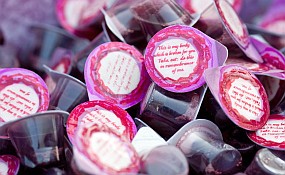 the Body and Blood fully commodified and stripped of all meaning.