
Lord, Purge Your Church

Standard

It’s the early a.m. here and quiet as a tomb. That silence lends opportunity to think.

I’m pondering the state of the American Church. But then, I never stop.

We live in a world coming apart at the seams. Some say that’s not the case, but as I see it, the deterioration is clear. I wonder regularly how it is that all sense is missing from whichever brouhaha holds our attention this day.

It may not be much on the grander scale, but the fiasco surrounding last week’s notorious conference makes it clear genuine Christians must pray this:

Lord, purge Your Church.

If the Church in America is to have any influence at all on the larger culture and society of the United States, the dross must be removed.

Pray also that you are not the dross.

At this point in 2013, I’m fully convinced that the American Church is thinking too far ahead of itself if it continues to believe it can have such an influence. While the gates of hell cannot hold against the Church as a whole, no assurance is given for any one branch:

Ephesus in ruins

Ephesus in ruins

“To the angel of the church in Ephesus write: ‘The words of him who holds the seven stars in his right hand, who walks among the seven golden lampstands. “‘I know your works, your toil and your patient endurance, and how you cannot bear with those who are evil, but have tested those who call themselves apostles and are not, and found them to be false. I know you are enduring patiently and bearing up for my name’s sake, and you have not grown weary. But I have this against you, that you have abandoned the love you had at first. Remember therefore from where you have fallen; repent, and do the works you did at first. If not, I will come to you and remove your lampstand from its place, unless you repent.
—Revelation 2:1-5 ESV
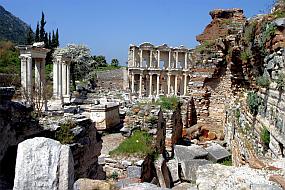
We could point to the vitality of the Ephesian Church and its contemporary influence on the world—if it were still around. But the Lord removed that Church’s lampstand and the light went out.

The American Church is at the lampstand-removal phase, if it hasn’t happened already. An opportunity to repent may still exist, but I wonder if it must come down to something more drastic than repentance.

Lord, purge Your Church.
Charismatics, Cessationists, Strange Fire, Logic, and Bible Truth

Standard

Now there are varieties of gifts, but the same Spirit; and there are varieties of service, but the same Lord; and there are varieties of activities, but it is the same God who empowers them all in everyone. To each is given the manifestation of the Spirit for the common good. For to one is given through the Spirit the utterance of wisdom, and to another the utterance of knowledge according to the same Spirit, to another faith by the same Spirit, to another gifts of healing by the one Spirit, to another the working of miracles, to another prophecy, to another the ability to distinguish between spirits, to another various kinds of tongues, to another the interpretation of tongues. All these are empowered by one and the same Spirit, who apportions to each one individually as he wills.
—1 Corinthians 12:4-11 ESV

Last week was something of a new low in the “conversation” between those who believe the gifts of the Spirit (charismata) continue today (charismatics or continualists) and those who claim those gifts ceased as of the closing of the apostolic age (cessationists). It’s almost a fact that charismatics don’t start battles with cessationists. If only the opposite were true, especially on the Internet.

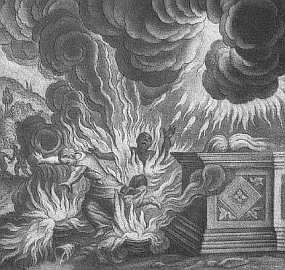
Nadab and Abihu offered "strange fire" to God and were slainThe supposed reason for the Strange Fire Conference of last week was to address and correct “charismania”—out-of-control or flat-out bogus gifts and the people who express them. The authority question arises when the correctors included no charismatics. So much for cleaning one’s own house first or sticking to the log in one’s own eye before finding the speck in your brother’s.

There is no doubt that the charismatic movement is a mess. Most charismatics with orthodox theology will acknowledge this—and there are MANY of us. I know I’m not happy with charismania and have written EXTENSIVELY on it and its practitioners, decrying the nuttiness and flat-out heresy. And MANY of us have loudly proclaimed this.

Which is why it’s frustrating that some folks who reject the charismata waltz into the charismatic house and tangentially proclaim by live streamed conferences that every charismatic is borderline, and if we’re actual born-again Christians, we’re so in spite of our charismatic beliefs. Like I said, a new low. No end exists for the ways in which such reasoning can be reversed and delivered back upon the correctors. But then, most charismatics don’t want this fight and never asked for it.

I was working through a response to a teaching at the Strange Fire conference that was liveblogged by Tim Challies and given by Tim Pennington, “Strange Fire Conference: A Case for Cessationism.” Frankly, I was appalled at the teaching, not only for descending into the very argument types that the group giving the conference would ordinarily savage if they came from others, but also for the teaching’s extensive logical fallacies. In short, the entire teaching has so many obvious problems, it besmirches legitimate Christian scholarship. And I say that with great reluctance and sadness.

I was prepared to blog a response in light of Scripture, history, and logic, but someone else wrote an almost identical rebuttal. I’d say it’s amazing how similar my response would have been, but then that’s how the Holy Spirit works in like-minded charismatics.  😉

Anyway, please do read Andrew Wilson’s “Cessationism and Strange Fire,” as it mirrors my thoughts.

Too Much Grace?

Standard

One of my projects for the summer was to read the New Testament out loud with my son. We finished a couple days after summer ended.

I’ve read through the entire Bible a few times, and through the New Testament more times than I can remember. But I had not read straight through the New Testament in perhaps five years. That was certainly too long, but we have a tendency in the Church to break down everything into acceptable chunks rather than dealing with larger wholes, so I suspect my failing is more common than not.

This time through the NT, one theme kept hitting me in the face. John sums it up:

Everyone who has been born of God does not commit sin, because His seed remains in him, and he cannot sin, because he has been born of God.
—1 John 3:9 MKJV

Whiter than snowWe Protestants love to talk about grace. At one point, we loved to talk about holiness too. Today, we don’t talk much about that second one at all.

What struck me hard in my read-through of the NT this time was that every writer of every book warned the Church about sin. Believers were commanded not to sin. Believers were warned of the consequences of sin. The writers were pretty darned serious that Christian faith and sin cannot coexist. The Book of Revelation holds nothing back regarding what happens to those who sin and those who do not.

The Bible makes it clear that we believers are commanded not to sin. We are also commanded on the flip side: to be righteous. If this is a command, then it must be something we have some control over.  If we are told, “Don’t do that!” or “This you must do!” then some means exists for us to take action or else the command is pointless.

Some might argue that these commands sound too much like New Testament Law. Maybe. But they are there in the pages of the NT nonetheless.

I see Christians today excusing all manner of bad behavior under the blanket of grace. We seem to have room for all manner of grace for all manner of sin. I’m not sure we have the same room for holiness though.

When Jesus says that calling your brother a fool is murder, and the Bible says God won’t let murderers inherit His kingdom, do we take that seriously? Do I even have to ask that question? Because the answer today seems to be that we don’t. At all. Or else we believers would look more distinct from the unrighteous hordes who have chosen the wide, sin-strewn way that leads to destruction.