
Have the Protestant Reformation and Democracy Harmed Christianity?

Standard

I enjoy reading Coffee with Jesus, one of those minimalist Comics 2.0 strips where the images don’t really matter but the text does.

While I normally nod my head in agreement, a recent strip bothered me:

Coffee with Jesus -

Is it naive to think that all you and I really need is Jesus? That He is the only one we should listen to?

I mean, Paul said to imitate him as he imitated Jesus. And we are a Church, which is meant to function as a Body, which means communication between the parts. And my spiritual gifts are not intended just for me alone.

The other day, I was considering whether two of history’s most respected events/institutions have actually amplified our confusion within the Western Church. Anyone who has a pair of eyes and ears can look and see that the Church is struggling in what seems to be a losing battle against a degenerating culture, while simultaneously drifting along with what that degenerating culture deems important, breaking down into 40,000 sects, schisms, and strains as a result.

The Protestant Reformation attacked the singular authority of the united Roman Catholic Church and deemed that each man and woman has been empowered to be his or her own priest. Reading the Bible for oneself and coming to a personal understanding of what it says was a hallmark of the Reformation. This idea broke the (genuine) stranglehold the RCC had on most of Christianity. It wrested power away from the controlling, organized clergy and put it back into the hands of the people.

Most would consider the Reformation an improvement.

In the New World years later, democracy took hold in the federal republic of the nascent United States of America. The idea that power rests in the will of the people mimics politically those spiritual concepts found in the Protestant Reformation. The two go hand in hand, and it’s hard to imagine America as a democracy without Martin Luther and his “rabble-rousing” kin.

Most would consider democracy an improvement.

But were the Protestant Reformation and democracy an improvement for the Church?

Reading that Coffee with Jesus above, one wonders. In turning every man and woman into his/her own spiritual authority, have we introduced too much confusion into the Christian faith?

If I am my own authority while I listen to the Redeemer, what happens when I encounter someone who thinks he is the authority while he listens to the Redeemer? What happens is that he drifts into a sect of his own leaning while I drift into another.

The comic above nails the problem. But does it only muddy the solution?

One of the most damning verses in the Bible:

In those days there was no king in Israel. Everyone did what was right in his own eyes.
—Judges 17:6 ESV

While spiritual people will clearly note that this “right” was too often downright wicked, what happens when we in the Church get into a situation where the Good is the enemy of the Best?

Paul says that when a revelation is given, the spiritual will debate its veracity and usefulness so as to arrive at a united understanding. Does this happen, though? Or are we too quick to start another sect because we can’t reach unity because we have made everyone his own authority?

A joke many have heard, but it applies here:

Once I saw this guy on a bridge about to jump. I said, “Don’t do it!” He said, “Nobody loves me.” I said, “God loves you. Do you believe in God?”

He said, “Yes.” I said, “Are you a Christian or a Jew?” He said, “A Christian.” I said, “Me, too! Protestant or Catholic?” He said, “Protestant.” I said, “Me, too! Which denomination?” He said, “Baptist.” I said, “Me, too! Northern Baptist or Southern Baptist?” He said, “Northern Baptist.” I said, “Me, too! Northern Conservative Baptist or Northern Liberal Baptist?”

He said, “Northern Conservative Baptist.” I said, “Me, too! Northern Conservative Baptist Great Lakes Region, or Northern Conservative Baptist Eastern Region?” He said, “Northern Conservative Baptist Great Lakes Region.” I said, “Me, too!”

Northern Conservative†Baptist Great Lakes Region Council of 1879, or Northern Conservative Baptist Great Lakes Region Council of 1912?” He said, “Northern Conservative Baptist Great Lakes Region Council of 1912.” I said, “Die, heretic!” And I pushed him over.

The Coffee with Jesus strip above certainly had this joke in mind. Yet as much as the comic says the answer is to listen to Jesus alone, it seems doing so still resulted in 40,000 sects, schisms, and strains.

Makes you wonder sometimes about the Reformation and a democratic mentality.
The Problem with Christian Criticism

Standard

Recently, I wrote “Humility, Unity, and the Overly Opinionated Christian.” In it, I noted that too often we lack the facts to comment and should probably, in humility, refrain from adding our two cents.

Seems some may consider me part of the problem. 😉

At Christianity Today, Rachel Marie Stone, in her “Why Criticism Belongs in the Christian Blogosphere,” argues the merits of Christian opinion. She equates it to iron sharpening iron, and she wonder how it is that Christians are refraining from offering much-needed criticism.

I would like to offer my answer.

1. Many people are tired of angry discourse on the Internet. It doesn’t seem as if anyone has enough couth to criticize without resorting to sinful expressions of anger and resentment. Stone notes her own criticism of others has often resulted in ad hominem counterattacks. Well, yeah. That’s where we Americans are in 2013. Still, some thoughtful people—thankfully—are tiring of this.

2. Our critical vision as Christians is too small. Nearly all criticism by Christians on the Web is directed at individuals rather than at systems. Problem is, it’s mostly the systems mucking up everything. While it is much easier to criticize individuals, doing so rarely changes anything on a larger scale, because the power of that larger scale is not in individuals but in systems.

3. Systems are ridiculously hard to address. Criticizing the guy next door for letting his dog poop on your grass may accomplish getting him to keep his mutt out of your yard. But if your state determines your house is ground zero for a new shopping mall for “the public good,” good luck with your criticism of the state. And many systems are more complex than even a state government. Try criticizing the result of the Industrial Revolution and changing it through criticism. That system is far harder to assault because it is enormous and nebulous at the same time.

4. Criticism of individuals does not lead to change on a larger scale, while criticism of a system often gets absorbed by the immensity of that system. That tendency toward “lose-lose” explains the result Stone laments in her article.

For too long, some Christians have focused too much anger in their criticism, reserving much of it for individuals. So and so is a heretic! You don’t know your Bible! And on and on. This does not get us far. More people now recognize this. They also note that much of that criticism was not wrapped in love but in self-righteousness and pride.

Where Christians should be focusing our criticism is on systems, yet almost no one does. No one talks about workplace justice. No considers whether our lifestyles are based on fallacies locked in place by deviant cultural assumptions. No one asks whether the Reformation and democracy have led Americans to no longer fear of God. For the most part, Christians are not offering criticism of these larger thoughts, ideas, and systems because we’re too intellectually lazy and too satisfied with the status quo. Why rock the boat and bring down the system on our little heads?

I stopped reading most Christian blogs because they went after the minuscule. They strained for gnats. And then when they did, they were too often mean-spirited about it.

I think many people are tiring of the mean spirit. Meanwhile, few are willing to wade into larger battles. Stone talks about how hard it was to receive criticism for her criticism of another writer’s book.  If that’s the size of our vision, then all is lost already. Taking on systems, which is what we Christians SHOULD be addressing, is costly, complex, and tedious. Our criticism needs to be laser-like, educated, and relentless if we are to fix entire systems in the name of Christ.

Christians of long ago were up for that task. I’m not so sure we are today.

Oh, look…

“Hey, you! Get your dog off my lawn!”

When the Church Gets All OT on You

Standard

Can’t stop thinking about this…

Whenever Church leaders talk about how great it is to be a follower of Jesus, does it ever bother you that they always go back to the Old Testament for props for their teachings and sermons?

In the Old Testament, the reward in this life for faithfulness included the following:

Health

Material prosperity

Freedom from want

Large families

Respect from the community

Long life

But then in the New Testament, something else enters that idyllic picture and seems to replace it. The reward in this life for faithfulness in the New Testament:

Persecution

Separation from family

More persecution

Martyrdom

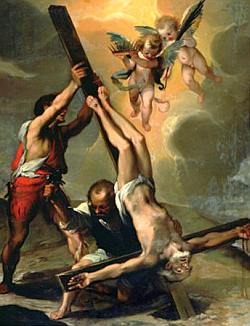
"The Crucifixion of St. Peter" by Ventura SalimbeniAmid all those sermons on all the great stuff you’ll now get from claiming OT promises, no one seems to talk about the hallmarks of NT faithfulness and what its rewards now look like.

My son and I are reading through the entire NT together, and that thread of persecution for following Jesus is simply unmistakable. Not only this, but Jesus Himself states that much of what was thought to be the hallmark of Old Testament faithfulness and reward would look different in the Kingdom of God that Jesus was instituing and that expectations should change. Something larger was now here, and it eclipsed what was thought to be the be all and end all of faithfulness and reward.

We don’t talk about that though.

What if instead of thinking about the OT reward of long life and material prosperity we instead thought of the blessing of having our head lopped off at age 30 by people who hated us and our Christ?

What does that do to “counting the cost”? Can any of us who have bought into the OT reward mentality truly accept the NT reward reality? Or do we keep retreating to a place that lessens the likelihood that we should ever receive a genuine NT reward—the only kind that truly matters.

Because, hey, someone once called me a bad name on my Christian blog, and I felt all persecuted.  🙁