Just How Hard Is It to Be Saved?

Standard

About midnight Paul and Silas were praying and singing hymns to God, and the prisoners were listening to them, and suddenly there was a great earthquake, so that the foundations of the prison were shaken. And immediately all the doors were opened, and everyone’s bonds were unfastened. When the jailer woke and saw that the prison doors were open, he drew his sword and was about to kill himself, supposing that the prisoners had escaped. But Paul cried with a loud voice, “Do not harm yourself, for we are all here.” And the jailer called for lights and rushed in, and trembling with fear he fell down before Paul and Silas. Then he brought them out and said, “Sirs, what must I do to be saved?” And they said, “Believe in the Lord Jesus, and you will be saved, you and your household.” And they spoke the word of the Lord to him and to all who were in his house. And he took them the same hour of the night and washed their wounds; and he was baptized at once, he and all his family. Then he brought them up into his house and set food before them. And he rejoiced along with his entire household that he had believed in God.
—Acts 16:25-34 ESV

…if you confess with your mouth that Jesus is Lord and believe in your heart that God raised him from the dead, you will be saved. For with the heart one believes and is justified, and with the mouth one confesses and is saved. For the Scripture says, “Everyone who believes in him will not be put to shame.”
—Romans 10:9-11 ESV

No one can come to me unless the Father who sent me draws him. And I will raise him up on the last day.
—John 6:44 ESV

Therefore I want you to understand that no one speaking in the Spirit of God ever says “Jesus is accursed!” and no one can say “Jesus is Lord” except in the Holy Spirit.
—1 Corinthians 12:3 ESV

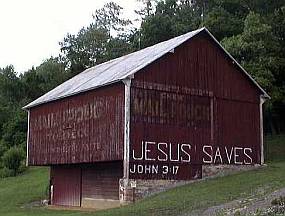
I like to follow trends in the Church and in the Christian blogosphere. One trend that is gaining power attempts to tell who’s in and who’s out by questioning if some people who think they’re saved really aren’t. Jesus Saves barnAny consistent readers of Cerulean Sanctum will know that on more than one occasion I’ve quoted Leonard Ravenhill asking if only 2% of professed Christians are truly born again. So even here there’s been some of that same rhetoric.
John Piper has a new book out called God Is the Gospel and it’s stirring up controversy about this very topic of how one is saved. Over at Old Truth, there was a post about decisional regeneration that adds fuel to the fire.

The debates about who’s in and who’s out rage, but I have to wonder if we are making it too hard. Look at the four verses posted above, for instance.

In the case of the jailer, look how simple his conversion was. Believe on the Lord Jesus Christ and you’ll be saved. Did the Lord draw him? Yes, in the middle of despair, the Holy Spirit was drawing him. Did Paul ask anything of him other than to believe? Not that’s listed here. Nor does Luke list anything different said by Paul than what the apostle himself outlines in the Romans passage above.

We can try to second-guess God on this, piling up other requirements, but isn’t that adding to the Gospel? If someone confesses with their mouth that Jesus Christ is Lord, why is there reason to believe that God has not drawn that person?

My confession is that I’m a Lordship salvation person. Have been for a long time. But that puts me in the company of others who make coming to Jesus a real trial.

Perhaps the problem here is one of theological systems.

The Calvinist position is hard to hold because persistence of the saints becomes a problem. What do you do with people who profess Christ then seemingly fall away. The out for Calvinists is saying that those people never really were drawn by God in the first place and therefore never made a true profession of faith. But do the Scriptures above, when taken together, paint that picture? It sure doesn’t seem so. It certainly appears that someone can be drawn of God, confess Christ with their lips and believe in their heart and still have the possibility there for falling away. Saying they were never a Christian in the first place seems like a lazy out.

Those against decisional regeneration are confronted with the fact that the jailer responded not because he was confronted with the full measure of the Gospel, but because he was in despair. He was ready to be saved without hearing a full Gospel presentation. He didn’t say to Paul, “I’m a sinner under full conviction of the Spirit as He’s brought me to the foot of the cross!” His rationale was that his boss was going to kill him OR he was astonished at the miracle earthquake that made it possible for the apostles to leave. I know plenty of people who became Christians at a remarkably low point in their lives or because they were confronted with a miracle. Is their salvation null and void? Can God not use situations to draw people? Do the passages above say that?

A Lordship salvation person, like me, struggles for a couple reasons. One is that I’m forced into an Arminian position, even though I don’t want to ascribe to it, simply because I have to struggle with the same issue as the Calvinists: what to do with people who fall away. The other is that the verses above do not say anything about the actual living out of the Lordship of Christ in one’s life. It’s assumed, obviously, but the question must be asked then if the process of Lordship begins at conversion and progresses, or is completely in place at conversion. The former makes salvation progressive while the latter makes it instantaneous. A quandary, obviously.

I could go into great deal about how all the other views on this struggle, but that doesn’t provide a solution to the original question: are we adding too many qualifiers to a person’s coming to Christ?

I would truly like to hear what other people think about this. Just how hard is it to be saved?
His Winnowing Fork Is in His Hand

Standard

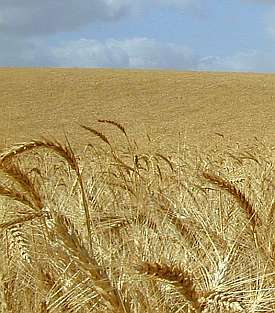
Wheat field

I baptize you with water for repentance, but he who is coming after me is mightier than I, whose sandals I am not worthy to carry. He will baptize you with the Holy Spirit and with fire. His winnowing fork is in his hand, and he will clear his threshing floor and gather his wheat into the barn, but the chaff he will burn with unquenchable fire.
—Matthew 3:11-12 ESV

Last week I was shopping for groceries in my local Kroger when I was overcome by a staggering feeling. Turning into an aisle with two rows of cooler cases, I felt like I was displaced from the rest of the crowd in the store, pulled away, destined to persecution at the hands of those around me. It was a sobering, yet eerie, sensation. When I finally took it to prayer, I was reminded of John the Baptist’s comment on the work of Christ, the Savior’s winnowing fork in hand, ready to thresh the nations.

Many times on this blog I have commented that we are not ready. A passage that comes to mind so frequently is

For man does not know his time. Like fish that are taken in an evil net, and like birds that are caught in a snare, so the children of man are snared at an evil time, when it suddenly falls upon them.
—Ecclesiastes 9:12 ESV

Will the world soon be “caught in an unguarded moment?” Is an evil time coming more swiftly than we realize? I cannot say with prophetic certainty, but something is happening. I don’t want to blame this on two hurricanes, either. It’s more than that. It feels, to quote C.S. Lewis, as if “Aslan is on the move.”

I thought about all those people around me in the store. Chaff? I also felt like hard times were coming for us believers in Jesus, the wheat, and that we will have underestimated its ferocity when it arrives. I heard recently that Chinese Christians are praying for persecution for American Christians so that the sleeping American Church would finally get serious. Will that prayer soon come to pass?

Anyone else get this same impression recently?

Joy

Standard

Though the fig tree should not blossom, nor fruit be on the vines, the produce of the olive fail and the fields yield no food, the flock be cut off from the fold and there be no herd in the stalls, yet I will rejoice in the LORD; I will take joy in the God of my salvation. GOD, the Lord, is my strength; he makes my feet like the deer’s; he makes me tread on my high places. To the choirmaster: with stringed instruments.
—Habakkuk 3:17-19 ESV

JoyIf anyone were to ask me the one quality Christians routinely claim to have, but which is actually in short supply, I’d have to say it’s joy.

Ask a non-Christian what the most prevalent Christian trait is and you’re likely hear the word “indignation.” To them, Christians seem to be the perpetually put off, mad about one thing or another, but certainly not joyful.

From within the ranks of church people, some would note that fear is the trait shared by more Christians than anything else. For most of my Christian life the bestseller shelf at Christian bookstores have been packed with apocalyptic works that claim to know who the antichrist is or when the world will end, selling fear and worry. For all our talk of heaven, we sure worry an awful lot.

Some other Christians may say that love is the most common Christian trait, but then the folks answering that question treat love differently. The “tough love” people are those who like to use love like a crowbar, to influence others or even give them a rap on the noggin should they not conform to the Christian ideal. The other love camp consists of those who turn love into acceptance, never asking for more than blue skies, unicorns, and rainbows. Set those two groups of lovers against each other and see how well love holds up in the midst of their sparring over what love truly is.

But I don’t hear too many people offering joy as the end state of true Christian living. Too few Christians actually manifesting real joy may be the reason for joy being left out in the cold, and that is more than just a sad state of affairs; it’s an outright tragedy.

Jesus said to His disciples after they returned from their glorious time of ministry in their Master’s name:

Behold, I have given you authority to tread on serpents and scorpions, and over all the power of the enemy, and nothing shall hurt you. Nevertheless, do not rejoice in this, that the spirits are subject to you, but rejoice that your names are written in heaven.”
—Luke 10:19-20 ESV

Do we rejoice that our names are written in heaven? Or does our rejoicing come from accumulating money, sex, power, or the adulation of men?

I’ve heard many Christians say that the reason the Church in America is powerless is that too many Christians are satisfied with being saved and leave discipleship at that. We have a church geared to fire insurance only. But if this were the case, why the lack of Christians rejoicing that their names are written in heaven? Why so little talk of heaven at all? Does heaven hold no joy for us now?

From the pits of his heart, David speaks:

Create in me a clean heart, O God, and renew a right spirit within me. Cast me not away from your presence, and take not your Holy Spirit from me. Restore to me the joy of your salvation, and uphold me with a willing spirit.
—Psalms 51:10-12 ESV

David asks for nothing more be restored to him than the joy of salvation and a willingness to obey God. In the wallow of sin he created for himself, he desires the joy of his salvation over all other things. His humiliation was public, but he did not ask for his reputation back. Nor did he ask for the resurrection of his dead child. He wanted a deeper joy.

The sad truth of American Christianity is that our joy is found in the wrong things. Our material possessions count for more and create more joy in us than possessing Christ. Yet the prophet Habakkuk might stare at desolate fields, dead livestock, the slow wasting of his friends and family, and the loss of all he holds dear and say, “I am filled with the joy of the Lord. His joy makes me carry on.”

Joy has been relegated to a low position today in the hearts of too many Christians. We’ve confused it for happiness, one of the reasons we chase after things—for the temporary happiness they bring. But joy does not burn up in house fires, nor on the pyres that claimed more than one martyr for Jesus Christ. You can’t manufacture it or pretend you have it. It’s either present or it’s not.

In the midst of the fear that many are feeling today, do you have joy? Do you know the joy of your salvation? Does that joy trump all worry, fear, and anxiety?

We have to have the right priorities now. How well we will function in the days that are coming is a measure of the joy that is within us. It should be infectious. It should draw people to Jesus. It should strengthen us. If that’s not you, what better time than now to ask the Lord for an irrepressible joy in your life that cannot be altered by shifting circumstances out of your control?

Lord Jesus, make my joy full today, no matter my circumstance, that people may see your joy in my life and ask me about its source. Make me the fount of joy that pours Your joy into the life of others, that my joy be full and overflowing. When barrenness surrounds me, Jesus, let there be your abundant joy. Let me continue to look to eternity and see my name written in your Book of Life, the reason for my joy today. When all around me are filled with worry, may my joy be complete in you. For your glory always, I pray this in your name. Amen.