
Post-Election 2012: Sex, Race, Evangelicalism, and the Future

Standard

A week ago, we as a nation were set to decide several important political outcomes. A week later, those outcomes are decided, with the clearest message of all being that Evangelical Christians were repudiated convincingly at the polls. Whatever hubris existed in that voting bloc at the time of the 2000 elections has been wiped away, possibly forever, in the wake of the elections of 2012.

I wrote some initial thoughts on the 2012 election last week (“The 2012 Election Results and What They Mean for ‘Evangelical Christian America'”), but I wanted to throw out more musings and questions for those of us who are Bible-believing Christians who vote conservative.

  • Rod Dreher may have prophesied when he addressed the same-sex marriage issue. Absolutely read this: “SSM, Social Conservatives, & The Future.” The gist of Dreher’s contention is that social conservatives (Christian, in particular), have lost the battle against same-sex marriage (and other “traditional values” issues). He believes this will force the Republican Party to move center-left if it wants to compete politically. I believe Dreher is correct, which means a GOP/Evangelical divorce in the future or a weakening of Evangelicals on issues of abortion, same-sex marriage, and so on—and possibly both.
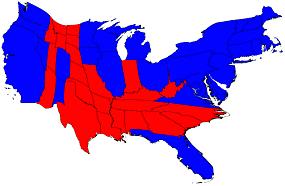
  • 2012 Electoral Vote Map Adjusted for Population

    2012 Electoral Vote Map Adjusted for Population

    While the election was close by popular vote, it was not by electoral college vote. Not only this, but it shows a country divided by the following:

Urban vs. Suburban/Rural

All Other Races vs. Whites

Women vs. Men

Younger vs. Older

Liberal vs. Conservative

In every pairing, the group on the left sided with the majority of winners.

  • The vote of women decided this election, for the most part (but see below). And with the popular vote in four states approving same-sex marriage, it raises the question of whether women, as a whole, are less negative concerning lesbianism as men are of male homosexuality. It would appear so. (Witness the election of lesbian Tammy Baldwin of Wisconsin to the Senate, for instance.) In addition, this outcome begs for clarification on whether women are more likely to desire same-sex marriage for themselves than men are. If so, the only way to prevent further erosion of traditional family values is to appeal to women.
  • One “truth” we are always told is that Hispanic and Asian cultures are both strongly pro-family, largely allying with Evangelicals in rejecting the liberal social reconstruction agenda. The results from Election 2012 violate that supposed bromide. The question is whether the strong support Barack Obama received is the prioritization among Hispanics and Asians of a racial minority mindset over conservative family values. Further research on this issue is necessary, because the liberal social reconstruction agenda those two groups assented to has not been adopted by the GOP—yet. If Hispanics and Asians are voting for a candidate primarily because they identify with that candidate as a fellow minority, then race is moving to the forefront of politics again, trumping any other social agenda.
  • In that same vein, if the GOP had managed to snag just 10-15 percent of the Asian and Hispanic vote that otherwise went to the Democrats, the outcome of this election may have been dramatically different.
  • For all the talk from Evangelical pastors of black congregations who were incensed at the Obama administration’s wholesale attack on values those churches hold dear , they were totally ineffective at swaying their congregations to vote to support those values and reject the current administration’s finagling. One must also look at the Roman Catholic vote, in that RC leadership leans GOP, while the congregants themselves seem devoted to the Democratic cause. This divorce only highlights an increasingly obvious truth: Leaders of “conservative” churches are far more conservative than are their congregations, and their own hubris causes them to overestimate their influence on the folks in their churches.
  • Stats show Mitt Romney pulled more votes from conservative Christians than any GOP candidate on record, nearly 80 percent of self-identified Evangelicals. In addition, few Evangelicals voted for third party candidates. Obviously, Evangelicals worried more about the policies of Barack Obama than were troubled by Romney’s Mormonism. This is a disturbing trend since it seems that Evangelicals will vote politics above theological truth. Regardless of where you stand on Last Days theology, Christians who downgrade heresy are setting themselves up to side with future leaders of questionable doctrine, all in the name of political promises. Obviously, few are reading the Book of Revelation.
  • Those of us who voted third party or for write-ins saw one of the worst showings ever for such candidates. However, if the GOP does move center-left on social issues (see above), Evangelical Christians will be stuck. Yet imagine a scenario where a new political party united by Christian belief challenged the Democrats and Republicans. It’s not hard to believe that a less Evangelical GOP could draw off some Democratic voters, while a Christian-leaning party would give the two other parties a serious run. Perhaps, though, it is impossible due to too much factionalism within Evangelicalism to create a political party favorable to its causes. Still, should the GOP move center-left as I believe it will, a competitive third party based on the beliefs the GOP is soon to repudiate might actual make some inroads and win a few elections. I mean, Maine elected an independent senator, so it’s possible.

Those are my additional thoughts. What do you think about the above or about other issues pertaining to the future we conservative Christians now face?


N.T. Wright, Christian Virtue, and the Missing Person of God

Standard

 N.T. Wright -  'After You Believe: Why Christian Character Matters'You can’t run in certain “intellectual” circles of modern Evangelicalism without hearing the name N.T. Wright. To some, the Bishop of Durham in the Church of England is the modern day C.S. Lewis, only with more degrees in theology.

I’ve never read Wright, so when his After You Believe: Why Christian Character Matters showed up in my local library recently (though the book came out in 2010), I availed myself of the opportunity to finally become hip and cool by claiming, “Oh yes, I’ve read Wright.”

The central idea of this Wright book is that a return to instinctual practice of Christian virtues is the only way to save Christianity. Too many Christians today don’t function like genuine Christians because a true Christian ethic eludes them. Most of this, Wright claims, is due to a misunderstanding of what it means to be a Christian postconversion. Too few people grasp how the basic truths of Christianity should inform our practice of the Kingdom of God on earth, and how the Kingdom should undergird our beliefs.

Wright’s solution to the problem is to instill Christian ethics in people the same way a drill sergeant teaches his military charges how to rebuild a gun while blindfolded. Everything about the Christian life needs to be so instinctual and second nature that we no longer think about what we’re doing, but it instead comes naturally. Wright claims this occurs through a synergistic practice and methodical incorporation of five elements: Scripture, Stories, Examples, Community, and Practices.

Quite a few leaders in Evangelicalism would certainly add a hearty Amen to Wright’s plan, especially those who love to talk about the Desert Fathers and Ancient Faith. Practice makes perfect in their regard, and building a new Christian army of those who do without thinking sounds like the cure for what ails us.

While I can certainly see that drilling people in the core truths of Christianity, both truths in fact and truths in practice, is a good thing, Wright’s book has a glaring omission. As someone who has not read Wright before, I see this lack as so enormous, it makes me wonder just how wise Wright truly is and how he ever ascended to gathering such a herd of fanboys.

To me, what cripples modern Christians more than anything else, even when they embody those worthy virtues Wright espouses, is a complete lack of understanding as to what it means to live by the Spirit. The key differentiator between the righteous people of the OT and the righteous people of the NT is that the NT folks now have the Spirit of God living in them always. Say what you will about the Church, but its defining characteristic is that God now resides in men. No other reality trumps this.

That Wright writes almost nothing in his 307-page tome about how to live by the Spirit pretty much renders his entire book useless. Christian virtues are critical, but Wright’s advocacy of a drilled Christian ethic resembles building a Lamborghini and then leaving out the engine. Unless Christians learn to live by the Spirit, all that drilling, worldview, and ethic will lead to just another failed attempt to turn Christianity into a set of rules, with Wright’s entire plan condensed to making those rules reflexes that require no thinking—and no Spirit, either.

What is particularly galling is that Wright goes so far as to downgrade the idea of fully realized Spirit-led living as “romantic.” This smacks of rushing to the polar extreme in an effort to make his point about the need for a practiced, down-to-earth Christian ethic. He makes the mistake of denigrating the key element of the Christian life in his effort to amplify a smaller component he feels has been neglected. In the end, though, he commits the ultimate “throwing the baby out with the bathwater” error that someone of his stature in Evangelicalism should NEVER make.

When Evangelicalism persists in reducing Christianity to a Spirit-less ethic, it substitutes the zombie religionist for the fully alive believer. And we need more “Christian” zombies like we need…well, more zombies. Which is to say, not at all.

How Evangelicalism can continue to mangle life in the Spirit and push out this pale imitation of Christian maturity is beyond me, yet this is what passes for the Christian life in most churches: Here are the rules of the Faith; now live by them. How no one can see that this is no different from any other failed religious system is startling to me, yet this is what I perpetually see in most Evangelical churches. We simply do not know how to live by the Spirit.

Words cannot adequately express my utter disappointment with After You Believe. To me, it’s little more than an intellectual exercise that represents the half-answer now working against restoring the Church in the West to its former glory, despite Wright’s contention that it is the balm for what ails us. A partial balm maybe, but until more reputable Christian authors start writing on how to live by the Spirit, we’ll keep instituting partial balms that ultimately prevent us from becoming all that God intends us to be.

The Devil in Outcomes-Based Living

Standard

Off the road and into a ditchI’ve spoken about politics lately far more than I ever have in my life. It seems to be getting me in trouble too. This means I should probably stir the pot more.  😉

But really, this post is about faith, not politics—though it doesn’t start that way.

One of the most perplexing aspects of this current election cycle is the extent to which it reveals some Christians have no qualms at making strange bedfellows. Solid believers who would ordinarily argue against certain courses of action are willing to forget their arguments because they have a goal in mind. To them, the outcome matters more than anything else. How they achieve that outcome and their justifications for their actions are inconsequential. What is foundational becomes secondary to the result.

What I see happening is many Christians aligning behind a candidate whose worldview basis is completely at odds with God’s Word. In a different context, we would call those beliefs “doctrines of demons,” and God, through the Scriptures, has nothing good to say about such worldviews. But because this is “just politics” and the candidate supposedly supports certain outcomes that align with what many Christians hold to as the core of “values voting,” many excuse the worldview that informs those outcomes. To them, the outcomes matter more.

The problem with an outcome-based line of reasoning is that it produces unintended consequences. God says as much, and the Bible is filled with people who desired a certain outcome, ignored what God said was all that He asked of them, and instead pursued that outcome.

Consider this verse:

The heart is deceitful above all things, and desperately sick; who can understand it?
—Jeremiah 17:9 ESV

The heart is always depicted as the seat of longings. And longings are about the outcomes we desire in life. We want something, and it can even be something noble and good, but we can go down wrong paths to find it.

The Bible warns about this from its first book and shows the perfect instance of how outcomes-based thinking leads to error:

Now the serpent was more crafty than any other beast of the field that the LORD God had made. He said to the woman, “Did God actually say, ‘You shall not eat of any tree in the garden’?” And the woman said to the serpent, “We may eat of the fruit of the trees in the garden, but God said, ‘You shall not eat of the fruit of the tree that is in the midst of the garden, neither shall you touch it, lest you die.'” But the serpent said to the woman, “You will not surely die. For God knows that when you eat of it your eyes will be opened, and you will be like God, knowing good and evil.” So when the woman saw that the tree was good for food, and that it was a delight to the eyes, and that the tree was to be desired to make one wise, she took of its fruit and ate, and she also gave some to her husband who was with her, and he ate.
—Genesis 3:1-6 ESV

That final sentence shows outcomes-based thinking at work. Eve justified her behavior because the outcome was, in her limited understanding, desirable.

Eve’s error began when she glossed over a critical reality: God said no. Eve did not stop her subsequent actions at God’s injunction. While God said no, Eve concerned herself with the outcome alone.

In my life, I have seen far too many solid Christian people crash and burn because they did not stop at what God says. Whether God speaks through the Bible or through the Holy Spirit, our imprimatur as Christians is to heed God regardless of possible outcomes. If God says no, there is no further argument. If He says yes, then we proceed.

You see, outcomes are always God’s and His alone. He alone is Sovereign. He alone directs the lives of men and women. He is the Master of Time and Fate. We all know the verses. They are indisputable. If anyone questions this, read the Book of Job.

Few thing sidetrack and cripple the Church more than focusing on desirable outcomes. We simply cannot make an outcome foundational and work backwards toward a justification for it. This is a recipe for error and has destroyed churches and their people. Instead, God says to start with Him and proceed to do what He says. Understanding who God is and how He can be known matters. The Bible and the Holy Spirit tell us. We begin there, do what God says, and leave the outcomes to Him. Period.

The embodiment of this is found in this beloved verse:

…for we walk by faith, not by sight.
—2 Corinthians 5:7 ESV

What God calls us to do is to be faithful to Him by trusting His revelation to us. If we are faithful to do what He wills, He is faithful for the outcomes, even if on the surface those outcomes appear negative.

And the truth is, the Christian life lived faithfully will often end negatively—at least negatively by the world’s assessment of outcomes. Don’t believe me? Then ask the great saints of our Faith how well they enjoyed their martydom.

It’s funny, though, how God turns the negatives into positives when we do what He says and leave the outcomes to Him.  The Kingdom of God always seems upside-down. The world won’t understand, but we know better, right?

One of the realities the Bible shares is that in the Last Days almost everyone on earth will accept the mark of the beast. I don’t know for certain what that mark may be or when it will come, but this I know: People will rationalize taking the mark because they desire a specific outcome more than they desire to abide by the words of God. And we all know how that turns out for them.

There is a way that seems right to a man, but its end is the way to death.
—Proverbs 16:25 ESV

Outcomes-based living has no other end. When we live only to achieve a certain outcome, we are bypassing the most essential understanding of how God wants us to live by what He tells us to do. None of us can see the future, but we know in the present what God has said.

Do what God says, then leave the outcomes to Him.

I end with this: Every evil perpetrated on earth since the dawn of time has been justified by what appears on the surface to be a desirable and proper outcome.