
The Christian Walk in a Nutshell

Standard

Here is the classic conundrum that has boggled the church in the last fifty years or so.

The charismatics say, “Well, the Holy Spirit says….”

The doctrinarians say, “Well, the Bible says….”

The neo-“Jesus People” say, “Well, Jesus did….”

Here’s the only truth: They all reinforce each other. You can’t have one without the others.
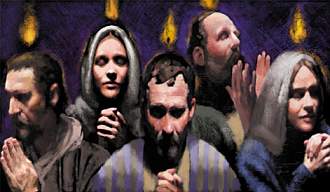
Tongues of Fire at PentecostYou want the Christian walk in a nutshell? Here it is: Those who love the Lord Jesus and serve Him alone are led by His Spirit to speak the Truth of the Scriptures while reaching out to other people like He did. That’s it. Doesn’t seem too hard, does it? Here’s all we need to understand as disciples of the Lord Jesus: We must love and serve the Lord alone:

It is the LORD your God you shall fear. Him you shall serve and by his name you shall swear. —Deuteronomy 6:13

And you shall love the Lord your God with all your heart and with all your soul and with all your mind and with all your strength. —Mark 12:30

Whoever has my commandments and keeps them, he it is who loves me. And he who loves me will be loved by my Father, and I will love him and manifest myself to him.” —John 14:21

We must know Jesus and know His voice:

And this is eternal life, that they know you the only true God, and Jesus Christ whom you have sent. —John 17:3

My sheep hear my voice, and I know them, and they follow me. —John 10:27

For all who are led by the Spirit of God are sons of God. —Romans 8:14

We must know the Scriptures:

Let the word of Christ dwell in you richly, teaching and admonishing one another in all wisdom, singing psalms and hymns and spiritual songs, with thankfulness in your hearts to God. —Colossians 3:16

And when they had prayed, the place in which they were gathered together was shaken, and they were all filled with the Holy Spirit and continued to speak the word of God with boldness. —Acts 4:31

All Scripture is breathed out by God and profitable for teaching, for reproof, for correction, and for training in righteousness, that the man of God may be competent, equipped for every good work. —2 Timothy 3:16-17

We must get out there and reach people:

And Jesus came and said to them, “All authority in heaven and on earth has been given to me.Go therefore and make disciples of all nations, baptizing them in the name of the Father and of the Son and of the Holy Spirit,teaching them to observe all that I have commanded you. And behold, I am with you always, to the end of the age.” —Matthew 28:18-20

Then the King will say to those on his right, ‘Come, you who are blessed by my Father, inherit the kingdom prepared for you from the foundation of the world. For I was hungry and you gave me food, I was thirsty and you gave me drink, I was a stranger and you welcomed me, I was naked and you clothed me, I was sick and you visited me, I was in prison and you came to me.’ Then the righteous will answer him, saying, ‘Lord, when did we see you hungry and feed you, or thirsty and give you drink? And when did we see you a stranger and welcome you, or naked and clothe you? And when did we see you sick or in prison and visit you?’ And the King will answer them, ‘Truly, I say to you, as you did it to one of the least of these my brothers, you did it to me.’ —Matthew 25:34-40

Truly, truly, I say to you, whoever believes in me will also do the works that I do; and greater works than these will he do, because I am going to the Father. —John 14:12

That’s it—the Christian walk in a nutshell. Now what’s it going to take for us to live it?

Commune-ity Values (or Redefining “Church” Yet Again….)

Standard

Oy vey!

That’s all I can say after reading The House Church Blog’s post on what the Bible really says about house churches.

As someone who has even considered whether a house church was the “church of last resort” for a couple of square pegs like my wife and I, this semi-new definition of what constitutes a house church should have even Robert Fitts throwing a few of his namesake (minus a “t”—of course.)

A distressing—for all those house church proponents, at least—excerpt:

The implications of Gehring’s insights about the importance of oikos [Greek for “household”—Ed.] are huge! For one thing, it means that moving church from a special church building into a home does not go nearly far enough. The churches established by Jesus and his disciples were not mere weekly meetings. They were literally households—ongoing, 24/7, family-like communities.

Consider 1Cor. 16:19 – “Aquila and Prisca greet you heartily in the Lord, with the church that is in their house (oikos)”. If we read this from our 21st Century Western context, we would (unconsciously?) conclude that once a week a group of Christians met in this couple’s home for church. However, if we read this verse from the 1st Century context, we would conclude something quite different.

To say that we have a “house church” because we meet in someone’s home at 7 pm on Tuesday nights, falls significantly short of the New Testament concept of “house church”.

Yikes! Are we back to the redeemed hippie communes of the 1970’s Jesus People era? Well, from this assessment, it seems we are.

St. Chapelle Stained Glass by Dan EdelenThe perpetually moving target that is the method of some to capture the exact mode of meeting of the first century Church is bothersome. Methodology is great and I applaud those who are going for as pure a methodology as can be understood, but at some point we just need to get on with doing what the Lord commanded: making disciples. If every couple years we rip down the idea of what constitutes a “true” church meeting, then we are only forcing our churches through ever-finer strainers. Who or what comes out of that in one piece is debatable.

Perhaps we are asking too much of people. In the midst of a resurgence in house churches, this is an acid test that few can withstand, I suspect. “Now we have to live in the same house with these people!” is asking too much too early on in this nascent movement.

My wife and I have wondered if the best model is to get a group of six or seven committed Christian families to purchase about fifty acres of land near a smaller town and build a home for each family on that land, along with a larger building that can provide a centralized meeting place. One or two of the families can work the remaining land as a source of food and revenue for the community, not to mention a source for feeding the poor. A portion of the income of each family would be pooled and used to support the community, especially during times of duress (such as medical expenses or job losses), and for basic outreach benevolences. Childcare and homeschooling would also be provided in this model, with every family chipping in. Group meals could also be planned, as well as allowances made for private dinners devoted to the needs of each individual family. The items that many families duplicate (yard care, basic tools, even vehicles) could be pooled in order to save money, while time can be saved not having to work and shop for duplicated items, freeing folks up to spend more time in devotion to the Lord.

Despite this idea of ours, I’m not completely ready to give up on the current model we have used for so long. It may not be perfect, but that imperfection may lie more in our inability to stay true to the Gospel message than in our lack of replicating the Book of Acts’ style of church meeting to a “T.” There is much to be said for the synergy a church of two hundred or more can bring to a locality when all two hundred souls are on the same page spiritually, right with God and with each other. You just can’t get that with any other style of church meeting.

That’s what I am hoping for now in the church we just joined, at least. Should we grow that into something more “organic,” then great. But for now, I’m not going to get flustered by yet another (somewhat) new direction in ecclesiology. You shouldn’t, either.

The Curse of Monasticism Reborn

Standard

No sooner do I get done writing a far-between post noting how my posts have been far-between while I work on finishing up my novel, and offering up a link elsewhere to ponder just to prove the point, God grabs ahold of me and makes me write this.

I wonder if we are creating a new monasticism.

The Reformation drove a stake into the separatist mentality that is the core of monasticism, proving that the Gospel belongs out among the people, out in our communities, villages, towns, and cities. It was a call to leave the ivory towers and get one's hand dirty out in the "real" world. And not only that, it called Christians to be pillars in their communities, villages, towns, and cities, to have a real presence that brought Christ into the marketplace of ideas.

The True Light cannot be hid in us who cherish Him, so the Reformers told us to get out from under our bushels and shine. They taught that Christianity was not to be a religion of disconnection, but a relationship with Christ who gathers us in a Body and dwells amid that Body—a Body centered in our local communities.

This is why I wonder about the current moves going on in the American Church. There is a gung-ho attitude toward small groups, house churches, and select meetings of a few outside the large church assemblies. It is good that we think about those types of groups and consider their impact.

However, in a day and age when fractionalization and withdrawing from community are the norm are we Christians missing the bigger picture by de-emphasizing large assemblies while heaping praise on smaller groups?

My wife and I spent much of this year searching for a new church. More than three years ago, we moved an hour's drive away from our old church while continuing to go there. The outcome of this was that we did not plug into the village we lived in because our church was fifty miles away. Having one foot in the community we lived in and one in our community of faith many miles away meant that neither found a connection to the other. In the end, both were diminished.

Yet it is more than just a distance issue. It may also be a numbers issue. The church that we have landed in near our home has about four hundred people in it. That winds up being four hundred connections into our local village. That's four hundred reinforcements to a presence in town AND four hundred reinforcements to our community of faith.

A small group cannot do that. A house church cannot do that, either. When we wonder why we feel disconnected in our own communities, perhaps this is why. Neglecting our presence in our towns and villages in numbers that reinforce rather than divide is ushering in a new monasticism. We find ourselves cut off from the world at large and also cut off from the Church at large. Dwelling in this limbo, we gut our effectiveness not only to reach new people with the Gospel, but to enjoy relationships with a wide variety of people, relationships that have Kingdom potential ranging from a simple "God bless you!" to the clerk at the local grocery store to a deep discipleship relationship with a new believer at our church.

Synergy is also lost. It is one thing to cast the seed everywhere we go, but how much more effective can we be when we repeatedly cast it right where we live? The compounding of this synergy repeated four hundred times every day by the folks in our new church can also not be overlooked. A new monasticism cripples this kind of synergy, diluting its effectiveness.

One of the first verses I ever felt God illumined in me is this one:

As the rain and the snow
come down from heaven,
and do not return to it
without watering the earth
and making it bud and flourish,
so that it yields seed for the sower and bread for the eater,
so is my word that goes out from my mouth:
It will not return to me empty,
but will accomplish what I desire
and achieve the purpose for which I sent it.
—Isaiah 55:10

God's word does not return void. In some people it is like rain, soaking into the soil of a barren heart, that rain finally giving nourishment to the seed there. In others, it is like snow, piling up and up until something warms it, causing it to melt and seep into the soil.

When we Christians spread ourselves thin or withdraw into little groups, the storm is lost, and the blizzard is reduced to a mere frost.

There is something to be said for churches between two hundred and a thousand people. A church that size allows us to know the ones with whom we fellowship. It also can take a people of one mind and cause a storm in the towns and villages in which we live. And lastly, it affords us connections into those same towns and villages that allow us to be a vital part of their livelihood rather than just listing them as a place where we get our mail.

People wonder why we feel disconnected from the people who live right next door to us. They ask why our churches seem to be so ineffective, too. Perhaps our monastic mentality is the cause.

God helps us break out of our ivory towers and get out among the people, both those who know the Lord and those who hope one day to know. Let us be a vital presence in our local communities, bringing the Gospel Light into all we do. And let us also be the beneficiaries of the connections we forge immediately around us, to our neighbors, and to the community at large. Always for Your glory and Your Kingdom. Amen.