
Several years ago, at a church I no longer attend, I heard a sermon about how much God loves us and what that means for societal conformity. The young pastor, who couldn’t have been more than 30, talked about how Christians can’t get hung up on appearances or on what other people think. He talked about how it does not matter if you have gray hair or you’re overweight. He said that the world’s standards aren’t our standards, so we can ignore those standards, because only God’s standards matter.
I remember walking out of that church afterwards furious because I just heard a pastor lie to a couple thousand people.
It’s not that he was wrong about what God thinks of us. God isn’t put off by your wrinkles. He doesn’t judge you by whether or not your clothes are out of fashion or you drive a rustbucket car. Really, those conditions are not preventing Him from loving and saving you.
BUT…
The world cares. It cares massively about those issues the pastor said don’t matter. And the last time I checked, Christians still must live in that world.
Reader Brian sent a link that intersects with something I planned to write today in this vein, so perhaps the following will provide a nice setup for that post, which will now come later.
Over at The Gospel Coalition, Cameron Cole wrote “Busy All the Time: Over-Scheduled Children and the Freedom of the Gospel.” Cole’s words sound familiar, like something I heard from a young pastor many years ago.
The setup, as is evident from the title, deals with Christian parents who are melting down because they cannot manage jumping through all the hoops needed to make their children exceptional:
The vocabulary of fear and obligation dominates expressions I hear from parents when they lament over their child’s busyness. “Well, we have to do an ACT prep class, or else . . . we have to take a full load of AP classes or else . . . we have to play a sport to round out that college resume . . . Johnny has to be an Eagle Scout . . . we have to attend every event at the church.” This attitude suggests they face certain condemnation if they deviate from the cultural norms. Fear looms over the possibility a child may not maximize every minute of every day in the name of resume optimization and ultimate human development.
Furthermore, parents reveal a fear of inadequacy as they guide their children. On one hand they feel as if they are failing to maintain an intimate family unit, because their family runs ragged. Conversely, they feel damned if they do not provide their child with every advantage to achieve success in high school and beyond. It is as if they live cursed: either deny your child the opportunity of future success or board a non-stop treadmill.
Later on, Cole provides “the answer”:
Christ has set his followers free from social mandates. Parents can begin their escape from this high-pressured frenzy of over-scheduling by first embracing the counter-cultural nature of following Jesus and living in response to the gospel. A follower of Christ has been freed from any obligation except that blessed call to follow and obey Christ and his Word. Given the freedom from the law, which Christ has won for his people, Christian parents can say, “No! No! No!” to travel baseball, math tutors, ACT prep, personal trainers, and so on. Parents can call into question every activity because there is no obligation to conform to cultural expectations.
The godly solution from Cole’s perspective? Raise a spiritual middle finger to what the world wants because what the world wants does not matter. At all. Now go live free and stop helping your child work toward success in the world.
The only problem with that thinking, which was written by a youth pastor pursuing professional, paid ministry, is that it completely ignores the reality that the world has a set of rules, and you either play by them or fail.
If Cole hasn’t noticed, the world systems and structures are getting more punishing each year. I overheard a job recruiter say, “Don’t bother to walk into a company today looking for work if you have gray hair. You will not only not be hired, no one will even talk to you.” (I noted this recently in this post.)
It’s not just issues seasoned adults face, either. Employers DO consider which college young people attended when interviewing them for jobs. Getting into those better colleges means jumping through some outrageous hoops just to get noticed amid a sea of clamoring kids loaded with exceptional accomplishments. For some elite colleges, the ones that open almost any HR department door, you practically need to have won a Nobel Peace Prize at 16 by founding a worldwide humanitarian organization to be considered for admission.
Crazy at the college level only? Last year, my son was denied entry into National Honor Society at his middle school because he did not participate in enough community service projects. He was 12 at the time. When I was 12, I’m not sure I knew what a community service project was.
What does any of that have to do with salvation? Not a thing. In this, every pastor saying don’t worry about it is absolutely correct.
But every pastor who blows this off for other realms of life is not thinking about what people must do to live day to day.
I’ve talked to Christian people who made tough decisions about work and life. When they were younger, they came home from work right after the clock struck 5, because Christian leaders told them they should not try to climb the corporate ladder and instead focus on the family. Those people listened to the leaders. So they blew off the after-work martini with the movers and shakers in the company. They didn’t work 60-hour weeks. They put away the company notebook computer and didn’t open it when they got home.
And what they found when they got to 45 is that they never advanced in their company. They never got entrenched in the system. Never got an entry in the boss’s Rolodex. And when the hammer eventually came down, they were the one let go, not the guy who put in the long hours, blew off his family, sucked up to the big wigs, and got entrenched in a corner office, pretty much immune from pink slips and pain.
I hear Walmart is hiring greeters.
When most paid, professional pastors talk about the work world, they’re talking about something they don’t know. At all. They give advice based upon their own experiences growing up Christian, going to some small Christian college, some even smaller Christian seminary, and then they tell everyone else, This is how life works.
Except it’s not like that. Outside the bubble those folks live in, it’s far harder.
In his book Outliers, Malcolm Gladwell does an excellent job noting what the stakes are and what must be done to achieve them. I think everyone should read that book and pay special attention to the chapter on professional hockey players. What Gladwell writes between the lines, and what it means for us, is startling.
In what can only be one of the oddest statistical anomalies—on the surface—the large majority of NHL hockey players have birthdays within the first three months of the year. How is this?
Junior hockey leagues tend to follow a yearly promotion schedule for kids based on a January–December calendar. As a result, those born earlier in a year have a slight, but real, maturity advantage. The kid born in January is a bit more mature for his group than the peer born in December of the same year. That small maturity advantage means the older kid may be slightly larger or faster. Which gets him noticed more regularly for inclusion in special programs that bolster his skills. Which means he later is more likely to be accepted onto an elite team. Which means he plays tougher opponents. Which means he develops deeper skills. Which means he gets a scholarship to a college dominant in hockey. Which gets him noticed by the pros.
All because of his birth date. This is why most pro hockey players are born in the first three months of the year.
At every step, all that was essential was a slight advantage, which led to greater opportunities that compounded over time. It’s the difference between becoming a pro and being that guy who now skates in the adult league at his local rink, dreaming of what might have been.
Is it unfair? Well, actually it is. But it’s real. It’s life.
Christians can choose not to play by the world’s rules. We then get a church with real people dealing with real outcomes of real decisions they made about real life, often informed by their Christian faith.
The major disconnect here is that the American Church is absolutely unprepared to deal with the consequences of those who raise a middle finger to the world’s way of working. Because those people who do opt out don’t get all the benefits of those who play by the world’s rules. And those benefits this side of heaven are real.
Now we can be all spiritual and say that the guy who jumped through all the hoops and did things the world’s way neglected his family and his spiritual life and may spend eternity in hell. I’m not sure how it is we can find comfort in that, but some people do use such rationalization as a justification for their choices to opt out of the world system.
But a lot of Christians who decided to opt out now find themselves marginalized. Where is the Church when you’re an unemployed 48-year-old, with a bachelor’s degree from an average college (or, heaven forbid, a Christian one), no evidence of career climbing intent, and you can’t find meaningful work to feed your family?
Will the Church take care of you? Will the Church provide you that elusive job?
And what about your kid? You elected to say no to all that hoop-jumping for him because you are not under the law and Christ put an end to all that striving. Is your kid’s community college degree going to equip him with what he needs to compete? Because it IS a competition out there. Will he get noticed in the résumé slush pile filled with 2,000 other applicants, perused by a hiring manager tasked with differentiating one faceless candidate from another?
You know what Cameron Cole thinks. What do you think?
I’m not writing this to be a contrarian or a scold. I’m writing this because I’m sick of professional Christian leaders who give people bad advice because they don’t know what is happening outside the Christian cocoon.
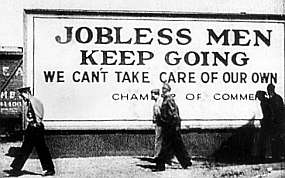 Worse, I’m sick of seeing well-intentioned Christians who abide by all the things they are told by those leaders only to find that there is a price to pay at the end that is staggeringly tough to accept—and with no one to help them in the aftermath.
Worst of all, I’m sick of seeing the individual forced to suck up the outcome and not the institution that compels the decision. Telling individuals to raise the middle finger is easy. Working to change the broken world systems, which is what Christian leaders and Christian institutions used to do, is far harder.
What is Cameron Cole doing as a youth pastor to work with local colleges to find a more sane approach to admissions that doesn’t force parents and kids to drown in busyness? I can forecast the answer: Nothing. Because Cole thinks none of that really matters in the spiritual schema anyway.
Folks, this is where we are. It’s both unreal and real. It’s a major disconnect in which the stakes are people’s livelihoods and lives. And for those people who listened and rejected the hoops just like they were told to, it can be a daily question of How did I end up in this terrible place, and with no one who will help me or my family?
Can Jesus change systems? Can Jesus alter social structures? True believers know He can.
But He won’t if the Church plays silly games and pretends those systems and structures don’t exist or aren’t worth addressing.
 On this Thanksgiving, I will forgo commentary on the wickedness of keeping nonessential retail stores open this day or on the craziness of Black Friday. Instead, let’s consider this: