
The fool says in his heart, “There is no God.” They are corrupt, they do abominable deeds, there is none who does good.
—Psalms 14:1 ESV
The English Standard Version translation shows 202 verses in the Bible that contain some variation of the root word fool. Reading those verses makes it evident that the world is filled with fools and folly.
Indeed, we are all fools in wisdom and knowledge when compared against God.
But some don’t get this. And they don’t comprehend it because they have no humility. If anything, they exult in their foolishness:
Whoever trusts in his own mind is a fool, but he who walks in wisdom will be delivered.
—Proverbs 28:26 ESVClaiming to be wise, they became fools…
—Romans 1:22 ESV
I’m tired of foolish talk. Sadly, we live in an age when the people babbling on like fools are most likely viewed as wise by most of the world. I see a lot of scientists who get face time in the media prattling on with foolish and desperate theories about this and that, and it’s clear after a while that the one thing you can say most assuredly about their views is that they desperately want God to vanish. Fact is, God doesn’t care what they think because such people are fools, no matter how many letters and titles they stack before and after their names.
The really sad part about that is almost all of Western science is based on the ideas of scientists who were Christians, or at least who ascribed to a Christian worldview. In fact, because the Christian faith is one of the only ones that contends that God is both knowable and understandable and the creator of an ordered world that reflects His knowability and understandability, science is even made possible. What would be the point of examining a capricious world built on the whims of an unknowable God or on the ruthlessness of a random world? No, that science exists at all is because God Is, God Was, and God Will Ever Be.
But then, the fool can’t begin to comprehend that truth. Somehow, the fool thinks that faith and science can’t co-exist or that science alone can answer all the questions of life. Which forces us to ask, in the end, who then is the truly close-minded?
I listen to a lot of discussions between atheists and theists, and the one thing that never fails to strike me is that for all their learning, the atheists never seem to know all that much. Their arguments are remarkably simpleminded, and when people of faith bring up the slightest aspect of what it means to live by faith, the atheist seems baffled by such reasoning.
But then, atheists are just people who are unable to admit they are sinners and that their thoughts are futile and packed with one sinful idea after another, and isn’t it easier to justify all that mental futility and wickedness by erasing God? For intellectual cowards, yes, that may be true, but not for sober people who look at life with any seriousness.
I’m not surprised that people try to erase God as a means to justify their immoral lifestyles, though. A recent scientific study shows that many people are unable to morally reason from the perspective of someone whose beliefs differ from theirs. In most cases it is people who hold more “liberal” attitudes about life who cannot grasp the thinking of more conservative people, though the reverse is demonstrably not the case. While this is not intended as a political statement, it nonetheless shows that an incapacity to grasp some moral truths does exist in people, especially those who proclaim their “enlightenment.” In that same way, the Bible says that issues of faith are foolishness to many. Things of the Spirit are incomprehensible to them:
Now we have received not the spirit of the world, but the Spirit who is from God, that we might understand the things freely given us by God. And we impart this in words not taught by human wisdom but taught by the Spirit, interpreting spiritual truths to those who are spiritual. The natural person does not accept the things of the Spirit of God, for they are folly to him, and he is not able to understand them because they are spiritually discerned.
—1 Corinthians 2:12-14 ESV
We live in an age when spiritual discernment is at an all-time low. Our leaders talk all sorts of lofty ideas, but they cannot bring themselves to talk about God or anything related to Him because they don’t know Him. In the end, their wisdom is actually foolishness, and that foolishness is blasted out for everyone to see and hear and receive as “wisdom” when it is anything but.
Sadly, some who self-identify as faithful are just as foolish. Many people who parade themselves as Christians are peddling fear instead of faith. That’s foolishness, too, and yet those hucksters are able to gather around them a sycophantic horde and sell millions of books that do nothing but stir the pot of fear.
In the midst of all these fools, what does God ask of us? It’s pretty simple actually:
He has told you, O man, what is good; and what does the LORD require of you but to do justice, and to love kindness, and to walk humbly with your God?
—Micah 6:8 ESV
Fools can do none of those things. Only the wise can acknowledge that, without Jesus Christ, we are all fools.
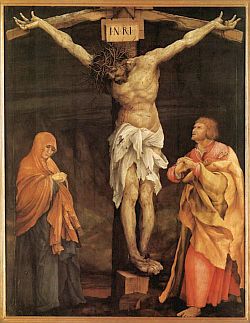 With Holy Week now concluded, I was pondering what appears to be the demise of the local Good Friday service in my community. It used to be that the local churches near my little town would combine to host a Good Friday service, but I heard nothing about it this year. The large (for our area) Pentecostal church of which I am a member does not hold its own Good Friday service, but we did host the traveling community service now and then.
 I’d like to believe that the American Church is filled coast to coast with people who wait patiently on the Lord. I’d like to believe that.