TBN Founder Paul Crouch Dies

Standard

Over the weekend, the Christian broadcasting world lost one of its most powerful leaders when Paul Crouch of TBN died Nov. 30 at 79.

Anyone who has read Cerulean Sanctum knows I am not a fan of TBN, largely because it was indiscriminate in who it gave airtime to. For every Jack Hayford or Kirk Cameron featured on its programming, there was Benny Hinn or T.D. Jakes.

And then there was all the garish opulence and money, much of which was spent in ways I’m pretty sure Jesus would not have condoned.

From a TV broadcasting standpoint, though, few can argue with the success of what Paul Crouch built almost singlehandedly. Some might contend that one did not need to be a broadcasting genius to blow through millions of dollars generated through prosperity gospel teachings, but still. In it’s prime, TBN was a force to be reckoned with, and despite some fall-off from its glory days, it remains the largest religious TV network of any kind. At one point, I used to watch TBN because it was the only place one could see Christian music videos. As a popularizer of the Christian subculture through media, Crouch and TBN were both shrewd and peerless.

What will be the legacy of TBN and Paul Crouch? I find it hard to say. Certainly, TBN put Word of Faith and its teachers in a bigger spotlight. Even if Oral Roberts had been the real forerunner in that regard, Crouch perfected it. Those unfamiliar with Pentecostalism got an eyeful and earful of it through TBN, and I’m certain that some of TBN’s broadcasting had an influence on African nations and the religious trends toward Pentecostal Protestantism both there and in South America.

For me, Paul Crouch is a conflicting character, and I don’t know what else to say about him and the television ministry he built. There really is no real contender for that Christian broadcasting throne, and with Pat Robertson hitting 83,  the last formidable challenger for Crouch and TBN may also be exiting center stage shortly.
Telling the Time

Standard

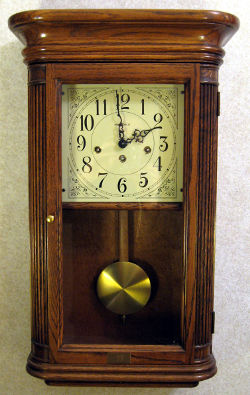
Grandmother clockWhen I came downstairs to eat breakfast before going to church, I saw that the wall clock had stopped.

It’s a “grandmother” clock my father received as a gift for 20 years of service with the company he worked for. He wouldn’t make it to 30. That company downsized him nine months before he was to receive his full retirement package. Nine months.

Still, it’s a nice clock, and it was given under a different company ownership, when people still cared, before the relentless string of mergers and ownership swaps.

Because it’s a grandmother clock, it chimes every 15 minutes. And because it chimes every 15 minutes, it has three keyholes where you stick in a key and wind it. I wind it pretty religiously, but life is filled with distractions, especially this time of year, and I forgot that regular task.

The hands read 1:59. Sometime in the a.m., it had stopped right before it was due to chime.

Having had the clock all these years, I take the chiming for granted. I think any owner of such a clock does. After a while, you don’t notice the chiming as much. When it fails to chime, you don’t realize it. You have to note the lack of pendulum movement, and then you know.

Something about a stopped clock makes me a little sad. That clock is wondrously alive so long as all its springs remain tightly wound, and the slow tick-tock fills the foyer. It’s a comforting sound, one that recalls a different, slower time. A time of artisans working deftly on such things as grandmother clocks, of great-grandfathers smoking a pipe while reading the newspaper, of sepia-toned memories and a sense that what is to come is a marvelous thing where people are somehow better than they are now.

I wonder what Christian people in the age of grandmother—and grandfather—clocks thought the present age might be like. What can a clock tell us?

My clock stopped a minute before it was due to chime twice. Slack springs couldn’t do the job of alerting us to the hour. People in the household forgot their duty, so the clock tick-tocked until it ran out of stored energy. It had been running on its last winding for too long and had no power left. Without that power, no alert sounded. It took a long time for anyone to notice the clock had stopped.

The silence of a stopped clock doesn’t register immediately. One must know to listen for it. If no one listens, and no one considers what was once present is no longer, the clock persists in its mute deadness.

A stopped clock is still right twice a day—so goes the old joke. Still, a stopped clock is far more wrong than right. It becomes less than helpful, because if you don’t see or hear it actively working, it gives mistaken information that can lead astray. What was once critical to one’s proper functioning is now detrimental. A stopped clock becomes an excuse for lateness and for failing to attend to important matters.

A long time ago, a stopped clock was a major problem. How can it be reset unless another, working timepiece is present in the household? If the stopped clock was the sole teller of time locally, one had to go elsewhere to discover the correct time. In some communities, the church belltower might have a clock. Or the village square. Today, centralized timepieces are mostly lost to the past. Oddly, time signals fly continuously through the air now—but beyond perception without special gadgets to snag them. The proper time is always with us, but we can’t sense it without help. Those special clocks that intercept hidden signals require something more than just the simple human intervention of a winding. The average person might understand how a wound clock works, but the new kind are inscrutable to all but the most technically adept.

Some would argue that the new technology behind clocks renders the old act of winding a clock moot. Everything has a clock in it nowadays. Funny, though, that so few can truly tell us the time.

Thanksgiving? Thank the Lord

Standard

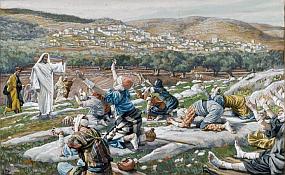
'The Healing of Ten Lepers' by James TissotOn this Thanksgiving, I will forgo commentary on the wickedness of keeping nonessential retail stores open this day or on the craziness of Black Friday. Instead, let’s consider this:

On the way to Jerusalem [Jesus] was passing along between Samaria and Galilee. And as he entered a village, he was met by ten lepers, who stood at a distance and lifted up their voices, saying, “Jesus, Master, have mercy on us.” When he saw them he said to them, “Go and show yourselves to the priests.” And as they went they were cleansed. Then one of them, when he saw that he was healed, turned back, praising God with a loud voice; and he fell on his face at Jesus’ feet, giving him thanks. Now he was a Samaritan. Then Jesus answered, “Were not ten cleansed? Where are the nine? Was no one found to return and give praise to God except this foreigner?” And he said to him, “Rise and go your way; your faith has made you well.”
—Luke 17:11-19 ESV

All our healing, all our hope, is found in Jesus. Not some, but all.

How can we not be thankful? How can we not be weeping with gratefulness?

More than anything I want my weeping to be in gratefulness to God for what He has given me despite my frailty, cravenness, and thoughts of self-worth. There is none worthy of those riches, not one. Not you. Not me.

I think much good would come if we Americans wept today because we are not worthy to have received all that we now possess. And it may be that unless we weep we may very well lose all those wonderful gifts because we have been so ungrateful, so unwilling to say that our own cleverness or resourcefulness has NOT gotten us those things apart from God’s mercy.

Don’t waste your thankfulness giving thanks to an ideal or a philosophy or your own talents. Give your thanks to the Lord. Be that tenth leper who was smart enough to know his source of blessing and come back to the feet of Jesus with praise and tears.