 My son and I have been reading out loud through the New Testament this summer. We’ve tried to read as much as we can of one book in one sitting so that the harmony of the books is maintained. I’m convinced that we too often approach the Bible with a piecemeal mentality that ends up losing the bigger picture. This is especially true of the epistles, which should never be read any way other than in one piece. Reading them this way spotlights the confusion that our over-reliance on chapter and verse markings has created.
While I’ve read through the Bible many times in my life, I’ve never tried to read it both out loud and in the biggest chunks I can manage. That another person is listening as I read makes an additional subtle difference that forces me to be clear in how I pause and phrase the written word. Truly, it makes a difference. Try it.
This time through the New Testament, I’ve focused on most everything BUT the theology. Too often when we read the epistles, we tend to gloss over the credential establishments, the callouts to this person and that, and the real humanity depicted by the writers as they communicate to their readers.
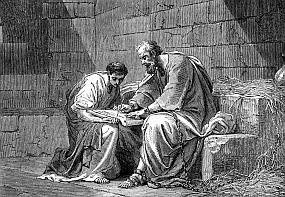
For this post, I want to share a few thoughts from reading through Paul as if I were a long-ago church leader reading to an assembly of new believers who were going against the flow of the age.
A baker’s dozen thoughts on the Pauline epistles:
- We tend to see Paul as a dry, driven, exacting, Type A personality, but his emotional life is more rich on these pages than we give him credit for. This shows us that Christians need to be in touch with their emotional lives and bring emotion to our assemblies. Ours is not an arid, intellectual faith, though a quick perusal of Christian blogs and websites often communicates it as such. There is much to grieve—and also much to be joyful over. You can sense Paul’s melancholy and father-heart when he talks about his love for these young churches. His imprisonment weighs on him, and you can feel the sadness in the distance it creates. His writings show how important a solid network of Christian confidants and supporters is to our emotional well-being.
- Paul faced enormous opposition, often from people who seemed to be genuine Christians but were slightly off. (Sounds like today, right?) That so much of Paul’s writings consists of establishing his credentials is both illuminating and sad. This Christian life is more fragile than we imagine, and it is easy to go off the rails from simple carelessness regarding truth.
- To a modern age we think of as truly connected, Paul’s writings hammer the importance of Christian community, the need for loving, caring community that functions with peace, order, and utter dependence on God for direction. (Are our churches living that way?)
- Church hopping isn’t a 21st century phenomenon. Witness the number of companions to Paul who fade in and out of his life, many starting off well but finishing badly.
- As much as we look at Paul’s letters as theological treatises, the majority of their text, both opening and closing, is dedicated to connecting with specific people and establishing what Paul is all about.
- Personal holiness, perseverance, and a sober understanding of the age are themes in nearly every one of Paul’s books. So is the reality that Christianity is not another religion. The Christian faith cannot be equated with other streams of religious thought because it is not a dry—and ultimately empty—system like those others. Instead, Christianity is a dynamic relationship with Jesus Christ, based in complete reconciliation, and awash in grace for living each day.
- The Christian is to be the most average of people but one who lives an extraordinary, eternal life. Humility, gratefulness, and discipline are hallmarks of that life.
- Sins of a sexual nature and those that afflict male-female relationships are extraordinarily prevalent and a major stumbling block for many, but Christ can forgive, redeem, and restore.
- Paul’s letters repeatedly note that many people will wash out of the faith, and while we can have confidence in God’s preservation, the number of people who get sidetracked and seduced by the world’s offerings is larger and more common than we understand.
- The Christian life is NOT a set of rules and can never be. People who teach a set of rules are false teachers.
- Grace in our present age is largely misunderstand and rarely dispensed to the extent that Paul writes that it should be.
- Most of what Paul writes about isn’t rarefied, theological ponderings but practical Christian living. He points out how faith translates into real life and how practical our beliefs must be.
- A believer not living by the Holy Spirit is not living. The Christian life is less scripted than the religious life of the day, which is what makes it so exciting.
Those are a few thoughts on the writings of Paul from an overarching perspective. I hope they resonated with you. Have a blessed day and week.