

Modern Evangelicalism: An MAO Inhibitor?

Standard

A pharmacological cornucopia!I rarely watch more than two hours of TV a month, so I’m no expert on ads or what’s happening in the TV scene. No matter how little TV you may consume, it’s darned near impossible not to encounter a plethora of Big Pharma ads hawking this prescription drug or that. See enough of those ads and its clear that every single drug on the market comes contraindicated whenever the prospective user’s downing MAO inhibitors, a type of antidepressant that comes with some serious side effects and warnings.

MAO is monoamine oxidase, an enzyme in the body critical for proper neurological functioning, hence the use of MAO inhibiting drugs for treating nervous system diseases. Are you yawning yet? Ready for the tangential slide?

Okay, here it comes…

The Godblogosphere’s been bloated with enough posts on “returning to Rome” to gag the Pope and all his Cardinals. A few noted Evangelical leaders jumped the Reformation Ship and the handwringing, fingerpointing, and accusations flew. In other words, typical Evangelical Sturm und Drang.

Amid the voluminous posting on this leap from Evangelicalism into the Roman Catholic Church (heck, one post I read even had Elisabeth Elliot pining for the papacy), plenty of volcanic theological discourse erupted, but I heard very little about MAO—the other MAO, that is.

The MAO I speak of is Mystery, Awe, and Otherness. You know, the stuff modern Evangelicals jettisoned on their way to a bookshelf full of systematic theologies, dusty pages of do’s and dont’s, and three-points-and-a-conclusion sermons. In their rush to be real and down to earth, Evangelicals found a way to make God dull. In short, modern Evangelicalism has become a theological MAO inhibitor.

I can’t help but think that most of these “un-converts” who fled to Rome did so in part because of the radical vivisection Evangelicalism got away with concerning the Body of Christ. I happen to believe that God placed in each one of us a yearning for mystery, awe, and otherness. That desire drives us to God as the source for all meaning, even if that meaning can never be fully grasped. This isn’t postmodernism’s vacuous “There can be no absolute truth” stupidity, but a genuine recognition that God is wholly other and therefore contains an element of mystery that generates awe in those who encounter Him.

How so? Remember when you basked in the throes of the first ache of passionate love? The object of your affection seemed like some strange creature from another planet that you’d walk across burning coals to know, even if that knowledge was little more than a favorite book he or she loved. Remember that first kiss? The electricity! That mystery, awe, and otherness found in the kiss of your beloved! (Song of Solomon explodes with mystery, awe, and otherness, doesn’t it?)

Now imagine kissing your sister. (Or your brother, as the case may be.) Where’d all that passion go? Now imagine Evangelicalism turning every day supposedly devoted to passion into just another day of kissing your sister. Now who can blame anyone for bolting that dry familiarity for a place that still kindles mystery, awe, and otherness?

Don’t get me wrong. I’m solidly in the Reformation camp. I see the RCC as a dead-end and always have. I feel sorry for anyone so seduced by a need for mystery, awe, and otherness that they’ll abandon truth for it.

Yet I still understand why they do it.

So plenty of Evangelicals go slack-jawed at these bolters who make for the Seven Hills. They’ll go on and on with analyses—psychological, theological, and otherwise—in their attempts to understand why they couldn’t keep ’em down on the Reformation farm. But sadly, they’ll never ask “What did we do wrong?” See, that question begs an answer and the answer gets a bit too close to the heart of the problem. Evangelicals today are loathe to put the words we and wrong in the same sentence, so they affix blame anywhere they can so long as that anywhere doesn’t involve looking in a mirror.

In the end, it does little more than make me tired. The false either/or propositions about what we should do and believe. The tired arguments against emotion. The constant sniping about mystery. If Evangelicals want to drive it all out, then they shouldn’t be surprised that people go elsewhere looking to fill that God-given need for mystery, awe, and otherness. Folks will go to the RCC, to the Orthodox, to whatever source fills that vital need. They’ll look for a way to stop taking the MAO inhibitors the self-appointed “doctors” of the Evangelical Church prescribed.

And someday Evangelicals will scratch their heads and wonder where all their adherents went.
Frauds

Standard

By the time I’d counted my tenth radar-wielding cop in only twenty miles, I could only shake my head. I’m no speed demon, don’t get me wrong. Still, I knew our ride back home from visiting the in-laws over Memorial Day would be more snail-like than usual. People get cowed by all the law enforcement and they take on a herd mentality that makes good driving impossible.

When a mobile cop car pulled onto the highway, I knew we were done for. Every lead-footed, Top-Gear-watching, Michael Schumacher wannabe suddenly spazzed and downshifted into second. Think “trailing the pace car” kind of gridlock here as about forty vehicles all jammed together behind the cop car, each driver petrified of passing him. Three lanes of gear jockeys cursing their dumb luck scrunched onto I-71 heading south through Amish country. Oh, joy.

What did I think? What a bunch of frauds.

And they were frauds twice over, too. If they truly were crazed speed enthusiasts, you’d think one would have the guts to pass the cop (who was doing about 55 in a 65 zone). On the other hand, they all acted like law-abiding little old ladies out for a Sunday drive in their pristine K-cars—another lie.

Frauds.

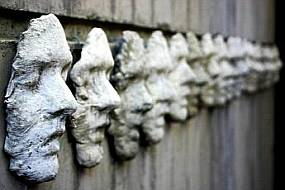
I think most of us are frauds, each in his or her own way. Our society doesn’t reward honesty. Doesn’t give out medals to people who keep it real. We may think Jeff Bridges’ iconic character from The Big Lebowski, The Dude, epitomizes a guy just being, but he’s a fictional character in a movie mouthing fictional statements written by someone else. The whole thing smacks of fraud when you distill it down to its essence.

I think most people in this country would die a thousand times over if other people knew what they were truly like, could know their thoughts, could feel their insecurities. I think most spouses have never scratched the surface of what the other looks like deep in his or her heart of hearts.

I’m convinced that far too many Christians in churches around this country live a fraudulent life filled with keeping up an aura of spiritual perfection. They go through life as someone they’re not. FraudsA few live in such self-deception they don’t even know they’re doing it. Still, most do know—and they hate themselves for it.
In the very early days of this blog, I’d get e-mails from folks castigating me for being holier than thou simply because I pointed out a few things I thought we all could do better. Me, holy? No, I’m just as fraudulent as the next guy. I think as time went by, people saw through whatever mask they thought I was holding up. But what they didn’t see was the more subtle one I wear all the time. It looks like me, only better, stronger, sharper, and swifter—but most of all, more spiritual.

When we age, the first thing that goes is pretense. Suddenly, the young punk down the street we used to dust in pickup basketball is creaming us every Saturday. We reek of wintergreen the day after, too. In the silence of our homes, we hear the knees creaking.

It happens the same way in the soul of the Christian attuned to the Lord. (At least it should.) We wake up and see that same masked face in the mirror. And when we pray, the Holy Spirit shows us that same lingering shadow of the Old Nature. He tries to get us to admit we’re frauds, but it doesn’t come easy. People talk. People have opinions. People, people, people—that same old fear of men. A snare, the Bible says.

The Bible also says this:

Therefore, if anyone is in Christ, he is a new creation. The old has passed away; behold, the new has come. All this is from God, who through Christ reconciled us to himself and gave us the ministry of reconciliation; that is, in Christ God was reconciling the world to himself, not counting their trespasses against them, and entrusting to us the message of reconciliation. Therefore, we are ambassadors for Christ, God making his appeal through us. We implore you on behalf of Christ, be reconciled to God. For our sake he made him to be sin who knew no sin, so that in him we might become the righteousness of God.
—2 Corinthians 5:17-21

We are ambassadors of Christ, and as such we represent the government of a new Kingdom with reconciliation as its message. And ambassadors don’t get to be ambassadors by clinging to fraudulent identities. No, they endure a character trial that proves their mettle. In other words, No Frauds Allowed.

All of creation awaits our coming into our ambassadorship. It’s groaning, in fact, that we come into our own, that “own” Christ established before the foundation of the world.

If only we’d put down the fraudulent lives, the fears, the secrets, and step into the Light.

Wonderland

Standard

I maxed out last week. Every day filled with activity and left me scurrying from place to place like a squirrel on amphetamines. I swore at one point I heard a hummingbird yell, “Dude, slow down! You’re like wearin’ me out.”

Around dusk last night and late this afternoon, I took a break in my favorite place, the outdoors. My halcyon time of the year is that holy month of days between mid-May and mid-June. The late spring grows pregnant with possibility for the upcoming summer. Hallowed days swell with life. The sky pulses cerulean. The trees fluoresce with green.

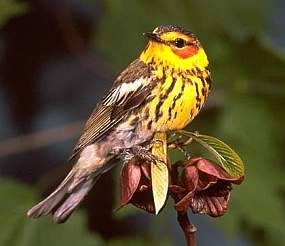
I picked up my binoculars, hoping to catch some stragglers on the spring warbler migration. The gorgeous Cape May WarblerWhile showing my son a Red-winged Blackbird atop one of our sycamores, I happened to spot a Cape May Warbler. On my own property! My neighbor across the street, an Audubon Society local president, blew my mind when he said he saw one of these uncommon birds in his stand of pines last year. Not having a Cape May on my life list, I thought I’d lost my opportunity forever. But it showed up when I least expected it.

Saw a Wild Turkey, too. It’s nice to know America’s bird is coming back. I’ve seen more in the last three years than in the previous twenty-five.

A Rose-breasted Grosbeak surprised me, since I hadn’t seen any on our property before. You tend to see more of them in winter in Ohio, but this one happily flitted through the canopy blissfully unaware of his being out-of-place in May.

An Eastern Wood Pewee hunkered on a spare limb by our pond…patience, patience. Then, zip! Snared a moth mid-flight. Back to the branch. Waiting….

Two Flickers tended their nest in a hole in an ash tree. Yellow Warblers, a Myrtle Warbler, a Yellow-breasted Chat, then pow—the eye-socking sight of the setting sun catching a Baltimore Oriole’s tangerine feathers. Two happy Chipping Sparrows watched me as they hopped around our gravel driveway, scouting for food, chipping as they searched.

Later, I left our forest, walked back to our porch, and pulled up a chair to watch the half acre of trees nearest our house, looking for tiny flashes of movement in the increasingly dense canopy. Here, the locust trees come late to the spring show, fighting with the walnuts to be the last to leaf. I hear the “drink your tea” of a Towhee, spot a Red-bellied Woodpecker as it digs for bugs wedged in tree bark, and hear a tiny Chickadee—its weight not more than a nickel, dime, and quarter together—scolding all 215 lbs. of me. And I’d probably lose that fight, too.

I saw a Cerulean Warbler a couple weeks ago, and I guess the reference to that color should bring me out of my reverie and back to the blog. People don’t want to read about a bunch of birds, do they? No time. People come here to skim some hard-hitting commentary on the latest ecclesiastical buzz, right?

A wise man once wrote,

Four things on earth are small, but they are exceedingly wise: the ants are a people not strong, yet they provide their food in the summer; the rock badgers are a people not mighty, yet they make their homes in the cliffs; the locusts have no king, yet all of them march in rank; the lizard you can take in your hands, yet it is in kings’ palaces.
—Proverbs 30:24-28

I don’t know what happened to wonder. It seems to be in short supply today. In a disposable world where people toss cigarettes and half-eaten bags of fast food out their car windows while on their way to their next appointment, I suppose there’s not much place for wonder.

Wonder goes missing in busyness. Spring warbler migration? What? When? Oh, I’ll pencil that in my calendar for next year, I promise.

Entertainment tramples wonder, since wonder may not be as flashy, not as trendy, not as immediate. Wonder takes a little work. Just a little.

We might not see wonder, but we do see truckloads of pragmatism in our churches. We can teach and preach and prophesy on how to have a great marriage, but most people will leave without any sense of wonder at the person sitting next to them on the drive home. We can spend an hour in worship, yet the second the last note dies out in the sanctuary rafters, we’re scanning our bulletins to see what’s next, hoping that the sermon won’t be too dry or lengthy.

Because we don’t wonder, we don’t pray. We already know what God’s like. Jesus won once and He’ll win again. Yadda, yadda, yadda. Hope He comes back soon—but not too soon. Amen.

When wonder goes missing in our churches, answers replace it. Not questions, just answers. Questions accompany the first signs of wonder, especially when the answers for those questions don’t come easily. And where wonder reigns, sometimes neither answers nor questions matter, only the wonder.

I wish I saw more wonder in American Christians. I suspect that many of us are too caught up in living our best life now to wonder at the way the Wood Pewee pirouettes in space to outmaneuver a zigzagging moth. Or how the craters on the moon form patterns. Or how the brook teems with tadpoles, mayflies, and tiny fish. What are the names of those fish? Does it matter?

I think it matters. I think we’ve lost something in the last hundred years in this country. Our wonder’s fled. I think it’s one reason why so many people take psychoactive drugs. Strip away the wonder and the world turns frightening, cold, and distant. It becomes the enemy. Life takes on a winner-take-all mentality where some win and others lose, and God help us if we’re not one of the winners. Now pass the damned Zoloft, thank you very much.

I think a loss of wonder means it’s far easier to take a gun and shoot at cars passing by. I believe a loss of wonder makes it that much easier for an angry husband to take a fist to his wife’s face. I know that a loss of wonder makes us shallower people.

Loss of wonder is a sin.

We won’t hear that sermon on Sunday, though. Because if we did, it would mean we’d have to start dealing with our culture, a culture that successfully murdered wonder and got away with it. Nothing pains me more than to hear some five-year-old say, “Ah, it’s just a stupid old bird.” Because I know that any child who says that will one day grow up to say, “God? What do I need God for?”

Something to wonder about.