Mysticism, Part 2

Standard

And this is eternal life, that they know you the only true God, and Jesus Christ whom you have sent.
—John 17:3

We don’t emphasize that verse enough. Eternal life is knowing the Lord. The great Christian mystics of the past had one goal: to know the Lord. And not just on a surface level, but as deeply as He might reveal Himself to them.

I don’t know how you see it, but I don’t see any conflict there. Nor do I see any problems here:

And after six days Jesus took with him Peter and James and John, and led them up a high mountain by themselves. And he was transfigured before them, and his clothes became radiant, intensely white, as no one on earth could bleach them. And there appeared to them Elijah with Moses, and they were talking with Jesus. And Peter said to Jesus, “Rabbi, it is good that we are here. Let us make three tents, one for you and one for Moses and one for Elijah.” For he did not know what to say, for they were terrified. And a cloud overshadowed them, and a voice came out of the cloud, “This is my beloved Son; listen to him.”
—Mark 9:2-7

For the three disciples, witnessing Jesus’ transfiguration exceeded the first laser light show, the U.S. Bicentennial fireworks display, the 2002 Super Bowl halftime show, and the reunion of The Police—combined. Huge. Mind-blowing. Even terrifying.

And downright mystical.

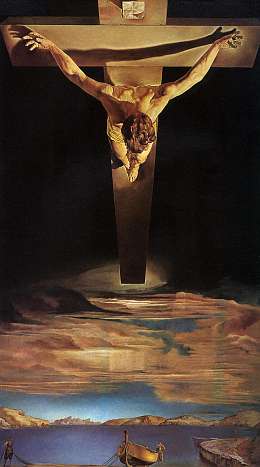
All across the world and through the ages, people have encountered God alive and moving, speaking into their lives in supernatural ways. 'The Christ of St. John of the Cross' by Salvador DaliPeople like Saul on the road to Damascus. Guys like St. Patrick, whose ministry to hundreds of thousands of people sprang from a dream he received as he slept. Or Dwight Moody, one of America’s great evangelists, who encountered God in a mystical, overwhelming way as he walked the streets of New York City, and his ministry immediately transformed in that meeting from good to great.
So this mysticism thing is awesome, right?

Well, maybe.

Christian mysticism perpetually runs the risk of deviating from the intended target. Aiming for God and hitting something (or someone) entirely different is possible. The wise way to open oneself to God requires a series of personal firewalls intended to keep out anything not of God.

To that end, some have asked me for a list of great Christian writers since 100 AD who’ve written flawless works that can be trusted 100 percent of the time. I’ve included that list below:

Nil, zero, zip, nada

Kind of empty isn’t it? That’s for a reason. God never intended for us to swallow everything we hear out of the mouth of someone who self-labels as a Christian. I don’t care if we line our bookshelves with the most orthodox writings known to Man, those books will contain errors. I hope I’m not bursting anyone’s bubble by saying this, but your favorite Christian author/teacher/pastor makes mistakes. True, some make more mistakes than others, but the point remains: we must ALWAYS be discerning in ALL encounters with ideas and practices, be they “Christian” or not.

One of the first posts I wrote for Cerulean Sanctum applies to this issue of Christian mysticism. “Charismatic Churches and the Cult of the New” outlines several flags we must always apply when dealing with anything we encounter presented in the name of the Lord. The following cautions should be considered whenever we approach “new moves of God” within the Church. I originally intended these flags to pertain to charismatic practices, but I believe these also apply to any practice or concept that relates to mysticism:

Flag #1 Cannot be squared with Scripture or is based on a single verse of Scripture (usually taken out of context.) If we’re doing something that violates Scripture, we need to stop. End of story. If we don’tknow what Scripture says about some mystic practice we wish to employ, better to actually KNOW the Scriptures first before we get all mystical.

Flag #2Is pronounced by direct revelation through a single individual or a small group of people. The Church today doesn’t lack for individuals and small groups speaking some strange things. I don’t believe that the Lord speaks “unusual” truth through one person or a small group alone. He may speak to you for your needs, but the whole “mystic secrets of divine union for select disciples who pay $200” thing isn’t going to wash with the Lord.

Flag #3Is considered relevant for today, yet has no historic precedent in the Church. Nothing new under the sun, folks. If the Church through the ages didn’t practice or teach it, it probably ain’t kosher.

Flag #4Attempts to make a New Testament practice/theology of an Old Testament practice/theology rendered moot by the finished work of Christ. While this plagues certain aspect of the charismatic movement more so than the mystic community, it’s still something to watch for.

Flag # 5Involves “Restoring or the “Restoration of a practice or theology. Some things died out for a reason. Yes, a few good practices have been neglected by us hypermoderns, but we must be careful.

Flag #6Is a “redeemed version of a secular/occult concept or practice (usually which has been abandoned or discredited by secular/occult practitioners.) A huge flag when dealing with anything deemed mystical. (I’ll unpack this more below when I talk about syncretism.)

Flag #7May produce immediate results, but does not move the Church or individual into a deeper, biblically-based relationship with Christ in the long run. Practicing mysticism for mysticism’s sake will get us nowhere. All too often, a fascination with mysticism reflects failing to pursue God in approved, traditional ways. Those must always be addressed first. All the mysticism in the world’s not going to make an infant in Christ into an adult. Got to make it to the teen years of the Faith before reaching adulthood.

Critics of contemporary mysticism in the Church have good reason to point out troubles. Any two of the flags above in combination should entail a gut check about the practice or idea we’re attempting to incorporate into our spiritual lives.

With Christianity in the West so heavily compromised by syncretism, if we wish to be a holy Bride, then we can’t keep whoring around. Too many Christians who are looking into mysticism don’t have the spiritual maturity or common discernment sense to know what’s genuinely of God and what’s not. Since the critics of Christian mysticism love to blanket condemn, clashes will be constant. For the chucklehead who wonders how well astral projection and Christianity work together, good for the critics for calling him on his folly. We’ve got so many Christians lacking in even basic discernment skills that perhaps a place may exist for the blanket condemnation. A sad state of affairs, but given the tendency to let all the garbage in 24/7/365, possibly warranted. We have only ourselves to blame for the critics’ hypersensitivity.

The thing about the old Christian mystics? They’d already gone through all the steps of growth and maturity. And that’s the key point here. The Cloud of Unknowing may very well grow us deeper in God. But if we’re not reading and meditating on the Scriptures, cultivating a consistent prayer life, making disciples, or laying down our lives for others, we’ve got no right to pick up that book and start yammering about how deep it is and how it’s going to take us to “the next level.” You don’t give an infant a powerful weapon like an AK-47 to play with, because if you do, someone’s going to get killed. And for the purposes of this illustration, it’s usually the infant.

The riches of the Lord are His and His alone. Looking into Buddhist (or any other non-Christian) mysticism to apply what one my find to Christianity is like panning for gold in a field of manure. God’s already got a river flowing with gold, no need to wade through the crap. Yet all too often we try to find truth in places it doesn’t exist. If we truly believe that Jesus is the Way, the Truth, and the Life, searching for Him by syncretizing rituals gleaned from the places He’s not couldn’t be a bigger waste of time. All too often, those dabbling in Christian mysticism do just that.

Get the basics of the Faith down first. Stay away from syncretistic practices that attempt to join Christ and Belial. Test every spirit to see if it’s of God (the flags above are a good start). Be as wise as snakes and as innocent as doves—not the other way around.

Yes, sometimes the critics are off-base. But then again, once in a while they’re not. It pays to listen to them and weigh what they have to say against the Scriptures and the Spirit.

I’ll conclude this mini-series in my next post.

Mysticism, Part 1

Standard

I know a man in Christ who fourteen years ago was caught up to the third heaven—whether in the body or out of the body I do not know, God knows. And I know that this man was caught up into paradise—whether in the body or out of the body I do not know, God knows— and he heard things that cannot be told, which man may not utter. On behalf of this man I will boast, but on my own behalf I will not boast, except of my weaknesses.
—2 Corinthians 12:2-5

Why is it that so many in the Christian Church, especially in the West, live to throw the baby out with the bathwater?

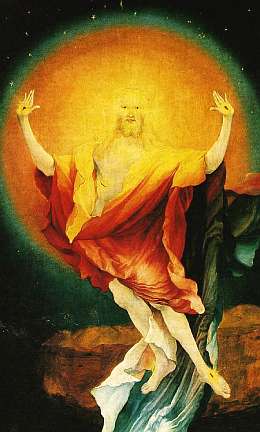
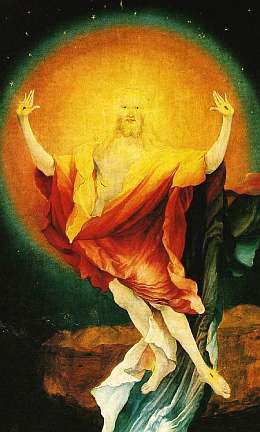
I see this tendency especially from those petrified that God will come along and shake up His Church by doing something they would classify as “weird.” Detail from 'The Resurrection' by Matthias GrünewaldI think that if you took those folks and put them into every biblical scene featuring the miraculous, they’d be quaking with fear with their hands over their eyes. They’d be the ones frozen stiff before the parted Red Sea screaming, “No! You can’t make me go through there!”

So these poor saints live to attack anything that threatens to undo their dusty religiosity. Unfortunately, in too many cases, that “anything” just happens to be God.

Now I perfectly understand the need to filter out heretical and false manifestations, but that’s why the Lord gave us discernment. Blanket condemnation of all such experiences, instinctive in these fearful saints, fails the discernment test. Nowhere in the Scriptures will you find “One bad apple ruins the whole bunch.” (If that were true, I suspect all our churches would be ruined!)

Instead, the Holy Spirit empowers our discernment. The Bible provides some basis for making distinctions between wrong and right, while the Spirit fills in the particulars. This is life in the Spirit, and it requires us to know His voice when He speaks to us in our day to day existence.

This brings us to today’s tossed baby, Christian mysticism.

I don’t know about the baby-tossers, but I can’t read the Bible and not see the mystical. As noted in the passage that starts this post, the Apostle Paul himself thought nothing of mystical experiences, such as being caught up in a heavenly realm where inexpressible realities can be glimpsed. Paul goes so far as to boast about the man who experienced this (likely Paul, as most commentators note).

The prophet Isaiah had a vision of God, the Holy One’s train filling the temple. He saw angels and they symbolically purged his sin with a touch of coal to the lips. Ezekiel glimpsed his famous wheel within a wheel. John fell prostrate before an angelic messenger who delivered a vision of the end of all things. Jacob’s ladder. Abraham entertaining three visitors. The inner sanctum of disciples witnessing Jesus’s transfiguration.

The Bible overflows with the mystical. So how is mysticism bad?

Some would claim that all these things vanished with the death of the Apostle John. That mystical experiences do not happen today.

Tell that to the Irish, though.

Last weekend, we celebrated St. Patrick’s Day. One could argue that no evangelist exceeded Patrick, for 120,000 conversions are directly tied to his ministry in the Emerald Isle. But to what did Patrick attribute his burning desire to evangelize the Irish?

From a classically mystical source: a dream.

Patrick, ensconced in England, had a dream one night of Irish druids begging him to come preach the Gospel to them. He wasn’t reading the Scriptures for this revelation. He wasn’t down on his knees praying. He dreamed it.

The Bible says this:

But Peter, standing with the eleven, lifted up his voice and addressed them: “Men of Judea and all who dwell in Jerusalem, let this be known to you, and give ear to my words. For these people are not drunk, as you suppose, since it is only the third hour of the day. But this is what was uttered through the prophet Joel: “‘And in the last days it shall be, God declares, that I will pour out my Spirit on all flesh, and your sons and your daughters shall prophesy, and your young men shall see visions, and your old men shall dream dreams; even on my male servants and female servants in those days I will pour out my Spirit, and they shall prophesy.
—Acts 2:14-18

Now as far as I can tell, we’re still in the last days. I think most of us would agree on this. So how is it NOT still true that God will speak to us through dreams and visions? I find it impossible for anyone to argue against the validity of dreams and visions for revelation. Consider what the 120,000 saved through Patrick’s ministry think about mystical revelation through dreams.

A.W. Tozer, one of Evangelicalism’s greatest prophets, had no qualms with the mystical. Even the most casual readings of his many books and sermons reveals Tozer’s heart that we Christians should pursue a mystical intimacy with God that defies earthly definitions. Tozer was known for his keen understanding of the writings of noted medieval mystics such as Julian of Norwich (who many of Tozer’s good friends referred to jokingly as his “girlfriend”), Teresa of Àvila, Meister Eckhart, and others. Tozer recommend that we Evangelicals read mystic literature such as The Cloud of Unknowing and The Dark Night of the Soul. Why? To cultivate a depth of intimacy with God that transcended the casual dabbling in Him afflicting so many of us time-burdened Evangelicals, to scry the secrets of the saints who have gone before us.

Because I hold Tozer in high regard, I’ve read many of those mystics and their writings. I’ve found them fascinating. But more than this, I found they relayed understandings of God I did not possess. Those mystics have been to the mountain of God, so they offer a valuable map, a treasured insight. Their talk of rapturous union with God should inspire us, not drive us to doubt the reality that we human beings can approach the Divine and know Him intimately! Sometimes I wonder if some of us merely wish to keep others from that deep intimacy for no other reason than we have not experienced it ourselves; our jealousy drives us to deny others the joy those few have found.

Many Protestants revere the Reformation, but they balk at anything that came before that. What a loss! As we stroll back in time to the Medieval era and Dark Ages, when some of the noted mystics lived, the less confident many of the mystic-bashers become, as if no big “c” Church existed at all during those times. That’s foolishness, though, and for some to act as if nothing can be learned from the Christians of those days, many of whom would be branded mystics by today’s Evangelicals, is nothing more than jealous pride.

Mysticism’s core ideal that knowledge of God and His ways can’t be explained in perfectly rational terms didn’t bother those Christians of that era. But it bothers those who live on the other side of the Renaissance and the Enlightenment.

If anything, the modern antagonism toward Christian mysticism has little of its basis in Scripture’s and the Holy Spirit’s illumination, and far more in the rationalism and anti-supernaturalism wrought by modernism (as ushered in by the Renaissance and the Enlightenment). Oddly enough, the real damage to Christianity came not from mysticism as practiced pre-Reformation, but from this post-Reformation upheaval in philosophy. Odder still, the stepchildren of the god-denying Enlightenment are those very Christians who oppose supernaturalism (especially as it pertains to the charismata), who endorse a sort of sanctified scientific rationalism that turns the tables and declares Christians being caught up into the third heaven not only not possible, but part of a damnable plot to subvert Christianity!

Who is the real wolf in sheep’s clothing? The mystics or the scientific rationalists? I would contend the latter far better fit the bill.

And so we’ve paid dearly within Christianity because of anti-mystic crusading. The rationalists have shoved the awesome God into a small box convenient enough to be understood. Miracles? Nah. Dreams and visions as guidance? No way. Only superstitious fools would embrace such nonsense.

Worse, any revival in mysticism within the Church is disingenuously labeled Gnosticism by the critics. But those who toss around the Gnosticism label do so haphazardly and with little regard for the truth.

Gnosticism is anti-matter, which Christian mysticism is not. As a result, Gnosticism denies the incarnation of Christ, which Christian mysticism certainly does not. Gnosticism holds to a dualistic worldview, which Christian mysticism does not . Gnosticism believes that secret knowledge necessary to salvation is held by a select few, and only a select few who seek that knowledge get it. Christian mysticism holds that deeper knowledge of God is the desire of all those filled by the Holy Spirit, but this knowledge is open to all and can be grasped by any who come to the Lord.

To stress that latter point, would anyone reading this doubt for one second that a great Christian who has sought the Lord through years of prayer would know more about God and His ways than the new convert? Does that righteous old saint (who may at some point in life have been swept up into the ecstasy of the third heaven by the Spirit) possess a deeper knowledge? Would anyone seriously label him a Gnostic? Or the third-heaven-visiting Paul for that matter?

No, in most cases the Gnosticism label is a fraudulent scare tactic.

This is not to say that all mysticism tagged “Christian” is. In the second part of this examination of mysticism, we’ll examine the criticism leveled against modern practices of mysticism and see in what cases the accusations against it should be heeded.

A Lesson on the Spirit from the Three Little Pigs

Standard

My son and I were discussing the moral ramifications of “The Three Little Pigs,” when a thought struck me. A peculiarly theological thought.

Young pigs strike out from home to seek their fortunes in the world. Each encounters a man carrying a building material. Each builds a home from that building material. Depending on which version of the story you read, the first two pigs either wind up as so much meat sticking to the Big Bad Wolf’s ribs or they escape to the third pig’s impregnable fortress of brick wherein they turn the tables on the wolf and make soup out of HIM.

Being the curmudgeonly type, I prefer the more dire outcome for the two foolish pigs. I mean, the wolf was just being true to type. Why should HE suffer?

Anyway…

You can’t read that story and miss the appellation slathered on the first two pigs: foolish.

But do we ever think why?

In the story I read with my son, the pigs went their separate ways. The first one encounters a man selling straw. In some parts of the world straw makes for a perfectly legitimate building material. How smart of the pig to transact some business and build a house. A house is better than no house, right? I would think so. It rains on the just and the unjust—and on pigs, too. A roof overhead when it’s raining feels pretty darn good.

The second pig, having not heard of the misfortune that eventually caught up with his sibling, contracted with another man to buy wood for his house. Seeing as most of us live in houses made of wood, The one who endured to the end...we’re that second pig. Wood makes a fine house save for encounters with F5 tornadoes and wolves of unusual lung capacity. But that pig was still foolish.

The third pig bode his time and just so happened to come across a man selling bricks. The rest is fairy tale history.

“So, Dan,” you’re saying, “I’ve got 1,732 other blogs to read today. Get to the point.”

Some circles of Christianity, at least in my opinion, have a low view of the Holy Spirit. He seals us for salvation and helps us understand Scripture, but He’s sort of shy and quiet otherwise, kind of the introvert of the Trinity. At least as some would paint Him. He certainly doesn’t go around guiding people. We have all the guidance we need from the Scriptures and there’s no possible reason why we’d need the Holy Spirit to tell us anything apart from what any of us would find in the Book.

Tell that to Pig 1 and Pig 2.

So a man comes up to you with some straw. The pragmatist in your swinish self informs you that straw would make a decent house. The opportunity is right before you. You never know when that straw’s going to show up again. Being quite the religious pig, you consider that God makes straw, right? It’s good stuff. God said so. Plus, you hate being rained on.

Straw it is.

Or a man comes up to you with wood. Strong stuff that wood! Would make a fine house. God makes trees. Plenty of God’s little creatures live in trees. They do okay by God’s trees. And then there’s that Noah guy. Gotta love that wooden boat and all the protection it gave. You’ve been to Sunday School, so…

Wood it is.

Next thing you know, you and your brother’s little digested corpses are so much steaming wolf scat on the side of the road.

What went wrong?

I see this happen in the lives of a lot of Christians. Because they’ve chopped out the Spirit’s ability to speak to them, they make pragmatic choices rather than godly ones. Straw and wood may be perfectly good building material in all but the most bizarre cases. But what does the Spirit say? Would He tell us to hold out for something that might be coming down the road that we can’t see, but He can? Would He ask us to endure the rainstorm for a few more days until the man with bricks enters the scene and saves the day?

For all we know, straw and wood may be our only choices. The pragmatist says to strike while the iron’s hot, to make the most of the opportunities God affords us. But what does the Spirit say?

The storyteller deems the third pig wise. In the eyes of the first two, he’s a fool because he had the opportunity to buy decent building material, but he didn’t. Those first two pigs didn’t have the God’s-eye view, though.

For the truly Spirit-led Christian, of which there seems to be few in this age of pragmatic churchmen, heeding the Spirit occurs throughout the day. The kind of guidance received can’t always be traced back to the Book. Consider this disciple:

Now there was a disciple at Damascus named Ananias. The Lord said to him in a vision, “Ananias.” And he said, “Here I am, Lord.” And the Lord said to him, “Rise and go to the street called Straight, and at the house of Judas look for a man of Tarsus named Saul, for behold, he is praying, and he has seen in a vision a man named Ananias come in and lay his hands on him so that he might regain his sight.”
—Acts 9:10-12

That’s some mighty fine guidance that disciple received, but he didn’t get it by reading the Book, did he? He took that guidance rather conventionally, too, since the next verse finds him arguing about it with the Lord. Perhaps he was used to the Lord speaking to him. I can’t see any of us in the same situation, the audible voice of God telling us to drive to Death Valley to change the tire of some couple who would be open to hearing the Gospel right there amid the rattlesnakes, and us saying, “But, Lord….” I suspect that the vast majority of us would keel over from fright, our hair bleached white, because it’s far too out-of-the-ordinary that the Holy Spirit should actually guide us like the Book says He will.

Straw was good. Wood was better. Brick was best. How often do we settle for straw because we weren’t listening to the Spirit’s call to hold out for something better? Because we’re so deaf to the sound of the Savior’s voice, we may never know the difference between the pragmatic solution and the one that’s spiritually discerned. But difference there is and the only way to know it is to have the Lord shout it right in our deaf ears until we hear it as a whisper.

Then we’re getting somewhere.