Oy vey!
That’s all I can say after reading The House Church Blog’s post on what the Bible really says about house churches.
As someone who has even considered whether a house church was the “church of last resort” for a couple of square pegs like my wife and I, this semi-new definition of what constitutes a house church should have even Robert Fitts throwing a few of his namesake (minus a “t”—of course.)
A distressing—for all those house church proponents, at least—excerpt:
The implications of Gehring’s insights about the importance of oikos [Greek for “household”—Ed.] are huge! For one thing, it means that moving church from a special church building into a home does not go nearly far enough. The churches established by Jesus and his disciples were not mere weekly meetings. They were literally households—ongoing, 24/7, family-like communities.
Consider 1Cor. 16:19 – “Aquila and Prisca greet you heartily in the Lord, with the church that is in their house (oikos)”. If we read this from our 21st Century Western context, we would (unconsciously?) conclude that once a week a group of Christians met in this couple’s home for church. However, if we read this verse from the 1st Century context, we would conclude something quite different.
To say that we have a “house church” because we meet in someone’s home at 7 pm on Tuesday nights, falls significantly short of the New Testament concept of “house church”.
Yikes! Are we back to the redeemed hippie communes of the 1970’s Jesus People era? Well, from this assessment, it seems we are.
 The perpetually moving target that is the method of some to capture the exact mode of meeting of the first century Church is bothersome. Methodology is great and I applaud those who are going for as pure a methodology as can be understood, but at some point we just need to get on with doing what the Lord commanded: making disciples. If every couple years we rip down the idea of what constitutes a “true” church meeting, then we are only forcing our churches through ever-finer strainers. Who or what comes out of that in one piece is debatable.
Perhaps we are asking too much of people. In the midst of a resurgence in house churches, this is an acid test that few can withstand, I suspect. “Now we have to live in the same house with these people!” is asking too much too early on in this nascent movement.
My wife and I have wondered if the best model is to get a group of six or seven committed Christian families to purchase about fifty acres of land near a smaller town and build a home for each family on that land, along with a larger building that can provide a centralized meeting place. One or two of the families can work the remaining land as a source of food and revenue for the community, not to mention a source for feeding the poor. A portion of the income of each family would be pooled and used to support the community, especially during times of duress (such as medical expenses or job losses), and for basic outreach benevolences. Childcare and homeschooling would also be provided in this model, with every family chipping in. Group meals could also be planned, as well as allowances made for private dinners devoted to the needs of each individual family. The items that many families duplicate (yard care, basic tools, even vehicles) could be pooled in order to save money, while time can be saved not having to work and shop for duplicated items, freeing folks up to spend more time in devotion to the Lord.
Despite this idea of ours, I’m not completely ready to give up on the current model we have used for so long. It may not be perfect, but that imperfection may lie more in our inability to stay true to the Gospel message than in our lack of replicating the Book of Acts’ style of church meeting to a “T.” There is much to be said for the synergy a church of two hundred or more can bring to a locality when all two hundred souls are on the same page spiritually, right with God and with each other. You just can’t get that with any other style of church meeting.
That’s what I am hoping for now in the church we just joined, at least. Should we grow that into something more “organic,” then great. But for now, I’m not going to get flustered by yet another (somewhat) new direction in ecclesiology. You shouldn’t, either.

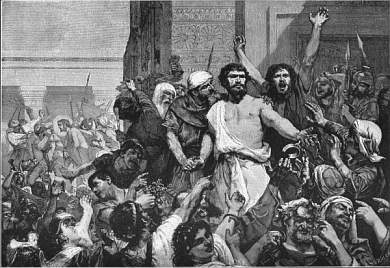 Those in the crowd knew the reputation of the man called Barabbas—as well as the reputation of the innocent man who stood in contrast to him on Pilate’s dais. They knew that Barabbas had victimized others through robbery, murder, and general thuggery. The other man, however, had taught them, healed them, given them hope, and relentlessly pointed them to God.